
At a glance: A commercial HVAC project in South Florida is decided by four questions that belong in the scope before bids go out: which refrigerant path the equipment follows under EPA’s 2026 rule changes, how rooftop units will be anchored under the Florida Building Code and its High-Velocity Hurricane Zone rules, whether the design controls humidity, and whether the roof beneath the equipment is due for work. This guide covers each question, compares project paths honestly, lists the cost drivers to pin down, and ends with a decision checklist assigned by role.
The expensive mistakes on a commercial HVAC project in South Florida are made before installation begins, when the scope is written around the tonnage on the old nameplate and leaves out the refrigerant path, the rooftop anchorage, humidity control, and the condition of the roof the new equipment will sit on. Each omission carries a price: a unit re-anchored after a failed inspection, a building that stays cool and clammy, a roof opened twice for two crane picks, or a change order that lands after tenants have been notified. This article sets out what to settle before bids go out, in the order a property or facility manager will face it. It is not a sizing manual or a price list, and it makes no code or engineering determinations; those belong to the building’s engineer of record and the local building official.
Why does a commercial HVAC project in South Florida look different in 2026?
Two regulatory calendars moved in 2026, affecting which equipment a South Florida building can buy and which code edition its permit follows. On refrigerants, the U.S. EPA finalized its reconsideration of the Technology Transitions rule under the AIM Act, published in the Federal Register on May 26, 2026 and effective July 27, 2026. The rule allows light commercial air-conditioning and heat pump equipment manufactured or imported before January 1, 2025 to continue to be installed, removing the earlier January 1, 2026 cutoff. EPA’s sector-by-sector table of HFC restrictions lists separate dates for variable refrigerant flow (VRF) systems, including an extension to January 1, 2028 for buildings that received an approved building permit before October 5, 2023.
The practical consequence is that owners now choose between two refrigerant paths on purpose. Legacy R-410A equipment can still be installed where inventory remains, while new production has moved to lower-GWP refrigerants such as R-454B and R-32, the transition described in Advanced Air Systems’ earlier article on the 2025 refrigerant change and HVAC pricing in Florida. The trade-offs are covered below.
On codes, the Florida Building Code, 9th Edition (2026) takes effect December 31, 2026. Miami-Dade County’s permitting notice on the 9th Edition states that permit applications and plans submitted on or after that date must comply with the new edition. As of September 2026, the 8th Edition (2023) governs earlier applications, so a project permitted near the turn of the year should confirm with its designer which edition its submittals are prepared against.
What actually fails on South Florida commercial HVAC systems?
South Florida air-conditioning systems fail in three characteristic ways. The first is moisture. A cooling coil removes humidity only while it runs long enough for water to condense and drain away, so equipment sized from nameplate tonnage or square footage alone often satisfies the thermostat and shuts off before it has pulled enough moisture from the air. EPA’s guidance on mold and moisture in buildings recommends keeping indoor relative humidity below 60 percent, ideally between 30 and 50 percent. Missing that target shows up as musty odors and stained ceiling tile.
The second is corrosion. Salt air attacks condenser coil fins, cabinet fasteners, and the tie-downs that hold equipment to the roof. FEMA’s building science guidance on rooftop equipment attachment states that rooftop equipment is typically torn off in high winds because the anchorage is inadequate, the equipment itself is not strong enough, or the equipment is corroded.
The third is water management at the roof. Condensate lines clog quickly in a humid climate, and Advanced Air Systems’ page on commercial HVAC repair in Miami lists clogged filters, dirty condenser coils, and blocked drain lines among the common causes of breakdowns. When condensate spills onto a membrane or an old curb flashing fails, the HVAC problem becomes a roof leak.
| Failure mode | What is happening physically | What to put in the scope |
|---|---|---|
| Persistent humidity | Equipment cycles off before the coil removes enough moisture | Load calculation including latent load; stated dehumidification strategy |
| Corrosion | Salt and moisture break down fins, fasteners, and tie-downs | Coastal coil protection; corrosion-resistant anchorage hardware |
| Condensate and curb leaks | Blocked drains overflow; aged curb flashing separates | Condensate routed off the roofing; curb scoped with the roofer |
Which project path fits: repair, change-out, redesign, or conversion?
Every commercial HVAC project follows one of four paths, chosen by equipment condition, changes in the building’s use, and how much disruption tenants can absorb. Advanced Air Systems performs repairs, commercial AC unit change-outs, HVAC retrofits including curb adaptors and tenant improvements, and new construction.
| Path | When it fits | Where it falls short |
|---|---|---|
| Repair and extend | Equipment has service life left; failures are isolated | Repeated repairs near end of life cost more over time; original design errors remain |
| Like-for-like change-out | Use unchanged, old system performed well, tight schedule | Carries forward sizing and humidity problems; may need a curb adaptor; old anchorage may not meet current requirements |
| Change-out with redesign | Humidity complaints, tenant changes, added occupancy | Engineering time, longer submittals, possible duct and electrical work |
| System conversion (e.g., packaged units to VRF) | Large buildings, long ownership horizon, major renovation | Highest first cost and longest schedule; benefit depends on controls and maintenance |
The refrigerant choice sits inside whichever path is chosen. Installing remaining R-410A inventory is lawful under EPA’s 2026 rule and can shorten lead time. The trade-off lies in the years ahead: the AIM Act phasedown continues to reduce the supply of higher-GWP refrigerants, and trade coverage of the final rule recorded contractor concern, voiced by the Air Conditioning Contractors of America, that refrigerant prices could rise. Lower-GWP equipment avoids that exposure but carries its own handling and installation requirements, which the design engineer should address in the submittals.
A contractor organized around multi-unit, occupied buildings is also not the right fit for every job. A single ductless split in a small office rarely needs a crane or a phased tenant plan, and the lowest qualified bid is often right there. New buildings follow a different sequence, covered in designing HVAC systems for new commercial construction.
What drives the budget on a commercial HVAC project?
The installed price of a commercial HVAC project is driven less by the equipment than by the work around it, and most budget surprises come from items a proposal left out. Advanced Air Systems does not publish pricing, and published cost ranges in this market rarely state their assumptions. List every driver below in each proposal so bids compare on the same scope.
| Cost driver | Why it moves the price | How to pin it down before award |
|---|---|---|
| Crane pick | Crane size, reach, lot or street closures, after-hours work | Pick plan with crane location, date window, and permits |
| Curb and roof work | Adaptor or new curbs need roofing, flashing, sometimes structure | Curb scope stated; roof warranty holder identified |
| Anchorage design | Wind and HVHZ rules may require engineered attachment | Anchorage detail and its sealing engineer as a line item |
| Electrical capacity | New disconnects, breakers, or feeders | Scope checked against the selected unit’s nameplate |
| Ductwork and balance | Leaking or undersized ducts undermine new equipment | Duct repairs and test-and-balance included or excluded in writing |
| Refrigerant path | Legacy inventory versus lower-GWP lead times | Refrigerant and lead time stated per unit |
| Utility incentives | Can offset part of equipment cost | Eligibility confirmed before ordering |
Florida Power & Light’s Business HVAC Program Standards, effective September 1, 2025, describe incentives for commercial and industrial customers that install high-efficiency chillers, split and packaged direct-expansion systems, and variable frequency drives on HVAC pumps. The utility sets amounts and rules, so confirm eligibility before ordering and treat any rebate as a possible offset.
What changes when the building stays open during the HVAC work?
Most commercial HVAC replacements in South Florida happen in buildings that cannot close, so the schedule is built around the people inside, a specialty Advanced Air Systems names on its homepage. Cooling is taken down zone by zone. Each outage window is sized so the new unit can be set, connected, and started within it, and spaces that cannot go without cooling, such as server rooms, medical suites, and food service, get temporary cooling or a cutover scheduled outside business hours.
Crane picks over lots and entrances are scheduled early morning or on weekends where the site allows, with the pick zone barricaded and tenants notified. Removing an old unit can leave an open curb or a damaged membrane, and those openings should be closed and watertight the same day. Advanced Air Systems is a division of Advanced Roofing Inc., with in-house roofing, sheet metal, crane, and lightning protection resources, so one project team can coordinate the curb, the flashing, the pick, and the roof warranty holder.
The Atlantic hurricane season runs June 1 through November 30, as noted on Advanced Air Systems’ hurricane season resource page. Projects with open curbs or staged equipment during those months need a written storm plan: equipment secured or removed from the roof, openings covered to a standard the roofing contractor accepts, and a decision point tied to National Hurricane Center outlooks for suspending crane picks.
Which Florida code rules apply to new rooftop HVAC equipment?
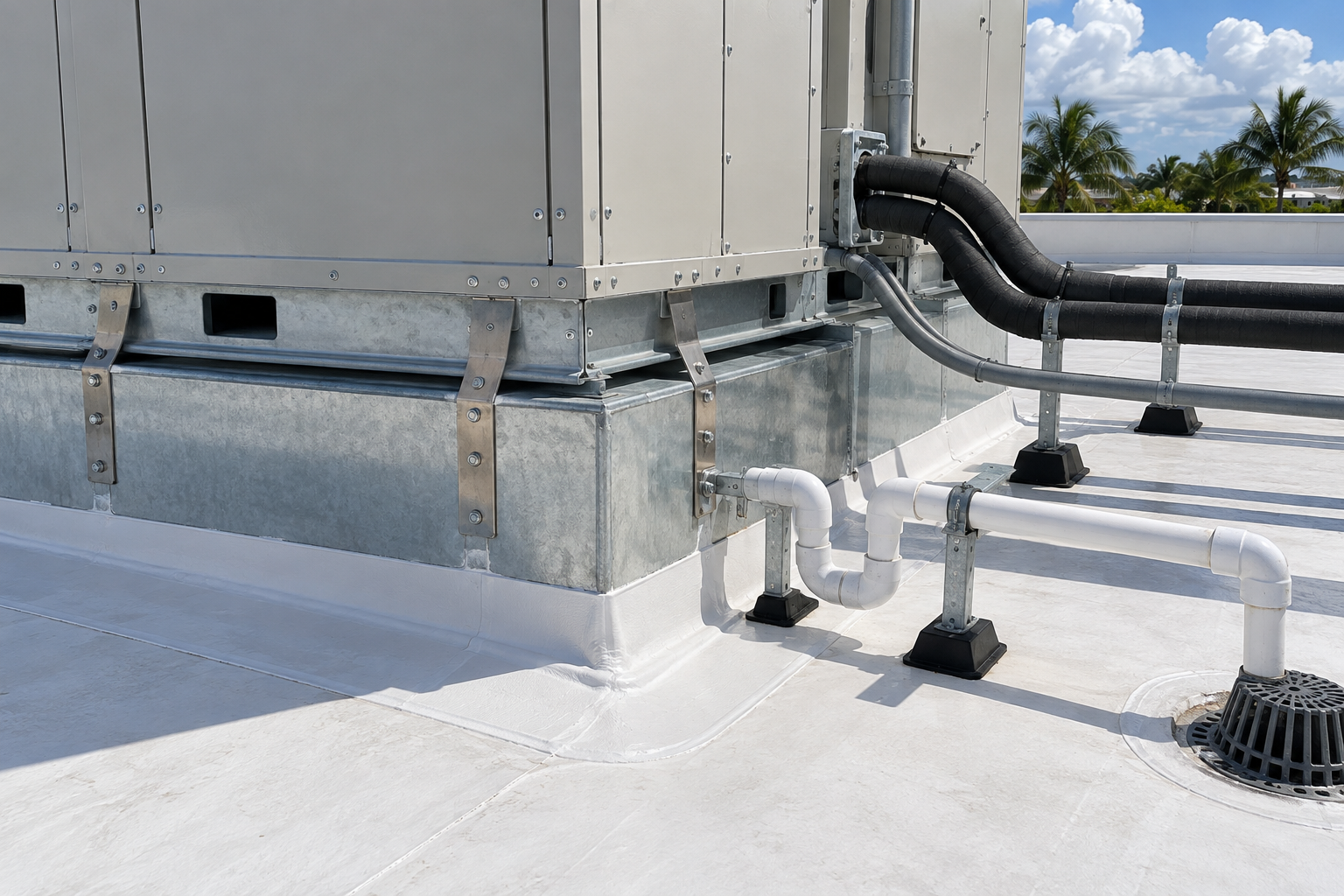
Rooftop HVAC equipment in Florida must be attached to resist wind, with stricter rules in the High-Velocity Hurricane Zone (HVHZ) covering Miami-Dade and Broward counties. The Florida Building Code, Mechanical requires equipment exposed to wind to be designed and installed to resist wind pressures determined under the Florida Building Code, Building, as the Florida Building Commission’s air-conditioning equipment workshop record reflects.
In the HVHZ, Section 1522 of the Florida Building Code, Building, 8th Edition (2023) requires rooftop equipment and supports to be secured to the structure under the high-velocity loading requirements, prohibits wood sleepers, sets minimum clearances so the roof beneath equipment can be repaired and replaced, requires conduit and piping on the roof to sit at least 8 inches above the finished roof surface, and prohibits condensate lines from draining onto the roofing system. SPRI’s white paper on rooftop equipment attachment notes that displaced equipment can tear the membrane and let water into the building.
Whether a project triggers these provisions, which edition governs, and what attachment design is required are determinations for the engineer of record and the building official.
Commercial HVAC project checklist: who owns each decision?
The main things to consider for a commercial HVAC project in South Florida are the refrigerant path under EPA’s 2026 rules, rooftop anchorage under the Florida Building Code and HVHZ provisions, humidity control in the design, the condition of the roof under the equipment, the tenant and crane plan for an occupied building, and utility incentive eligibility.
- Owner or asset manager: Choose the project path and state the ownership horizon it must serve.
- Facility or property manager: Document humidity complaints and service history by zone before design starts.
- Engineer of record: Provide a load calculation with latent load and a dehumidification strategy, and confirm the anchorage design and governing code edition.
- HVAC contractor: State the refrigerant, lead time, and curb condition for every unit in the proposal. The questions in how to choose the right HVAC contractor for commercial needs help compare bids.
- Roofing contractor or roof consultant: Report the roof’s remaining service life and confirm who performs curb flashing without affecting the roof warranty.
- HVAC contractor and property manager: Build the zone outage plan, temporary cooling, crane schedule, and tenant notices, and confirm utility incentive eligibility before ordering.
- Owner: Require close-out documents (equipment data, test-and-balance report, warranty registration) and a preventive maintenance program from day one.
Frequently Asked Questions
Do I need a permit to replace a rooftop AC unit in South Florida?
Assume a permit is required and confirm it with the building department before the proposal is signed. Rooftop equipment in Miami-Dade and Broward counties falls under the Florida Building Code’s High-Velocity Hurricane Zone attachment provisions, and the building official decides whether engineered anchorage details are needed. Permit timing also sets the crane date.
Can contractors still install R-410A commercial equipment in 2026?
For residential and light commercial air-conditioning and heat pump equipment, yes, if it was manufactured or imported before January 1, 2025. EPA’s reconsideration rule, effective July 27, 2026, removed the installation cutoff for that inventory. VRF systems follow separate dates in EPA’s sector table, and owners should weigh future refrigerant cost over the equipment’s life.
Why does a commercial building feel clammy when the AC is running?
The usual cause is equipment that cools the air without removing enough moisture. Oversized units satisfy the thermostat and shut off before the coil pulls water out of the air, and ventilation air adds humidity the system may not be designed to handle. EPA recommends keeping indoor relative humidity below 60 percent. A load calculation that includes latent load finds the cause.
Should the roof be replaced before new rooftop HVAC units go in?
That depends on the roof’s remaining service life, which a roofing contractor or roof consultant should assess before the HVAC scope is final. If the roof is near replacement, coordinating both projects avoids lifting equipment twice. If the roof has years left, the HVAC work can proceed with curb flashing approved by the roof warranty holder.
How long does a commercial HVAC change-out take in an occupied building?
Installation on site is usually the shortest part of the schedule. Equipment lead time, permit review, crane scheduling, and curb, electrical, or duct work set the overall timeline, and multi-unit projects are sequenced zone by zone. Ask each bidder for a schedule showing every zone’s outage window and temporary cooling plan.
Getting the scope right before the first bid
A commercial HVAC project in South Florida is decided by choices that are easy to make early and expensive to make late. EPA’s 2026 rule gives owners a real choice of refrigerant path, the 9th Edition sets a permitting date to plan around, and the HVHZ provisions make rooftop attachment a design item. Put each into the scope, assign each decision to its owner, and proposals can be compared on the same work. Local details are on the commercial HVAC Miami and West Palm Beach and Jupiter commercial HVAC pages.