At a glance: Commercial HVAC retrofit ROI in Florida depends on run hours, humidity and a measured baseline more than on equipment ratings. This guide explains where Florida rooftop units and chiller plants lose energy, compares retrofit measures with what each one cannot do, lists the cost and payback drivers with their sources, covers the 2026 to 2029 refrigerant, tax, efficiency and code dates, and ends with a decision checklist assigned by role.
Commercial HVAC retrofit ROI in Florida is set by three things most proposals never show: how many hours the equipment runs, how much moisture it has to remove, and whether savings are measured against a real baseline. Controls and drives on large, long-running units usually recover their cost fastest, while replacement is justified by failure risk and capital timing as much as by the utility bill. Approving a retrofit on an unsourced savings percentage produces a capital request that underdelivers, or a more efficient unit that leaves the building humid. This article is not a price list and does not argue that retrofitting always beats replacement; it explains what moves the return and how to make the number defensible.
Why does commercial HVAC retrofit ROI matter more in Florida?
Cooling and air movement are the largest electric loads in most Florida commercial buildings, so small efficiency changes compound into large annual figures. The U.S. Energy Information Administration’s 2018 Commercial Buildings Energy Consumption Survey found that ventilation, lighting and cooling together used 49 percent of the electricity consumed by U.S. commercial buildings, and that buildings in the South used 40 percent of all commercial-building electricity, most of it for cooling. Florida Power & Light’s Business HVAC Program page states that heating and cooling can use 50 percent of the energy in commercial buildings, a utility estimate, not a measured figure for any property.
The electric rate sets the dollar value of every kilowatt-hour a retrofit removes. EIA’s Florida Electricity Profile reports an average retail price of 12.53 cents per kWh across all customer classes for 2024, the latest year in that release. That is an all-sector average. A commercial account’s real marginal cost depends on its rate schedule, demand charges and recovery riders, so an ROI model should be built on the building’s own bills.
Three dates also changed the analysis in 2026. The federal Section 179D deduction ended for projects that begin construction after June 30, 2026, the next federal efficiency standard for commercial rooftop units applies from January 1, 2029, and the Florida Building Code, 9th Edition takes effect December 31, 2026. Each is covered in the timing section below.
Where does a Florida rooftop unit actually lose energy?
Most of the energy a packaged rooftop unit wastes is lost at part load, when the supply fan runs at full speed whatever the space needs. Codes require the supply fan to run whenever the building is occupied to deliver ventilation air, and most older units have a single-speed fan. Pacific Northwest National Laboratory’s 2013 field-test report on advanced rooftop controls explains that because the fan runs continuously, fan energy can exceed compressor energy in many U.S. locations, and that a constant-speed fan cannot reduce ventilation when a building is partly empty.
Florida adds a moisture load. A cooling coil removes water only while it runs cold enough and long enough for condensate to form and drain, so equipment that is oversized or poorly controlled satisfies the thermostat and cycles off with the air still damp. EPA’s guidance on humidity and moisture in buildings recommends keeping indoor relative humidity below 60 percent, ideally between 30 and 50 percent. Any retrofit that lowers fan speed or changes ventilation rates has to be checked against that target.
The third loss is degradation: fouled coils, slipping belts, stuck dampers and drifted sensors. Fix these before estimating any capital measure, or the retrofit gets credit for what was really a repair.
| Where energy is lost | What is happening physically | Typical retrofit response |
|---|---|---|
| Constant-speed supply fan | Fan runs at 100 percent speed whenever the building is occupied | Supply-fan variable frequency drive with multi-speed or modulating control |
| Fixed ventilation rate | Outdoor air is conditioned at the design rate even when occupancy is low | CO2-based demand-controlled ventilation, after the engineer confirms ventilation compliance |
| Latent shortfall | Unit cycles off before the coil removes enough moisture | Right-sized or variable-capacity equipment and a dehumidification control sequence |
| Constant-flow pumps | Chilled-water and condenser-water pumps throttle against valves | Pump variable frequency drives with a reset control sequence |
| Maintenance faults | Fouled coils, stuck dampers, drifted sensors | Retrocommissioning and repair before capital work |
Which retrofit upgrades pay back, and where does each fall short?
A commercial HVAC retrofit pays back fastest when it targets equipment that runs long hours: constant-speed fans and pumps on large units, controls that have drifted, and humidity problems the current system cannot handle. Payback depends on run hours, unit size, the electric rate, rebates, and whether savings are measured against a real baseline.
Field data supports controls on large, long-running rooftop units. In PNNL’s field evaluation of 66 rooftop units on eight buildings, an add-on controller combining multi-speed fan control, integrated economizer control and demand-controlled ventilation cut normalized annual unit energy use by 22 to 90 percent, an average of 57 percent. Units larger than 53 kW of cooling capacity running more than 14 hours a day paid back in under three years even at $0.05 per kWh. The test sites were outside Florida, most savings came from the supply fan, and the lowest percentage savings came from units with the longest compressor run times, the normal summer condition on a Florida roof.
Retrocommissioning is usually the cheapest first step. ENERGY STAR’s Building Upgrade Manual cites a study by Lawrence Berkeley National Laboratory and partners that found a median retrocommissioning cost of $0.27 per square foot, 15 percent energy savings and a 0.7-year simple payback across the existing buildings studied. Those are 2004 national figures, an order of magnitude rather than a Florida quote. Holding those gains depends on a preventive maintenance program that keeps coils, belts and sensors in condition.
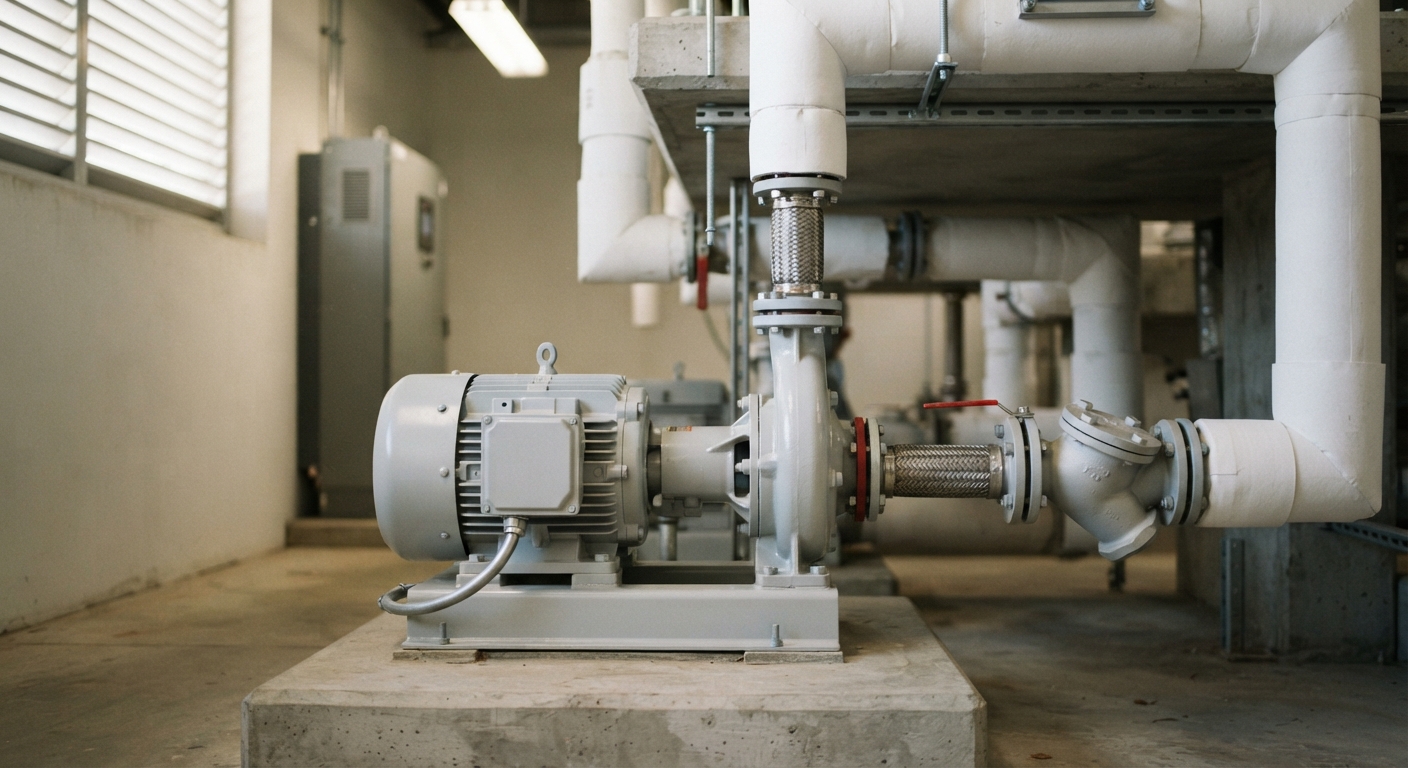
Central plants have their own short-payback measure. FPL states that, with its rebates, most commercial variable frequency drive installations on chilled-water and condenser-water pumps recover their cost within two to four years; treat that as the utility’s program estimate, not a guarantee for a given plant. Advanced Air Systems scopes this work through its chiller and cooling tower services.
| Retrofit measure | Best fit | Where it falls short |
|---|---|---|
| Retrocommissioning and repair | Any building with drifted controls or deferred maintenance | Savings fade without ongoing maintenance; does not fix undersized or failing equipment |
| Advanced rooftop unit controls (fan drive, demand-controlled ventilation, economizer logic) | Constant-speed units of roughly 15 tons and up with long daily run hours | PNNL found it not cost-effective on units of 5 tons and smaller; lower fan speeds must be checked for humidity control; ventilation settings need engineer sign-off |
| Pump and air-handler drives in chilled-water plants | Constant-flow pumps and fans in central plants | Needs a control sequence and balancing; savings shrink if valves stay throttled |
| Right-sized equipment replacement | Units near end of life, repeated compressor failures, persistent humidity | Highest first cost; savings depend on the load calculation; curb, crane and electrical work add cost |
| System conversion, such as VRF or a dedicated outdoor air system | Major renovation and a long ownership horizon | Longest schedule; refrigerant and code dates apply; results depend on controls and maintenance |
Replacement earns its return differently: avoided emergency failures, avoided rental cooling, and spend moved into a planned budget year. ENERGY STAR’s staged approach places heating and cooling equipment last because, after retrocommissioning and load reductions, the remaining load is often smaller and many existing systems were oversized to begin with. When replacement is the right call, commercial AC unit change-outs should be sized from a current load calculation rather than the old nameplate.
A contractor built for multi-unit, occupied buildings is also not the lowest-cost route for every retrofit. A single small split system or a controls change on two units is often handled well by a local service contractor. Advanced Air Systems’ commercial HVAC retrofit services in Florida matter most where crane picks, roof coordination and phased work around tenants are part of the job.
What drives the cost and payback of a commercial HVAC retrofit?
No single cost range describes a commercial HVAC retrofit, because the measure, the equipment size and the work around it move the price more than the hardware does. Advanced Air Systems does not publish pricing, and ranges quoted online without size, scope and location are sales numbers. PNNL’s 2013 report itemized one example: advanced controller hardware of $2,200 to $4,142 per rooftop unit depending on fan size, plus $750 of installation labor at an assumed $125 per hour, in 2012 to 2013 dollars.
| Driver | Why it moves the number | Source, or how to pin it down |
|---|---|---|
| Annual run hours | Fan and pump savings scale with hours of operation | Building automation trend logs or schedules, not nameplate data |
| Unit size and fan horsepower | PNNL measured savings rising from about 1.0 kWh per run hour under 10 tons to 3.9 kWh per run hour above 15 tons | PNNL-22656, July 2013 |
| Electric rate and demand charges | Sets the dollar value of each kWh and kW saved | The building’s last 12 to 24 months of bills; EIA’s 2024 Florida all-sector average of 12.53 cents per kWh for context only |
| Utility rebates | Can shorten payback; amounts and rules are set by the utility | FPL Business HVAC Program or the serving utility; confirm pre-approval before ordering |
| Work beyond the equipment | Curb adaptors, electrical, crane picks, ductwork and controls integration | Itemized proposal lines with quantities and exclusions |
| Measurement and verification | Adds cost but makes the savings claim defensible | An M&V plan written into the contract |
Simple payback, the installed cost divided by first-year savings, is the usual screen and the weakest standard measure, because, as the ENERGY STAR manual notes, it ignores savings after break-even and the time value of money. Its example: an informal two-year payback rule would reject a $7,500 upgrade saving $2,500 a year for ten years, a project with a 31.1 percent internal rate of return. Ask for net present value or internal rate of return over the period the organization expects to own or occupy the building, using its own discount rate.
How is HVAC retrofit work done in an occupied Florida building?
Most retrofit measures can be installed one unit or one pump at a time, which keeps the building open. Rooftop controls and drive retrofits are scheduled unit by unit, and the property manager notifies tenants before each zone’s outage window. Pump drives or a chiller replacement need a plant shutdown or temporary cooling, best scheduled in South Florida’s cooler months.
The savings baseline has to be captured before the work starts. If metering is installed only at commissioning, there is nothing to compare against and the savings remain an estimate. DOE’s Federal Energy Management Program publishes M&V Guidelines for performance-based contracts that describe the standard options, from measuring a key parameter on one isolated system to analyzing whole-building utility data.
Retrofits also touch the roof. A curb adaptor, economizer hood or relocated condensate line changes flashing, and the roof warranty holder has to accept the work. Advanced Air Systems is a division of Advanced Roofing Inc. with in-house roofing, sheet metal and crane resources, so the HVAC and roofing scopes can share one schedule. Anchorage and permitting for new rooftop equipment are covered in our guide to planning a commercial HVAC project in South Florida.
Which 2026 to 2029 dates change the retrofit math?
Four regulatory dates affect commercial HVAC retrofit decisions in Florida as of October 2026, and each should be re-checked when the project is scoped.
- Refrigerants. EPA’s Technology Transitions restrictions by sector limit new residential and light commercial air conditioning and heat pump systems to refrigerants of 700 GWP or less, with no installation deadline for systems whose components were all made or imported before January 1, 2025. EPA’s table also states that components used to repair existing systems are not subject to these installation restrictions, which favors retrofit and repair on equipment with service life left.
- Efficiency standards. DOE’s rulemaking page for air-cooled commercial unitary air conditioners and heat pumps covers amended standards for units of 65,000 Btu/h and larger, with compliance required from January 1, 2029 under new IVEC and IVHE ratings. Equipment bought before then is rated under the current IEER metric.
- Federal deduction. DOE’s Section 179D deduction page states that the One Big Beautiful Bill Act ended the deduction for property whose construction begins after June 30, 2026. Whether a project that began earlier still qualifies is a determination for a tax advisor.
- Building code. The Florida Building Code, 9th Edition takes effect December 31, 2026, including its Mechanical and Energy Conservation volumes. The permit application date generally decides which edition governs, which the design engineer and building official confirm.
Commercial HVAC retrofit decision checklist: who owns each step?
A retrofit request that survives a board review assigns every step to a named role before money is committed.
- Facility manager: Pull 24 months of utility bills and trend logs, and list every unit by tonnage, age and daily run hours.
- Mechanical engineer: Provide a load calculation that includes latent load, and confirm ventilation rates before any fan-speed or ventilation change.
- HVAC contractor: Retrocommission and repair first, then price each measure separately with its own savings estimate, source and assumptions.
- HVAC contractor and owner: Install metering or enable trends before work begins, and write the M&V method into the contract.
- Energy manager: Contact the serving utility for rebate pre-approval before ordering equipment.
- CFO or asset manager: Evaluate the package on net present value or internal rate of return over the expected hold period.
- Tax advisor: Confirm whether any project that began construction by June 30, 2026 still qualifies for Section 179D.
- Roofing contractor: Confirm roof condition and warranty requirements for any curb, hood or penetration work.
Frequently Asked Questions
How much does a commercial HVAC retrofit cost in Florida?
There is no reliable single range, because the measure, unit size and surrounding work drive the price. A controls retrofit on one rooftop unit and a chiller plant upgrade differ widely. PNNL’s 2013 field test itemized advanced rooftop controller hardware at $2,200 to $4,142 per unit plus about $750 in labor, in 2012 to 2013 dollars. Ask for each measure priced separately with its scope, quantities and exclusions.
What is a good payback period for an HVAC retrofit?
Many organizations screen on a two- or three-year simple payback, but payback alone can reject sound projects. ENERGY STAR’s Building Upgrade Manual shows a $7,500 upgrade saving $2,500 a year for ten years that fails a two-year rule yet returns 31.1 percent. Compare measures on net present value or internal rate of return over the period you will own or occupy the building.
Is it better to retrofit or replace a rooftop unit?
Retrofit when the unit has service life left, runs long hours and has a constant-speed fan; PNNL found controls retrofits on large, long-running units paid back fastest. Replace when compressors fail repeatedly, the cabinet or coil is corroded, or the unit cannot hold humidity at any setting. A current load calculation should set the size of any replacement.
Do FPL rebates cover commercial HVAC upgrades?
FPL’s Business HVAC Program offers rebates on qualifying high-efficiency chillers, direct-expansion units including rooftop units, and variable frequency drives on chilled-water and condenser-water pumps. Amounts depend on equipment type, capacity and rated efficiency, backup or emergency chillers do not qualify, and FPL asks customers to get pre-approved. Other utilities run their own programs, so confirm terms before ordering.
Can I keep my R-410A system if I retrofit instead of replacing it?
Generally yes. EPA’s Technology Transitions table states that components used to repair existing systems are not subject to its installation restrictions, and servicing existing R-410A equipment continues. Long-term refrigerant cost and availability still belong in the decision to repair or replace.
How are energy savings from an HVAC retrofit verified?
Savings are verified by comparing measured energy use after the retrofit with a baseline adjusted for weather and operating hours. DOE’s Federal Energy Management Program M&V Guidelines describe options ranging from measuring a key parameter on one system to analyzing whole-building utility data. Agree the method, metering and baseline period in the contract before work starts.
What makes a retrofit ROI case hold up with ownership
A commercial HVAC retrofit in Florida earns its return when the measure fits the equipment’s run hours and the building’s moisture load, and when the savings are measured instead of assumed. The 2026 refrigerant rules, the Section 179D cutoff and the 2029 rooftop standard make timing part of the analysis. Start with the building’s bills and trend data, price each measure on its own, and present the package on net present value or internal rate of return with a verification plan attached. Local details are on our commercial HVAC contractor in Miami page.
Written by The Technical Team at Advanced Air Systems. Established in 1994, Advanced Air Systems is a 100% employee-owned commercial HVAC contractor and a division of Advanced Roofing Inc.
Planning a retrofit or a capital request? Call (954) 332-1418 or request a free quote for your commercial HVAC retrofit.