At a glance: Salt air is a predictable design condition for rooftop units, chillers, and cooling towers near South Florida’s coast. This guide explains how chloride attacks condenser coils, cabinets, electrical parts, and rooftop tie-downs; compares coil corrosion prevention options with their limits; lists the variables that decide coil life and cost; covers shutdown planning in occupied buildings; and dates the code and refrigerant rules that affect repair-or-replace decisions in 2026. It closes with a role-by-role checklist an owner can forward to a board or asset manager.
Salt air is a design condition for any rooftop unit, chiller, or condensing unit near the coast, and the commercial HVAC corrosion South Florida buildings experience is largely predictable once the exposure is mapped. Owners who specify coil protection, corrosion-resistant attachment hardware, and a written rinse and inspection program at purchase are better placed than owners who discover corrosion through a refrigerant leak in August. The cost of getting it wrong is a condenser coil replaced years ahead of plan, a cooling outage in an occupied building, and, in hurricane season, rooftop equipment held down by fasteners that have lost section. This article does not argue that every unit in Broward or Miami-Dade needs a coating, and it offers no universal lifespan for coastal equipment, because the evidence does not support one.
Why is commercial HVAC corrosion South Florida’s recurring rooftop problem?
Coastal South Florida combines the conditions that drive atmospheric corrosion: airborne salt, long periods of surface wetness, and heat. ISO 9223, the international standard for classifying atmospheric corrosivity, names airborne salinity and time of wetness among the key factors used to classify a site. A rooftop condenser coil in Fort Lauderdale or on Biscayne Bay sits in both every day.
Florida’s coast is a recognized benchmark for this exposure. NASA’s Kennedy Space Center corrosion program reports that its beachside test site on the Atlantic coast has been documented with higher atmospheric corrosion rates than other known U.S. test sites. NASA’s atmospheric exposure test site page places that site about 150 feet from mean high tide and notes that rates run highest in winter, when morning condensation keeps metal wet longer.
Distance from the water matters, and published guidance on how much disagrees. Research published in the journal Corrosion and indexed by the Department of Energy’s OSTI database found that marine effects are concentrated within a few hundred meters of the shoreline and fall off roughly exponentially across the first 400 to 600 meters. Trade and contractor guidance often describes risk extending miles inland. Wind reconciles the two: shoreline studies measure averages, while one building’s exposure depends on onshore wind, surf, nearby open water such as the Intracoastal Waterway, and equipment height and orientation. Owners working with a commercial HVAC contractor in Miami or a commercial HVAC contractor in Fort Lauderdale should expect exposure to be assessed unit by unit.
Federal facilities treat coil corrosion as a resilience issue. The Department of Defense’s SERDP and ESTCP project EW24-8207, anticipated to finish in 2027, is developing an accelerated test method to rank HVAC coil coatings for seacoast environments. Until a standard exists, coating claims cannot be compared on one field-validated scale.
What does salt air do to coils, cabinets, and tie-downs?
Salt air damages commercial HVAC equipment by depositing chloride on metal surfaces that stay wet from humidity and dew. The chloride breaks down protective oxide films, corrodes aluminum condenser fins first, attacks the joint between aluminum fins and copper tubes, and works into cabinet fasteners, electrical connections, and the tie-downs that hold rooftop units in place.
Most condenser coils pair copper tubes with aluminum fins. Salt-laden moisture bridging the two metals forms an electrolyte, and the aluminum, the less noble metal, corrodes at the point of contact. The fin loses its grip on the tube and heat transfer drops before any leak appears, so head pressure rises to reject the same heat. Fins then thin, flake, and pack the coil face with corrosion product. All-aluminum microchannel coils remove the copper-aluminum pair but remain exposed to chloride attack, and repair options for them are more limited.
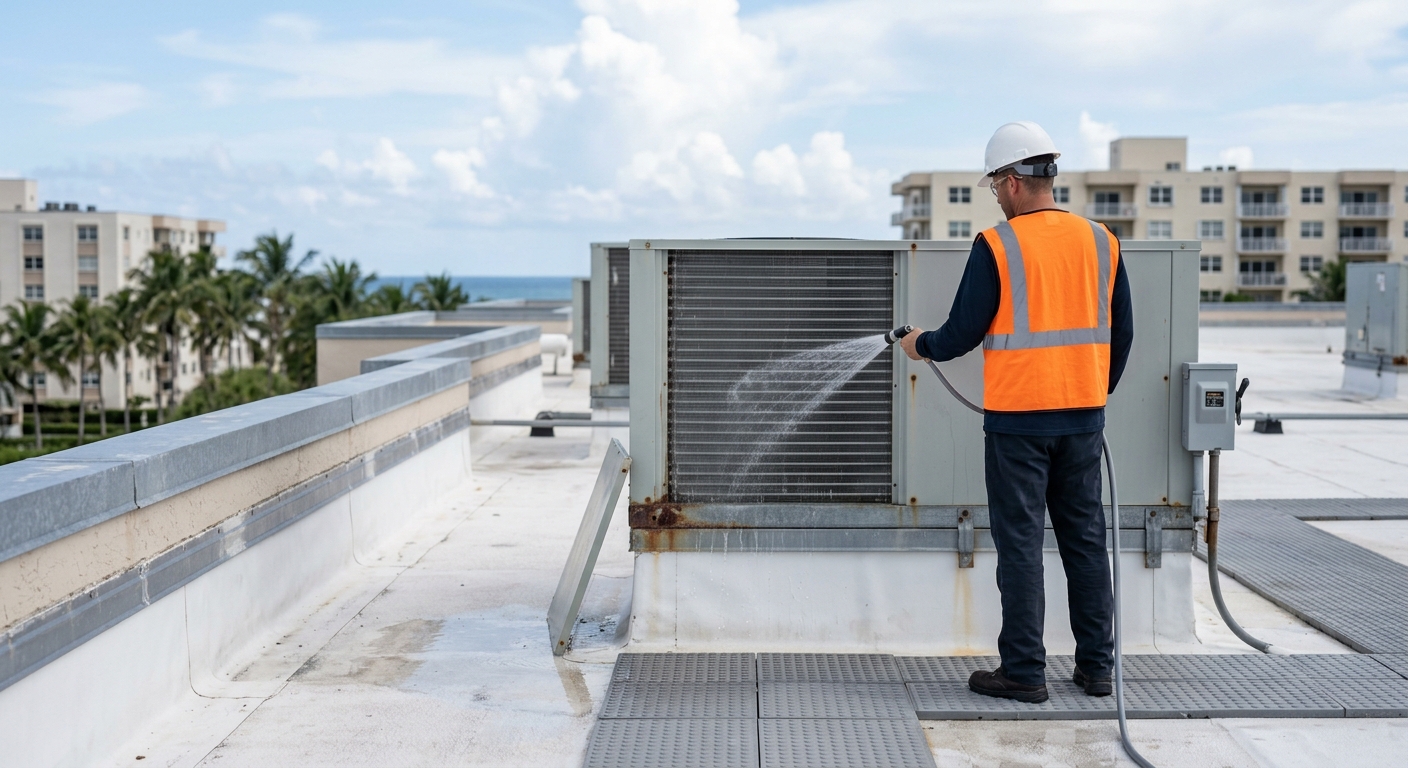
Painted galvanized cabinet panels rust outward from scratches, cut edges, and fastener holes. Carbon-steel screws lose section and seize. Contactor and terminal connections oxidize, producing intermittent faults that are easy to misread as control problems. The curb, rails, and the straps or brackets that tie the unit to the structure carry the same exposure, and a corroded tie-down is invisible to anyone who only checks whether the unit is cooling.
That failure has a hurricane consequence. A 2022 SPRI white paper on rooftop equipment attachment notes that rooftop equipment is often displaced at wind forces below those of major storms, and that dislodged equipment can tear the roof membrane. An attachment keeps its design capacity only while its fasteners and straps keep their cross-section.
Central plant equipment shares the exposure. Trane’s product literature, cited below, notes that coastal settings have traditionally limited air-cooled chiller use because of coil corrosion, and cooling tower hardware sits in a wet, salt-laden airstream. Inspection is covered in chiller and cooling tower maintenance tips, and repair or replacement under chiller and cooling tower services.
| Component | How salt air attacks it | What the owner sees first |
|---|---|---|
| Condenser coil (copper tube, aluminum fin) | Galvanic attack at the fin-to-tube contact; fin thinning | Rising head pressure, lost capacity, white powder on the fin face, later refrigerant leaks |
| Microchannel condenser coil (all aluminum) | Chloride pitting of thin aluminum tubes and fins | Refrigerant leaks; in-place repair options are limited and set by the manufacturer |
| Cabinet panels and base pan | Rust spreading from cut edges, scratches, and fastener holes | Blistered paint, rust streaks, a perforated base pan |
| Fasteners and access hardware | Section loss on carbon-steel screws and clips | Seized or missing screws, loose panels |
| Electrical components | Oxidation of contacts and terminals | Nuisance trips and intermittent faults |
| Curbs, rails, and tie-downs | Rust on steel straps, brackets, and anchors | Rust staining at the curb; lost attachment capacity visible only on inspection |
| Air-cooled chillers and cooling towers | Same chloride exposure on coils, casings, and hardware | Coil leaks, corroded casing hardware, fan component wear |
Which HVAC coil corrosion prevention options hold up on the coast?
Coil protection falls into three groups: factory protection, field-applied coatings, and practices that reduce the salt load. Each has a real limit, stated in the table beside its benefit.
| Option | What it does | Where it falls short |
|---|---|---|
| Factory electrocoat (e-coat) on the complete coil | Coil is immersed and coated electrically, reaching fin edges and interior surfaces | Must be specified at order; adds cost and lead time; damaged areas need touch-up; test hours are not field years |
| Pre-coated fin stock | Fin material is coated before the coil is assembled | Fin edges cut after coating and the fin-to-tube joints are left exposed |
| Field-applied coating on a new coil | Coating applied in a shop or on site before startup | Coverage deep in the coil depends on method and coil depth; quality varies by applicator |
| Field-applied coating on an existing coil | Slows further corrosion on a coil that is still serviceable | Requires thorough cleaning first; does not restore lost fin-to-tube contact or capacity |
| Scheduled freshwater rinsing | Removes deposited salt before it accumulates | Labor-dependent; wrong pressure or cleaner damages fins; offers no protection between visits |
| Siting, screening, and hardware upgrades | Reduces direct spray; corrosion-resistant attachment hardware | Limited options on existing roofs; screens must preserve airflow and service clearance |
Test hours lead most coating literature, and they need context. Trane’s CompleteCoat product literature states that its electrocoated condenser coils withstood a 10,000-hour salt spray exposure under ASTM B117 and acid fog testing up to 2,400 hours under ASTM G85. Those are published results for one named product. ASTM B117 itself cautions that performance in natural environments has seldom been correlated with stand-alone salt spray results. The hours help compare coatings tested the same way; they do not predict service life on a Miami rooftop.
A coating is not the right purchase for every unit. Equipment well inland, shielded from onshore wind, or near the end of its service life may not return the cost, and coating a coil that is already losing fins buys little time. The case is strongest for new equipment at exposed coastal sites.
What drives cost, downtime, and coil life on a coastal unit?
No single figure predicts how long a condenser coil will last near the water, and coastal lifespan numbers found online are rarely tied to data. The variables below decide the outcome, and bids should address each.
| Variable | Why it changes the result |
|---|---|
| Distance and wind exposure | Salt deposition falls with distance from the shoreline and rises with onshore wind, surf, and nearby open water (Corrosion journal research, OSTI index) |
| Coil construction and coating | Factory-coated, field-coated, and uncoated coils age at different rates; construction sets what can be repaired |
| Rinse and inspection program | Frequency, method, and documentation of salt removal |
| Mounting height and orientation | Units facing the water or set near roof edges receive more direct spray |
| Attachment hardware material | Decides whether tie-downs keep capacity for the life of the unit |
| Refrigerant and equipment age | Decides whether coil replacement is a sound repair or spending on a unit near the end of its life |
| Shutdown access | Crane availability, roof access, and tenant schedules set the timeline and cost of any change-out |
Exposure and coil construction are decided once, at purchase. Rinsing, inspection, and hardware condition are decided every year after. A preventive maintenance program that includes coil cleaning is where the coastal scope belongs, with the cleaners and water pressure the equipment manufacturer permits. Strong maintenance cannot fully offset an uncoated coil facing the ocean from the roof edge.
When corrosion is already advanced, the decision turns on what else in the unit has life left. A replacement coil is a sound commercial air conditioning repair when the compressor, cabinet, and controls are in good condition. On equipment with repeated failures, an air conditioning retrofit or replacement usually returns more for the budget, and new equipment can be ordered with coil protection from the start.
What changes when the building stays open during corrosion repairs?
Coil replacement, coating, and tie-down repair all take a unit out of service, and on an occupied building a zone or tenant loses cooling. Replacing a condenser coil means recovering the refrigerant, brazing in the new coil, pressure testing, evacuating, and recharging. A field coating needs a clean, dry coil and the cure time the coating manufacturer specifies. Each step sets the shutdown length and belongs in the approved schedule.
Shutdown windows should be agreed with the property manager and noticed to tenants before they start. Wet-season afternoon thunderstorms shorten the safe working day, and brazing, coating, and crane picks stop when lightning is nearby. Where a full change-out is the answer, rooftop unit change-outs should be sequenced so each zone loses cooling as briefly as possible, with crane picks outside business hours where the site permits. The full sequence is laid out in planning a commercial HVAC project in South Florida.
Hurricane season adds a deadline. Corroded tie-downs found in a spring inspection can be replaced before the peak months; the same finding in September competes with storm preparation for crews and cranes. In Miami-Dade and Broward, replacement hardware must also meet the High-Velocity Hurricane Zone requirements below.
Which code and refrigerant rules affect a corroded unit in 2026?
According to Miami-Dade County’s notice on the Ninth Edition, the Florida Building Code, 9th Edition (2026), takes effect December 31, 2026, and permit applications submitted on or after that date must comply with it; the county treats portal submissions after 4 p.m. on December 30 as falling under the new edition. As of October 2026, owners planning year-end replacements should ask which edition will govern their permit.
In Miami-Dade and Broward, rooftop equipment and its attachment fall under High-Velocity Hurricane Zone provisions and product approval. Replacing a unit, curb, or tie-downs can trigger a permit and an engineered attachment design; the building official and engineer of record make that determination.
Refrigerant rules shape the repair-or-replace decision. EPA’s Technology Transitions restrictions by sector, last updated August 28, 2026, sets a 700 GWP limit for new residential and light commercial systems from January 1, 2025, excludes systems whose components were all made or imported before that date, and states that components used to repair existing systems are not subject to the restrictions. Variable refrigerant flow systems carry a January 1, 2027 installation date. A replacement coil repairing an existing R-410A unit therefore sits on the repair side. The rule was amended in May 2026, so confirm the classification against EPA’s current guidance before ordering.
Coastal AC corrosion checklist: who owns each step?
Each decision below is assigned to the person who makes it, so the list can be forwarded as written.
- Facility or property manager: map every outdoor unit by distance from open water, height, and facing, and record each coil’s type and coating status.
- Facility or property manager: require a written rinse and inspection scope in the maintenance contract, with method, permitted cleaners, and dated photos of coil, cabinet, and tie-downs.
- Mechanical engineer: specify coil protection, cabinet finish, and attachment hardware for new coastal equipment in the bid documents.
- Mechanical contractor: report fin loss, leaks, and rising head pressure with dated photos, and state whether each coil is a candidate for coating, coil replacement, or unit replacement.
- Engineer of record and building official: confirm attachment design and permit requirements before tie-downs or curbs are replaced, particularly in the High-Velocity Hurricane Zone.
- Owner or asset manager: weigh coil against unit replacement using age, refrigerant, and remaining life, and schedule attachment repairs before peak hurricane season.
- Owner or board: read the manufacturer’s written warranty for corrosion terms before purchase, and keep coating and maintenance records.
Frequently Asked Questions
How far from the ocean does salt air corrode commercial AC equipment?
Salt deposition is heaviest within a few hundred meters of the shoreline, according to corrosion research indexed by the Department of Energy’s OSTI database, and falls off quickly with distance. Exposure also depends on onshore wind, surf, nearby open water, and unit height and orientation. Buildings well back from the beach can still see coastal AC corrosion when those conditions line up.
Is a coil coating worth it on a commercial rooftop unit in South Florida?
For new equipment at exposed coastal sites, a factory-applied coating protects the coil before salt exposure begins, when protection does the most good. The value drops for units well inland, shielded from onshore wind, or near the end of their service life. Ask your mechanical engineer to weigh exposure, coil type, and remaining life before specifying one.
How often should coastal condenser coils be rinsed?
No single interval fits every building. Frequency depends on distance from the water, wind exposure, coil coating, and what the equipment manufacturer’s instructions allow for cleaners and water pressure. Set the interval in the maintenance contract, document each visit with photos, and shorten it when inspections show salt buildup or early fin damage.
Can a corroded condenser coil be replaced without replacing the whole unit?
Often, yes, when the compressor, cabinet, and controls have service life left and the manufacturer supplies a replacement coil. EPA’s Technology Transitions table states that components used to repair existing systems are not subject to its restrictions, so a coil on an R-410A unit can proceed as a repair. On equipment near end of life with repeated failures, replacing the unit usually serves the budget better.
Does HVAC coil corrosion prevention change under the 2026 refrigerant rules?
Salt attacks new coils the same way it attacked older ones. New residential and light commercial systems generally must meet EPA’s 700 GWP limit, which in practice means A2L refrigerants such as R-454B or R-32. Specify coil protection on that equipment at order, since a field coating added later means another shutdown, and confirm compliance dates on the purchase date.
Do manufacturer warranties cover coastal corrosion damage?
Coverage depends on the manufacturer and its written warranty, and treatment of coastal environments varies. Before purchase, check how the warranty handles corrosion, coatings, and maintenance records, and keep dated documentation of every rinse and inspection. Advanced Air Systems does not interpret warranty or insurance coverage; the manufacturer, your insurer, or your attorney makes those determinations.
Planning for salt air from specification through close-out
Salt air corrodes commercial HVAC equipment through a known sequence: chloride deposits on metal, humidity keeps it wet, and fins, cabinet steel, electrical connections, and tie-downs lose material. The evidence supports managing that sequence at three points. Exposure and coil protection are decided at purchase, rinsing and inspection every year, and attachment hardware before every hurricane season. None of these steps makes a coastal unit immune, and no lifespan figure applies to every building. A written plan covering all three gives an owner a defensible budget and fewer outages in occupied space. In Miami-Dade, Broward, and Palm Beach counties, that plan should also account for the December 31, 2026 code change and the refrigerant rules now governing new equipment.
Written by The Technical Team at Advanced Air Systems. Established in 1994, Advanced Air Systems is a 100% employee-owned commercial HVAC contractor and a division of Advanced Roofing Inc., serving Florida buildings from offices in Fort Lauderdale, Miami, and West Palm Beach.
To review coastal corrosion on your rooftop units, chillers, or cooling towers, request a free commercial HVAC quote or call (954) 332-1418.