
At a glance: Commercial HVAC commissioning after a retrofit verifies that new equipment, existing ductwork, and controls perform together. This guide explains what HVAC performance testing catches in Florida buildings, compares startup, test and balance, and full commissioning with their limits, lists what drives commissioning cost and schedule, covers testing in occupied buildings and A2L refrigerant detection, summarizes the 2026 code and refrigerant dates, and ends with a sign-off checklist assigned by role.
Commercial HVAC commissioning after a retrofit is the step that proves the new equipment, the existing ductwork, and the controls that tie them together perform as one system, and it belongs in the retrofit scope before the contract is signed. Skipping it is how a building ends up with new rooftop units that short-cycle in a clammy lobby, an economizer that never opens, or a chiller plant whose expected savings never reach the utility bill, all discovered after the warranty clock has started and the installing crew has left. This article sets out what commissioning and HVAC performance testing verify on a retrofitted commercial system in Florida, how much rigor different projects need, and how to run the process in a building that stays occupied. It makes no code or engineering determination for any specific building; those belong to the engineer of record and the local building official.
Why does commercial HVAC commissioning matter more after a retrofit?
Commissioning is a documented quality-assurance process that verifies installed systems meet the owner’s stated requirements, and its value has been measured. A Lawrence Berkeley National Laboratory meta-analysis of building commissioning, published in the journal Energy Efficiency in 2011, compiled 643 non-residential buildings and reported median whole-building energy savings of 16 percent in existing buildings and 13 percent in new construction, with simple paybacks of 1.1 and 4.2 years. The same study found that comprehensive commissioning delivered nearly twice the median savings, which is the practical argument against a checkbox approach. Its figures predate current equipment and are stated in 2009 dollars, so treat them as an order of magnitude.
A retrofit sits between those two cases and inherits the risks of both. New equipment is connected to ductwork, dampers, sensors, and a building automation system that were designed for something else, and every one of those interfaces is a place where design intent can be lost. Advanced Air Systems’ commercial air conditioning retrofits include tenant improvements, interior build-outs, curb adaptors, and custom ductwork, and a unit change-out in an older building raises the same questions. ASHRAE publishes the process framework: Guideline 0 and Standard 202 for new systems, and Standard 230 and Guideline 0.2 for existing buildings and systems. A retrofit that places new equipment inside an existing building draws on both sets.
Florida adds its own reasons to commission in 2026. The Florida Building Code, Energy Conservation, 8th Edition (2023) carries a commissioning section, C408, in its commercial chapter, and the 9th Edition takes effect December 31, 2026, according to Miami-Dade County’s notice on the 9th Edition code change. EPA’s Technology Transitions sector table also means many retrofits now mix legacy R-410A equipment with new A2L-refrigerant units, which brings new safety controls to verify.
What does HVAC performance testing actually catch on a retrofitted system?
HVAC performance testing on a retrofit finds the faults a startup checklist cannot see, because they live in how the parts interact. Equipment startup confirms that a unit runs: rotation, voltage, refrigerant charge per the manufacturer, and safeties. Functional performance testing drives the system through its modes, including occupied, unoccupied, economizer, dehumidification, and failure modes, and records whether the controls respond the way the sequence of operations says they should.
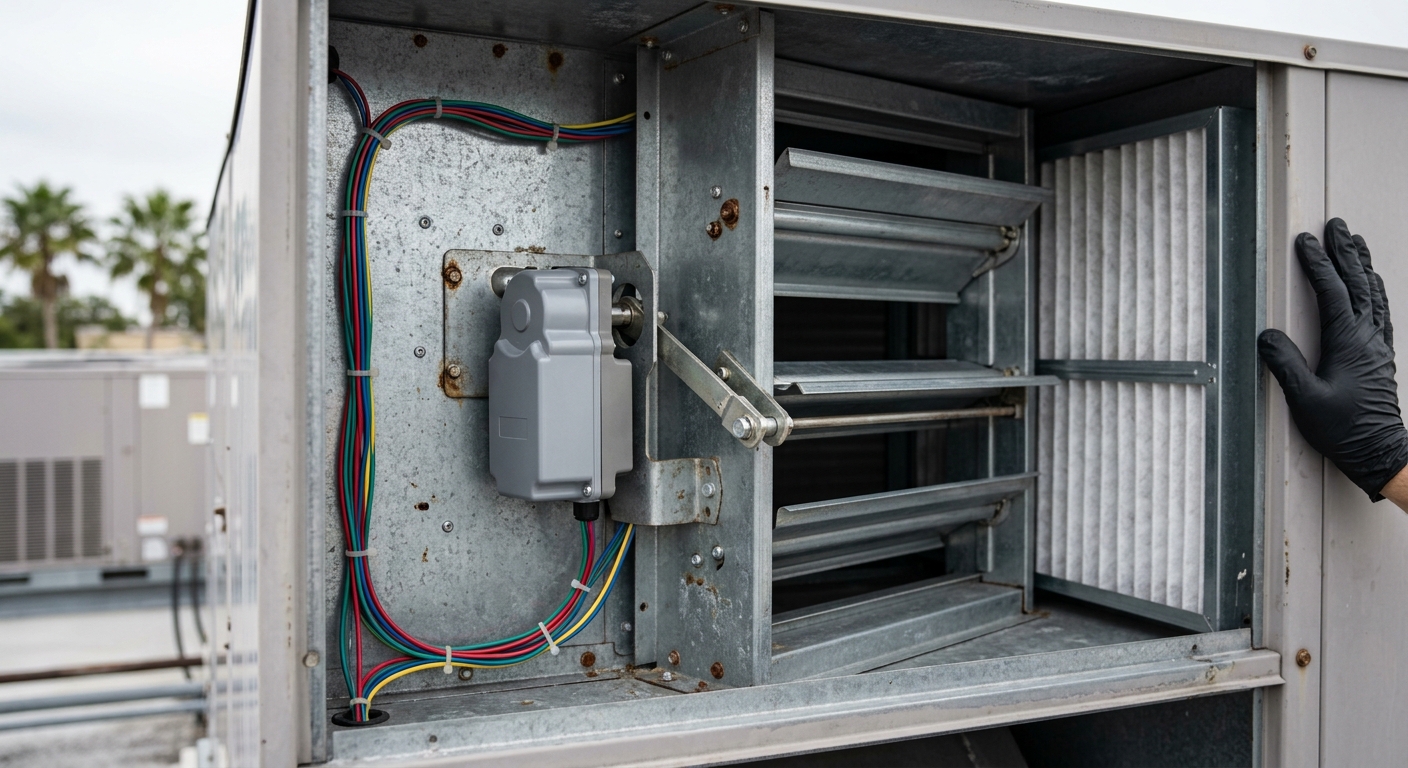
The physical mechanisms repeat across Florida buildings. A new, higher-efficiency rooftop unit connected to leaky or undersized ductwork delivers less air to the space than the schedule shows, so the coil runs colder, the fan works harder, and the far zones still complain. An outdoor air damper wired to the old controller can stay pinned open, pulling humid air through a coil never sized for it, or stay shut and starve the space of ventilation. A sensor left in its old location, such as a return-air thermostat near an exterior door, reports conditions that do not match the occupied space. EPA’s guidance on moisture and mold in buildings recommends keeping indoor relative humidity below 60 percent, ideally between 30 and 50 percent; a retrofit that cools without dehumidifying misses that target while the thermostat reads on setpoint.
| Deficiency | Physical cause | How testing finds it |
|---|---|---|
| Low airflow at far zones | Leaky or undersized legacy ducts; balancing dampers left in old positions | Test and balance readings compared with design airflow |
| High humidity at setpoint | Oversized equipment short-cycling; ventilation air not dehumidified | Trended space humidity and coil leaving-air temperature through occupied hours |
| Economizer stuck or mis-sequenced | Actuator not wired or configured to the new controller; failed linkage | Functional test commanding each economizer mode |
| Overnight runtime or simultaneous heating and cooling | Schedules and setpoints carried over from the old system | Automation system trend review of runtime against occupancy |
| Chilled water flow mismatch | Pumps, valves, or drives not reset for the new chiller | Hydronic balancing and plant sequence testing |
Each fault reads as equipment trouble to occupants and as controls trouble to the technician, so testing has to cover the full path from the coil to the occupied space.
Startup, test and balance, or full commissioning: which does a retrofit need?
Retrofit verification comes in levels, and the right level depends on how many systems interact and what it costs the building if they do not. Manufacturer startup is part of every installation. Testing, adjusting, and balancing (TAB) measures and sets air and water flows against the design. Full commissioning wraps both inside a documented process: owner’s project requirements, a commissioning plan, functional tests, an issues log, operator training, and a final report.
| Level | What it verifies | When it fits | Where it falls short |
|---|---|---|---|
| Manufacturer startup only | Unit runs; safeties, charge, and electrical per manufacturer | Like-for-like change-out of one unit on simple controls | Does not verify airflow delivered to rooms, control sequences, or humidity |
| Startup plus TAB | Air and water flows measured and adjusted to design values | Multiple units, duct modifications, tenant improvements | Confirms quantities, not how controls respond across operating modes |
| Full commissioning | Owner requirements through functional tests, training, and documentation | Chiller plants, automation integration, institutional and larger systems | Highest fee and longest close-out; value depends on independence and follow-through |
| Retro-commissioning of the remaining system | Existing equipment and controls the retrofit did not replace | New units serving old air handlers or legacy controls | Scope can grow once deficiencies surface; fixes need their own budget |
Commissioning reveals a design error; it does not correct one. If the load calculation was wrong, functional testing will show the symptoms, and the remedy is an engineering change. Pacific Northwest National Laboratory’s building re-tuning program reports that operational re-tuning can reduce commercial building energy use by 5 to 20 percent, a reminder that commissioning does not replace maintenance and that performance drifts after sign-off.
Not every retrofit needs the full process. A single packaged unit swapped on a small retail space with a simple thermostat is well served by a careful startup and an airflow check, and a commissioning authority’s fee on that job rarely earns itself back. The calculation changes when new equipment talks to an existing building automation system, when a plant served by chiller and cooling tower services is involved, or when the occupants cannot tolerate a bad week.
What drives the cost and schedule of commissioning a retrofit?
Commissioning cost on a retrofit is driven by the number of systems tested, the condition of the existing controls, and whether the owner’s requirements were written before design. Advanced Air Systems does not publish pricing. The broadest public benchmark, the Lawrence Berkeley study cited above, reported a median of $0.30 per square foot for existing-building commissioning and $1.16 per square foot for new construction, in 2009 dollars; use it for scale and replace it with current proposals.
| Driver | Why it moves cost or schedule | How to pin it down |
|---|---|---|
| Number and type of systems | Each air handler, rooftop unit, VRF system, or plant needs its own tests | List every system in scope with its verification level |
| Existing controls condition | Undocumented sequences and failed sensors add investigation time | Point list and sequence of operations reviewed before testing |
| Seasonal and humidity testing | Peak cooling and dehumidification modes need the right weather or trended data | Deferred-test schedule written into the plan |
| Occupancy constraints | After-hours testing windows extend duration | Windows agreed with tenants and property management |
| Independence of the provider | Third-party commissioning adds a fee and a layer of review | Decide early who holds the commissioning contract |
| Deficiency resolution | Fixes found in testing need labor and retesting | Contract language on who pays for retests |
Retesting is the line that most often surprises owners: a failed functional test means a fix, a return visit, and a second test, so the contract should state how many retests are included. Most of these drivers are cheaper to settle before bids than after installation. The scope questions in planning a commercial HVAC project in South Florida shorten this list when they are answered early.
How is commercial HVAC commissioning done in an occupied Florida building?
In an occupied building, commercial HVAC commissioning is scheduled around the people inside, and tests that disturb conditions run when the fewest people will notice. Functional tests that drive a zone into failure modes, shut down an air handler, or force full outdoor air are sequenced after hours or on weekends, with the property manager notified of each window in advance. Tests that only observe, such as trend reviews and balancing readings, run during normal operation.
Florida’s climate shapes the plan. The modes that matter most, full-load cooling and dehumidification, are best verified in the hot, humid months, so a retrofit that finishes in the cooler months should carry deferred tests into the next cooling season, written into the contract with dates. Several weeks of trended humidity and temperature data often reveal more than one afternoon of spot readings.
Newer refrigerants add a test item. Many A2L-refrigerant units carry an integral refrigerant detection system, and UL’s guidance on inspecting refrigerant detection systems explains that, where UL 60335-2-40 requires one, it is installed per the manufacturer’s instructions, usually with sensors placed low because A2L refrigerants are heavier than air, and on ducted zoned systems it signals the zone dampers to open fully. Verifying that the detection system is wired, located, and integrated with the building controls belongs in the functional tests. The building official decides what the code requires for a specific installation.
Rooftop work adds coordination. Test ports, access panels, and condensate routing are checked while the crew is still on the roof, and Advanced Air Systems, a division of Advanced Roofing Inc. with in-house roofing, sheet metal, and crane resources, can close curb and flashing details alongside the mechanical punch list.
Which code and refrigerant dates affect HVAC system commissioning in Florida?
Two calendars govern HVAC system commissioning in Florida as of October 2026: the energy code edition that applies to the permit and the refrigerant rules that apply to the equipment. In the model 2021 International Energy Conservation Code, Section C408.2 requires mechanical systems commissioning, including air and hydronic balancing, functional testing, and a preliminary commissioning report, with an exception for buildings whose total mechanical equipment capacity is below 480,000 Btu/h of cooling, roughly 40 tons, and 600,000 Btu/h of heating. Florida amends the model code, and whether a given retrofit triggers Florida’s C408 depends on the adopted text and the extent of the alteration, so the engineer of record and the building official make that call.
The Florida Building Code, 9th Edition (2026) takes effect December 31, 2026. Miami-Dade’s notice states that applications and plans submitted on or after that date must comply, and that online portal applications received after 4 p.m. on December 30 fall under the new edition.
On refrigerants, EPA’s sector table, updated August 28, 2026, shows that residential and light commercial split and unitary systems whose components were all manufactured or imported before January 1, 2025 have no installation compliance date, while variable refrigerant flow systems above 700 GWP carry a January 1, 2027 installation date with a narrow extension for older permits. Where a building installs remaining R-410A inventory alongside A2L units, the commissioning documents should record which refrigerant each unit uses. Re-check both rules on the day you rely on them.
Commissioning sign-off checklist: who verifies what?
Use this list before final payment on a retrofit.
- Owner or asset manager: Put written owner’s project requirements for temperature, humidity, ventilation, schedules, and energy targets in the contract before design, and decide who holds the commissioning contract.
- Engineer of record: Confirm whether the energy code’s commissioning section applies, which code edition governs, and which systems need functional testing.
- HVAC contractor: Deliver completed startup reports and pre-functional checklists for every unit, with refrigerant type and field charge recorded.
- Test and balance agency: Submit a report showing design and measured air and water flow at every terminal, with deficiencies listed.
- Controls contractor: Provide the as-built point list and sequence of operations, and trend humidity, temperature, and runtime through occupied hours.
- Commissioning provider: Run functional tests in every operating mode, including economizer, dehumidification, and refrigerant detection response, and keep an issues log until each item is closed.
- Facility manager: Attend operator training, receive the systems manual, and schedule deferred peak-season tests before the warranty review.
- Property manager: Publish testing windows to tenants and record comfort complaints by zone through the first cooling season.
Close-out should also start the maintenance record. A preventive maintenance program that begins on day one keeps filters, coils, and condensate lines from eroding the performance the commissioning report just documented.
Frequently Asked Questions
What is commercial HVAC commissioning?
Commercial HVAC commissioning is a documented process that verifies a building’s heating, ventilation, and air-conditioning systems are installed, tested, and able to operate as the owner’s requirements and the design intend. It covers startup review, testing and balancing, functional performance testing of equipment and controls, operator training, and a final report. ASHRAE Guideline 0 and Standard 202 describe the process for new systems, and Standard 230 covers existing buildings.
What is the difference between test and balance and commissioning?
Testing, adjusting, and balancing measures and sets air and water flows to design values. Commissioning uses those results and goes further, testing how equipment and controls respond in every operating mode, documenting deficiencies, and confirming they are fixed. A building can have a clean balancing report and still have an economizer or dehumidification sequence that does not work, which is why larger retrofits usually need both.
Does Florida require HVAC commissioning for a retrofit?
It depends on the scope and the system size. Florida’s energy code includes a commissioning section, C408, and the model IECC version exempts buildings below 480,000 Btu/h of cooling capacity. Whether a specific retrofit triggers the requirement depends on the adopted Florida text and the extent of the alteration. Ask your engineer of record and the building official before the permit is filed.
How long does HVAC performance testing take after a retrofit?
On-site functional testing for a modest rooftop-unit retrofit can fit in a few days, while a chiller plant with building automation integration takes longer. The calendar is usually set by deficiency fixes, retesting, and deferred tests that need peak cooling weather. In an occupied building, after-hours testing windows extend the duration, so ask for a testing schedule as part of the proposal.
Who should perform commissioning on a commercial HVAC retrofit?
The installing contractor performs startup and supports testing, but many owners hire an independent commissioning provider on larger or more complex projects so the installer is not grading its own work. ASHRAE offers a Building Commissioning Professional certification for that role. On smaller retrofits, a contractor-led process with a qualified balancing agency and written functional tests can be appropriate, provided the owner reviews the results.
Signing off on performance after the retrofit
A retrofit buys new equipment, and commercial HVAC commissioning confirms the building is getting the performance that equipment was bought to deliver, and in a humid climate the failures it catches are the ones occupants notice first. Put the owner’s requirements in writing, match the level of verification to the system, schedule tests around tenants and the cooling season, and hold final payment until the issues log is closed. Owners in Broward County can start with Advanced Air Systems’ page for a commercial HVAC contractor in Fort Lauderdale.
Written by The Technical Team at Advanced Air Systems. Established in 1994, Advanced Air Systems is 100% employee-owned and a division of Advanced Roofing Inc., serving commercial buildings across South Florida.
Planning a retrofit or closing one out? Request a free quote or call (954) 332-1418 to scope commissioning for your building.