
At a glance: Commercial HVAC condensate drain problems start where water leaves the cooling coil: the drain pan, the trap, the drain line, a condensate pump, or the point of disposal. This guide explains how each part fails in humid South Florida buildings, compares the secondary overflow protections the Florida Building Code, Mechanical allows and where each falls short, lists what drives repair cost, covers occupied buildings and rooftop units, and ends with a prevention checklist assigned by role.
Commercial HVAC condensate drain problems are drainage-system failures, and a South Florida building should design, protect, and maintain its condensate path as a system, because every rooftop unit and air handler pulls water from humid air for most of the year and sends it through a pan, a trap, and a drain line that most owners never see until a ceiling tile stains. When that path fails, the cost lands away from the equipment: wet ceilings that EPA guidance says should be dried within 48 hours, a tenant space out of service, or a roof membrane that has taken a steady drip in one spot for months. This article explains how condensate systems fail, compares the overflow protections the Florida Building Code allows, and assigns prevention to named roles. It does not diagnose a specific building or make code determinations, which belong to the engineer of record and the local building official.
Why do commercial AC water leaks cost more in South Florida buildings?
Commercial AC water leaks cost more in South Florida because the equipment that produces condensate runs for most of the year in a hot, humid climate, so a partial blockage has little idle time to clear and a full blockage overflows quickly. The water rarely appears at the unit. It travels along a ceiling plenum, through a curb, or across a roof membrane before it shows up as a stain, which means the damage is usually older and wider than the visible spot.
The U.S. Environmental Protection Agency treats this as a maintenance problem first. Its mold prevention guidance for schools and commercial buildings tells building managers to keep HVAC drip pans clean and draining freely, to hold indoor relative humidity below 60 percent (ideally 30 to 50 percent), and to clean and dry wet or damp spots within 48 hours. The guide’s introduction for building managers lists delayed or insufficient maintenance among the causes of moisture problems in schools and large buildings.
The code requirements have also moved. The Florida Building Code, Mechanical, 8th Edition (2023) added a requirement to mark concealed condensate terminations as primary or secondary and spelled out where condensate may discharge, as summarized in Miami-Dade County’s review of significant 2023 mechanical and plumbing code changes. Broward County’s Board of Rules and Appeals issued Formal Interpretation #38 on condensate disposal on September 12, 2025, covering when condensate must be piped to an on-site cooling tower. The 9th Edition (2026) takes effect December 31, 2026, and Miami-Dade’s permitting notice on the 9th Edition states that applications submitted on or after that date must comply with it. As of October 2026, an owner planning condensate re-piping or equipment replacement should confirm with the designer which edition the permit will follow.
What causes commercial HVAC condensate drain problems?
Commercial HVAC condensate drain problems are failures anywhere along the path water takes from the cooling coil to the point of disposal: the drain pan, the trap, the drain line, a condensate pump, or the termination. Most leaks start as a partial restriction that grows until the pan overflows or the water backs up into the unit cabinet.
A cooling coil runs below the dew point of the air crossing it, so moisture condenses on the fins and drips into the pan beneath. On many commercial air handlers and packaged rooftop units the fan pulls air through the coil section, which holds the pan at a lower pressure than the space around it. A correctly built trap keeps a water seal against that pressure. A trap that is too shallow, dried out, or missing lets the fan draw air backward up the drain line, and water stays in the pan or is carried off the coil into the cabinet. The installed trap should match the manufacturer’s installation instructions.
The pan is warm, wet, dark, and fed with dust that gets past the filters, so biological slime and sediment are the usual cause of a slow drain in a Florida building, collecting at the pan outlet and the trap. A slow drain can keep up through a mild week and then overflow during a humid stretch, when the coil produces more water than the restricted outlet can pass.
Physical faults account for most other failures: a unit out of level, a corroded or cracked pan, a separated drain joint, a condensate pump that fails without shutting the equipment off, and a roof line that ends on the membrane. The table maps each failure to where the water usually appears.
| Failure point | What happens physically | Where the water shows up | First check |
|---|---|---|---|
| Pan outlet or trap blocked | Slime and sediment restrict flow until the pan fills | Inside the unit, on wet insulation, or on the ceiling below an air handler | Clear and flush the line; inspect the trap |
| Trap seal lost or undersized | Fan draws air up the drain and holds water in the pan | Unit cabinet, supply duct, or ceiling near the unit | Compare the trap to the manufacturer’s installation instructions |
| Pan corroded or cracked | Water leaks through the pan instead of draining | Steady drip below the unit even with a clear line | Inspect the pan; repair or replace |
| Unit out of level | Water pools at the corner away from the outlet | Overflow at the low corner of the cabinet | Check level against installation instructions |
| Line separated or sagging | Joint opens, or a low belly traps water and debris | Ceiling stain some distance from the unit | Trace, support, and reconnect the line |
| Condensate pump failure | Reservoir fills with no shutoff | Floor or ceiling around the pump | Confirm the shutoff interlock stops the unit |
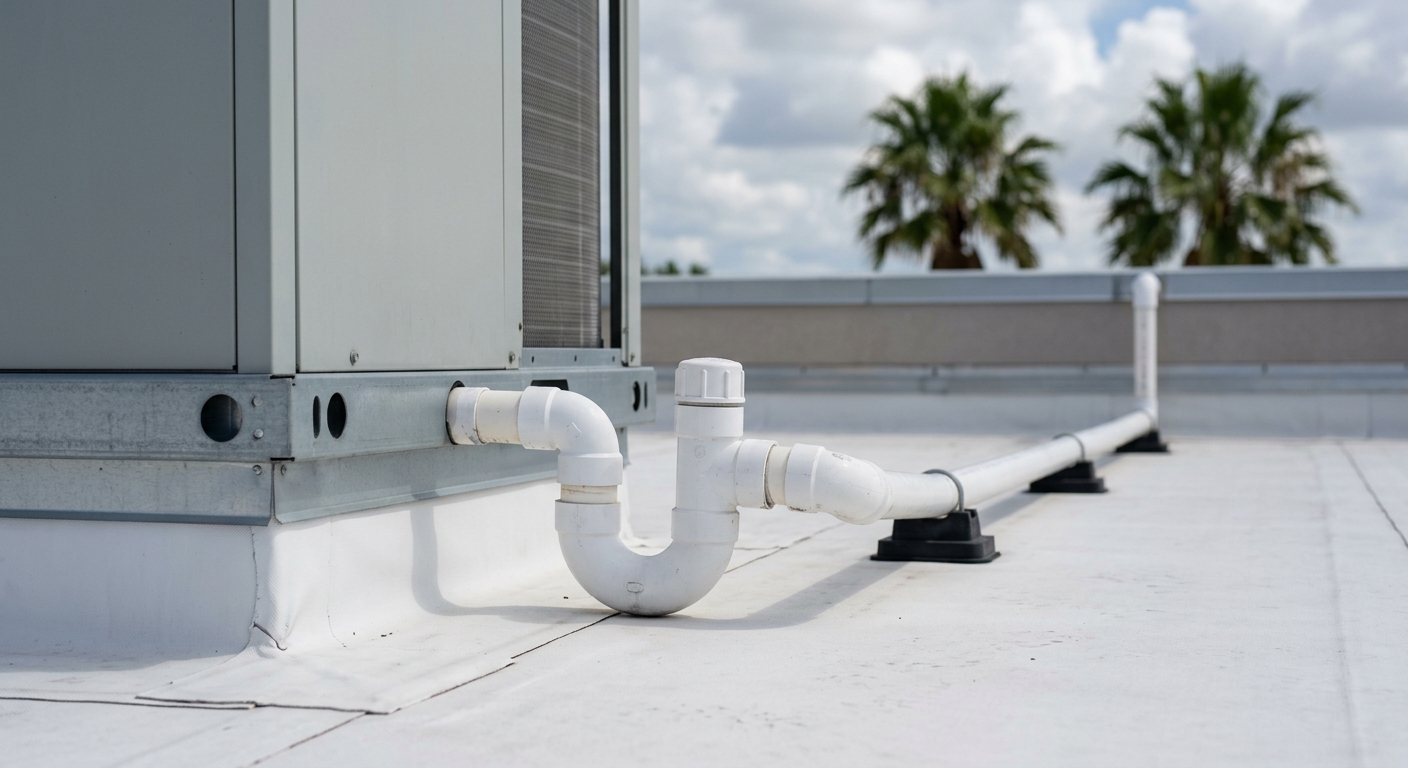
| Roof termination | Line discharges onto the membrane | Algae, dampness, and wear near the unit; leaks below | Route to an approved disposal point |
Secondary drain pan, overflow line, or float switch: which condensate overflow prevention fits?
Condensate overflow prevention in a commercial building rests on two layers: keeping the primary drain clear, and installing a secondary protection that controls what happens when the primary drain blocks. Section 307.2.3 of the Florida Building Code, Mechanical, 8th Edition (2023) requires that secondary layer where overflow could damage building components, and it lists the acceptable methods. Each method trades water damage against lost cooling in a different way.
| Protection | How it works | Where it fits | Where it falls short |
|---|---|---|---|
| Auxiliary drain pan with a separate drain | A second pan under the coil drains to a point where occupants will notice it | Air handlers above finished ceilings with room for a pan | Works only if someone sees the discharge; the pan can rust or fill with debris |
| Overflow drain from the primary pan | A line from a higher pan connection carries water once the primary outlet blocks | Units with a factory secondary connection | Shares the primary pan, so a cracked or rusted pan defeats it |
| Auxiliary pan with a water-level switch | A switch in the second pan shuts the unit off before the pan overflows | Spaces where any discharge would go unnoticed | The space loses cooling until a technician responds |
| Water-level switch in the primary pan | A switch shuts the unit off as water rises in the primary pan | Downflow units and coils with no room for a secondary pan | Shutdown is the only warning unless the switch reports to an alarm |
| Condensate pump with shutoff | A pump lifts water to a drain and stops the unit if the pump fails | Equipment located below the nearest drain | Pumps wear mechanically; the interlock has to be tested |
No secondary protection prevents a clog. A float switch converts a flood into a service call, and a secondary drain converts it into a visible drip, and both depend on someone acting on the warning. A switch that shuts down a unit serving a server room or a patient area should report to the building automation system or a monitored alarm, so the facility team learns of the shutdown before the tenant does. A secondary drain ending where nobody looks, such as on a roof, gives no warning at all.
Adding a switch or an auxiliary pan to older equipment is a scoped commercial air conditioning retrofit item, priced with the wiring and alarm connection included. The device is only as reliable as the maintenance behind it.
What drives the cost of condensate repairs and prevention?
The cost of a condensate repair depends far more on access and collateral damage than on the drain itself. Advanced Air Systems does not publish pricing, and a range quoted without the building, equipment location, and extent of damage is not useful for budgeting. Ask each contractor to price these drivers separately so proposals compare on the same scope.
| Cost driver | Why it moves the price | How to pin it down before award |
|---|---|---|
| Equipment location | Above-ceiling units need tenant access and protection; rooftop units need roof access and fall protection | Location and access plan for each unit |
| Number of units affected | A building-wide slime problem is a program, not a single call | Inspection count before pricing |
| Drain re-piping | Undersized, unsupported, or uncleanable lines may need rebuilding with cleanouts | Line route, material, slope, and cleanout locations |
| Pan repair or replacement | Corroded pans may need replacement | Pan condition documented with photos |
| Overflow protection retrofit | Switch or auxiliary pan, wiring, and controls connection | Device type and where the alarm reports |
| Water damage and drying | Ceiling, insulation, and finish repairs are often separate trades | Moisture readings and a written drying scope |
| After-hours work | Occupied spaces may require night or weekend windows | Work windows stated in the proposal |
Advanced Air Systems’ commercial air conditioning repairs page lists water leaks among the signs of a clogged drain or drain pump problem, and the company offers same-day and emergency service. Units that overflow repeatedly have a design problem worth pricing once.
What changes when the building is occupied and the units sit on the roof?
Most condensate problems in South Florida commercial buildings are found and fixed while tenants are in place, the occupied-building work Advanced Air Systems names as its specialty. An above-ceiling air handler in an office suite means protecting floors and equipment and scheduling the work with the tenant, and a unit serving a medical suite or server room may need temporary cooling or an after-hours window. The property manager should receive notice of every planned shutdown before it starts. The commercial HVAC repair in Miami page describes the same diagnose-first sequence for occupied buildings.
Water damage response runs on its own clock. EPA’s 48-hour drying guidance means the decision to open ceilings, remove wet insulation, and bring in drying equipment usually has to be made the day the leak is found. The HVAC repair stops the source, while drying and restoration are often a separate scope, and the owner should document both with photos and moisture readings.
On the roof, condensate is a roofing problem as much as a mechanical one. A drain line that ends on the membrane wets the same spot every hour the unit runs, feeding algae and hiding leaks at nearby curbs or penetrations. Rerouting a line or replacing curb flashing touches the roof warranty, so the work should be coordinated with the roofing contractor who holds it. Advanced Air Systems is a division of Advanced Roofing Inc., with in-house roofing and sheet metal divisions, and Advanced Roofing’s commercial roof repair team can assess the membrane and flashing around rooftop equipment. Owners planning a full replacement can review what to settle before a commercial HVAC project in South Florida so drainage is designed in from the start.
Which Florida Building Code provisions govern condensate disposal?
Condensate disposal in Florida is governed by Section 307 of the Florida Building Code, Mechanical, with local amendments and interpretations in some counties. As of October 2026, the provisions an owner is most likely to encounter are these:
- Section 307.2.3 requires an auxiliary pan with its own drain, an overflow drain, or a water-level detection device that shuts the equipment off where overflow could damage building components.
- Section 307.2.3.1 requires the water-level device to be installed inside the primary pan on downflow units and on coils with no provision for a secondary drain or auxiliary pan.
- Sections 307.2.5 and 307.3, added in the 6th Edition (2017) according to the City of Doral’s analysis of 2017 mechanical code changes, require drain lines that can be cleared without cutting and require equipment to stop when its condensate pump fails.
- Section 307.1.1 requires concealed condensate terminations to be marked primary or secondary, and Section 307.2.1.1 limits which plumbing fixtures may receive condensate; Miami-Dade’s summary notes a county ordinance keeping air conditioner water out of its sewer system.
- Broward County’s Formal Interpretation #38 requires condensate from equipment served by an on-site cooling tower, where aggregate capacity exceeds 65,000 Btu/hr, to be piped to the tower unless every listed exception applies, and leaves the isolated-or-remote judgment to the designer of record.
Whether existing equipment must be brought up to these provisions, and how the 9th Edition changes them, are determinations for the engineer of record and the local building official. Broward buildings with cooling towers can review tower and chiller work on the chiller and cooling tower services page before scoping condensate changes.
Condensate overflow prevention checklist: who owns each task?
- Facility or property manager: Keep a list of every unit with a cooling coil, where its condensate goes, and what overflow protection it has, including units above finished ceilings.
- Facility or property manager: Log every leak by unit, date, and stain location, so repeat failures point to a design problem instead of another clear-out.
- HVAC service contractor: Clear and flush drain lines, inspect pans and traps, and test every float switch and pump interlock on each visit, with photos in the service report. Advanced Air Systems’ preventive maintenance program includes regular drain line cleaning.
- HVAC service contractor: Confirm each secondary drain ends where someone will see it, and that each shutoff switch reports to a monitored alarm wherever an unannounced shutdown would affect occupants.
- Engineer of record: Review trap design, line size and slope, cleanouts, and secondary protection on any re-piping or replacement, and confirm which code edition the permit follows.
- Roofing contractor: Inspect the membrane and flashing around rooftop units and confirm no condensate line discharges onto the roof.
- Owner or asset manager: Require overflow protection and cleanable drain lines in the scope of every commercial AC unit change-out, and budget correction for units that overflow repeatedly.
Frequently Asked Questions
Why is my commercial AC leaking water from the ceiling?
The most common cause is a blocked condensate drain: the pan under the cooling coil fills and overflows onto the ceiling below. Other causes include a cracked or rusted pan, a separated drain joint above the ceiling, a lost trap seal, and a failed condensate pump. Shut the unit off if water is reaching finishes or electrical equipment, and have a technician trace the drain path before the ceiling is repaired.
How often should commercial condensate drains be cleaned?
Commercial condensate drains should be cleared and inspected on every scheduled maintenance visit, and more often on units with a history of slow drains. No single interval fits every building, because runtime, filtration, and humidity set the pace, and Florida equipment runs for most of the year. Log leaks by unit and shorten the interval on any unit that clogs between visits.
Is a float switch required on commercial AC units in Florida?
Where overflow could damage building components, the Florida Building Code, Mechanical requires a secondary protection, and a water-level detection device that shuts the equipment off is one permitted method. An auxiliary pan with its own drain or an overflow drain can satisfy the requirement instead. Which method applies to a specific unit is a determination for the designer and the building official.
Can rooftop unit condensate drain onto the roof?
Owners should treat condensate discharging onto a roof membrane as a condition to correct. It keeps one area wet for most of the year, feeds algae, and can mask or contribute to leaks around curbs and penetrations. The building official decides what counts as an approved disposal point for a given building, and the roofing contractor should confirm the routing protects the roof warranty.
What should a property manager do in the first 48 hours after a condensate leak?
Stop the source, then dry the building. Shut down or isolate the leaking unit, protect occupants and equipment from wet ceiling tile, and call the HVAC contractor to clear the drain and find the cause. EPA guidance calls for cleaning and drying wet materials within 48 hours, so photograph the damage, take moisture readings, and arrange drying or removal of wet materials the same day.
Treating condensate as part of the building’s drainage system
Commercial HVAC condensate drain problems are predictable because the water is predictable: every cooling coil in a Florida building produces it for most of the year. Buildings that avoid water damage treat the drain path as a system with a design, a backup, and an owner. They keep the primary drain clear on a set schedule, choose secondary protection that someone will notice, route rooftop condensate away from the membrane, and correct the design on units that keep overflowing. Owners in Broward County can find local service details on the commercial HVAC contractor in Fort Lauderdale page.
Written by The Technical Team at Advanced Air Systems. Established in 1994, Advanced Air Systems is a 100% employee-owned commercial HVAC contractor and a division of Advanced Roofing Inc.
To have condensate drains inspected or an overflowing unit diagnosed, call (954) 332-1418 or request a free quote from Advanced Air Systems.