At a glance: Tampa commercial building owners with aging rooftop units face three dated changes: EPA’s May 2026 revision of its refrigerant transition rule, the Florida Building Code Ninth Edition on December 31, 2026, and new federal efficiency minimums for commercial rooftop units on January 1, 2029. Tampa Electric’s commercial cooling rebates no longer appear on its business programs page. This guide explains why rooftop units wear out early near Tampa Bay, compares repair, replacement, and retrofit, lists the cost and schedule drivers, and ends with a checklist a facility manager can take to an owner or board.
Most owners comparing commercial HVAC Tampa contractors this fall are deciding when to replace aging rooftop units, and for most buildings that is a scheduling decision rather than a refrigerant emergency. A working R-410A unit can stay in service and be repaired, while a unit with repeated compressor, coil, or curb failures should be replaced on a timeline the owner controls, with equipment, refrigerant, permit edition, and crane window chosen before the next cooling season. Waiting for a July failure on an occupied building means renting temporary cooling, buying whatever equipment is in stock, and permitting under whatever code applies on the day of application. This article does not argue that every Tampa building should replace equipment now, and it makes no code, tax, insurance, or utility determination for any specific building.
What Changed for Commercial HVAC Tampa Owners in 2026?
Several dated changes reshaped rooftop equipment decisions for Tampa commercial buildings during 2026. The U.S. Environmental Protection Agency finalized a reconsideration of its HFC Technology Transitions rule on May 21, 2026, published it in the Federal Register on May 26, 2026, and made it effective July 27, 2026. EPA’s HFC restrictions by sector table now shows no installation deadline for residential and light commercial split systems whose specified components were all manufactured or imported before January 1, 2025. New equipment in that subsector made after that date must use a refrigerant below 700 global warming potential, and higher-GWP variable refrigerant flow systems keep a January 1, 2027 installation deadline.
The state change is the building code. The 2026 Florida Building Code, Ninth Edition takes effect December 31, 2026, and the Florida Building Commission is still processing glitch amendments to the 2026 code, with a comment period that closes October 8, 2026. In most Florida jurisdictions the permit application date decides which edition governs, so a replacement permitted in November and one permitted in January can be reviewed under different editions of the mechanical and energy volumes. Further out, federal efficiency minimums for commercial rooftop units change on January 1, 2029 under a standard the U.S. Department of Energy finalized in April 2024.
The utility change is local. As of September 26, 2026, Tampa Electric’s business energy-savings page no longer lists its commercial cooling or chiller rebate programs. It lists an energy audit, a variable frequency drive and motor controls rebate, a custom program based on peak-demand reduction, and a load management program. Cost guides that still quote per-ton Tampa Electric cooling rebates describe programs the utility has closed.
Why Do Rooftop Units Wear Out Faster on Tampa Bay Buildings?
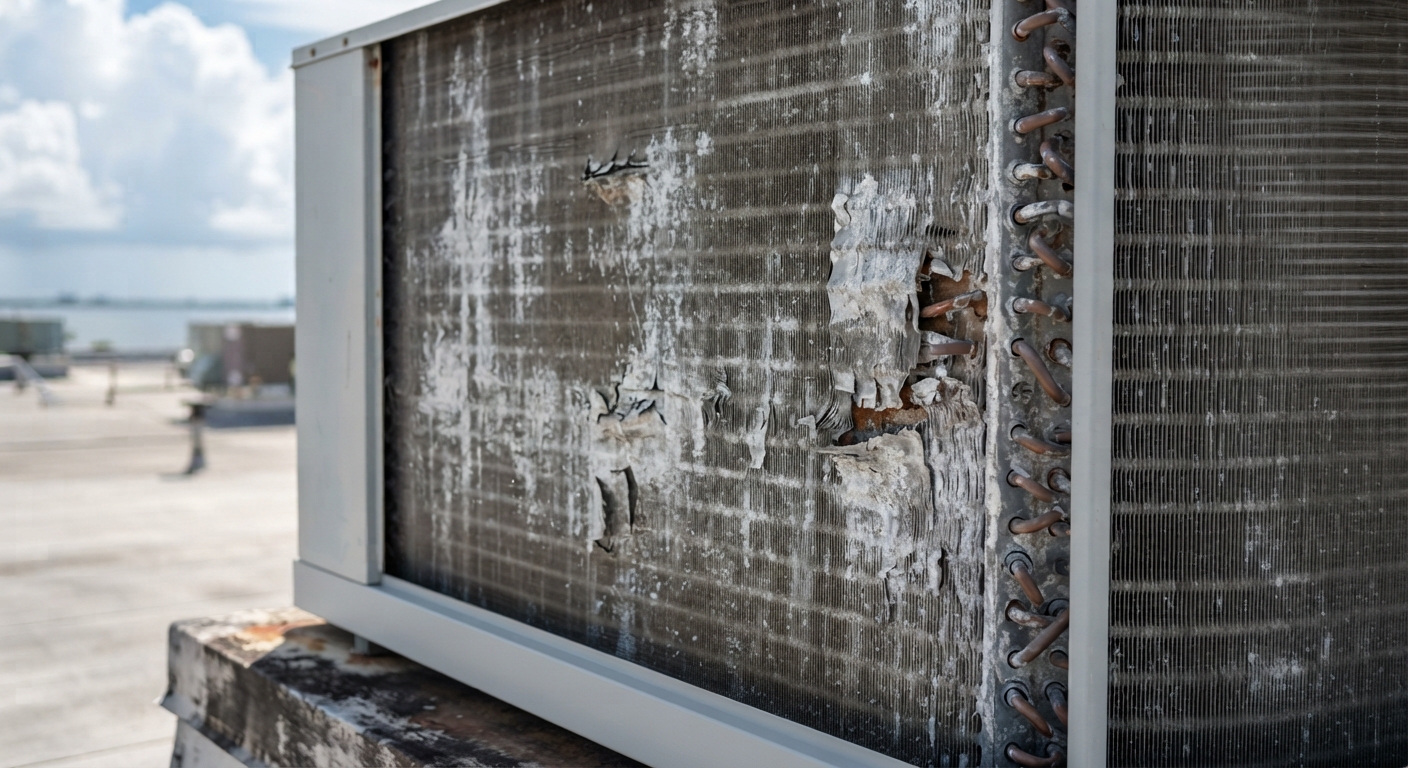
A packaged rooftop unit on a Tampa building runs a long cooling season against humid outdoor air, and most early failures trace to four physical mechanisms. Long runtime accumulates hours on compressors and fan motors. Humid air forces the evaporator coil to remove moisture as well as heat, so a unit that cannot run long enough to dehumidify leaves the space cool and damp. Marine air near Tampa Bay and the Gulf beaches deposits salts on condenser coils, where aluminum fins corrode and separate from the copper tubes they are meant to cool. The fourth mechanism sits under the unit: the curb, the flashing, and the roof membrane carry the weight and the water, and a leaking curb can be mistaken for a condensate problem for months.
Oversizing makes the humidity problem worse. A unit selected by matching the old tonnage, instead of from a current load calculation, reaches its thermostat setpoint quickly and shuts off before the coil has removed much moisture. The results are short-cycling, extra compressor wear, and a building that feels clammy at a comfortable temperature. Right-sizing belongs to the mechanical engineer, which is why a replacement bid that copies the nameplate tonnage deserves a second look.
| Symptom on the roof or below it | Physical cause | What it usually points toward |
|---|---|---|
| Condenser fins flaking, white corrosion, fins separating from tubes | Salt and moisture corroding aluminum fins | Coil or unit replacement; ask whether the new coil needs a factory coating for coastal exposure |
| Repeated compressor failures | Age, short-cycling, electrical faults | Replacement if the unit is at end of life; repair if the failure is isolated |
| Space cool but humid; stained ceiling tiles | Oversizing, low airflow, blocked condensate drain | Load calculation and airflow test before any equipment decision |
| Water at the curb or at the ceiling below the unit | Failed curb flashing or membrane | Roof and curb repair, scheduled with the HVAC work |
| Rust at base rails and curb | Standing water, age | Curb adapter or new curb at replacement; structural check |
Repair, Replace, or Retrofit: Which Option Fits Your Building?
A Tampa building owner should repair a commercial rooftop unit when the failure is isolated and the cabinet, coil, and compressor have service life left, and replace it when failures repeat, the coil is corroded, or the unit is oversized for a load that has changed. The refrigerant rule alone does not require replacing a working R-410A unit.
Each path carries a cost the bid will not always show. A repair keeps the existing refrigerant, curb, and electrical service, and it leaves the building exposed to the next failure on the same aging equipment. A replacement using remaining R-410A inventory is legal only where EPA’s rule allows it for that equipment category and manufacture date, and the supplier’s documentation, not the contractor’s preference, settles which category a specific unit falls into. A replacement with A2L refrigerant equipment, such as units using R-454B or R-32, meets the current limit but requires A2L-rated tools, trained technicians, and installation to ASHRAE Standard 15, ASHRAE Standard 34, and UL 60335-2-40 as adopted by the building official. A retrofit, such as adding dedicated outdoor air or changing system type, can solve humidity or zoning problems that a one-for-one swap leaves in place.
No equipment option repairs leaky or undersized ductwork, poor controls, or a bad original load calculation. A new high-efficiency unit connected to the same duct and control problems carries those problems forward, and any energy savings depend on runtime, the utility rate, and installation quality.
| Option | Best fit | Where it falls short |
|---|---|---|
| Repair in place (existing R-410A) | Isolated failure; coil and cabinet sound; unit mid-life | Leaves oversizing, coil corrosion, and curb condition unaddressed; next failure hits the same equipment |
| Replace using remaining R-410A inventory | Split systems whose specified components were made or imported before Jan 1, 2025 | Allowed only where EPA’s rule permits for that category and date; inventory is finite |
| Replace with A2L-refrigerant equipment | End-of-life units; owners planning a long hold | Can cost more to buy and install; needs A2L-rated tools, training, and code-compliant installation; may need curb adapters |
| Retrofit or redesign the system | Chronic humidity, zoning, or ventilation problems; major renovation | Longest design and permit schedule; engineering fee; may cross the Dec 31, 2026 code-edition line |
What Drives the Cost and Schedule of a Tampa Rooftop Unit Replacement?
Advanced Air Systems does not publish pricing, and a per-ton figure lifted from a web page without the building’s scope attached is a sales number. The variables in Table 3 move the budget and the schedule more than the equipment price alone, and each one should appear as a separate line item in every bid you compare. A single small package unit on a simple one-story building may not need a contractor organized around crane-lifted, multi-unit work on occupied buildings, and the owner may find a lower price elsewhere for that job.
| Driver | Why it moves the budget or schedule | Who confirms it |
|---|---|---|
| Curb fit | A new unit footprint may not match the existing curb; an adapter or new curb adds roofing and structural work | Mechanical engineer; roofing contractor |
| Crane access and pick window | Crane size follows unit weight and reach; street use and off-hours picks add time | HVAC contractor; crane operator; City of Tampa or county right-of-way office |
| Electrical service | New units can need different breakers, disconnects, or conductors | Electrical engineer; licensed electrician |
| Refrigerant type | A2L equipment requires rated tools, training, and code-compliant installation | Equipment supplier; building official |
| Permit edition | The application date decides which Florida Building Code edition governs | Building official or permit expediter |
| Equipment lead time | Stocked units ship sooner than ordered units | Equipment supplier |
| Wind-load tie-downs | Rooftop equipment attachment must meet the code’s wind provisions | Engineer of record |
Tax and utility items belong in the same conversation but not in the contractor’s hands. The One Big Beautiful Bill Act ended the Section 179D energy-efficient commercial buildings deduction for projects beginning construction after June 30, 2026, and utility program terms change, so both belong on the list of questions for the owner’s tax advisor and Tampa Electric account manager rather than on a bid sheet.
What Changes When the Building Stays Open During the Work?
On an occupied Tampa building, the replacement schedule is built around tenants, patients, students, or staff. Units are sequenced so each zone loses cooling for one shift or one weekend, crane picks are scheduled outside business hours where the site allows, and the property manager receives written notice of each shutdown window before it starts. Crane lifts beside occupied space follow OSHA’s cranes and derricks in construction standard, which covers rigging, signal persons, and keeping workers clear of suspended loads; the staging plan should also keep tenants and the public outside the swing radius.
The roof under the unit is part of the job. Removing an old unit exposes the curb and the membrane around it, and a curb adapter or new curb has to be flashed into the roofing system in a way that keeps the roof warranty in force. Advanced Air Systems is a division of Advanced Roofing Inc., whose Tampa commercial roofing office handles the membrane side of curb and penetration work, so roofing and mechanical work can run as one sequence. The company’s portfolio documents the replacement of 44 rooftop air conditioning units at the Hillsborough County Sheriff’s Office headquarters in Tampa, completed in 2016, and its in-house crane, sheet metal, and roofing divisions support that kind of multi-unit work.
Storm exposure changes where equipment should sit. The National Hurricane Center’s report on Hurricane Helene records that the September 2024 storm destroyed at least 419 homes and caused major damage to at least 18,512 structures across Pinellas and Hillsborough Counties. Ground-mounted condensers, chillers, and electrical gear in surge-prone areas face a different risk than rooftop units, and FEMA P-348, Protecting Building Utility Systems From Flood Damage, describes elevation and protection approaches for mechanical equipment. No rooftop unit or tie-down resists wind beyond its design pressure; storms can exceed design conditions, and the engineer of record sets the attachment design. Owners can review hurricane season preparation for rooftop equipment before the next season begins.
Which Dates Belong on Your Calendar Before You Sign a Contract?
The dates in Table 4 are current as of September 26, 2026, and each one should be re-checked against its source before a contract is signed. None of them decides by itself whether a specific building’s equipment must change; the equipment supplier, the mechanical engineer, and the building official make those calls unit by unit. Hillsborough County lies outside the Florida Building Code’s High-Velocity Hurricane Zone, which covers Miami-Dade and Broward Counties, but rooftop equipment attachment in Tampa still has to meet the code’s wind provisions, and the local building official decides what the permit requires.
| Date | What happens | Source |
|---|---|---|
| July 27, 2026 | EPA reconsideration rule took effect; no installation deadline for qualifying pre-2025 residential and light commercial split systems | EPA; Federal Register |
| October 8, 2026 | Comment period closes on the second round of glitch amendments to the 2026 Florida Building Code | Florida Building Commission |
| December 31, 2026 | Florida Building Code, Ninth Edition (2026) takes effect | ICC code text; Florida Building Commission |
| January 1, 2027 | Installation deadline for higher-GWP variable refrigerant flow systems with components made before Jan 1, 2026 | EPA sector table |
| January 1, 2028 | Sale and distribution of restricted self-contained residential and light commercial AC products ends, three years after the Jan 1, 2025 manufacture date | EPA sector table, footnote 1 |
| January 1, 2029 | New federal efficiency minimums for commercial rooftop units | U.S. Department of Energy |
Decision Checklist: What to Settle Before a Replacement Goes to Your Owner or Board
- Facility manager: list every rooftop unit with install year, tonnage, refrigerant, and three years of service history, and flag units with repeated compressor, coil, or curb failures.
- Mechanical engineer: run a current load calculation for each zone before anyone bids like-for-like tonnage, and state whether humidity complaints point to oversizing, airflow, or controls.
- HVAC contractor: state in writing which refrigerant each proposed unit uses, whether EPA’s current rule permits it for that equipment category and manufacture date, and the equipment lead time.
- Roofing contractor: inspect each curb and the membrane around it, and price curb adapters, new curbs, and flashing as separate line items that keep the roof warranty in force.
- Building official or permit expediter: confirm which Florida Building Code edition will govern based on the planned application date.
- Property manager: set shutdown windows, tenant notices, and crane pick times with the contractor before the contract is signed.
- Tax advisor and Tampa Electric account manager: confirm any deduction, credit, rebate, or rate program in writing rather than relying on a contractor’s summary.
- Owner or board: approve the replacement as a phased capital plan with a contingency for curb and electrical conditions found after the old units come off.
Frequently Asked Questions
How long does a commercial rooftop unit last in Tampa?
Service life for a Tampa rooftop unit depends on runtime, exposure to marine air, maintenance history, and whether the unit was sized correctly in the first place. A unit near the bay with a corroded coil can reach the end of its useful life well before an inland unit of the same age on a preventive maintenance program. A condition assessment of the coil, compressor, cabinet, and curb answers the question better than nameplate age.
Do I have to replace R-410A rooftop units because of the EPA refrigerant rule?
No. EPA’s Technology Transitions rule restricts the manufacture and installation of new equipment; it does not require owners to remove working R-410A systems, and EPA states that components used to repair existing systems are not subject to its installation restrictions. The rule governs what a contractor can install when a unit is replaced, so it matters most at the moment you decide to replace.
Can a Tampa contractor still install new R-410A equipment in 2026?
Sometimes. As of September 26, 2026, EPA’s rule sets no installation deadline for residential and light commercial split systems whose specified components were all manufactured or imported before January 1, 2025. Other equipment types follow different dates, including January 1, 2027 for higher-GWP variable refrigerant flow systems. Ask the supplier to confirm the category and manufacture date of each proposed unit in writing before you sign.
Does Tampa Electric still offer rebates for commercial air conditioning replacement?
As of September 26, 2026, Tampa Electric’s business energy-savings page does not list its former commercial cooling or chiller rebate programs. It lists an energy audit, a variable frequency drive and motor controls rebate, a custom peak-demand program, and load management. Program terms change, so confirm current eligibility with your Tampa Electric account manager before counting any incentive in a budget.
Will the December 31, 2026 building code change affect my HVAC replacement?
It can. The Florida Building Code, Ninth Edition, takes effect December 31, 2026, and in most jurisdictions the permit application date determines which edition governs a project. A replacement permitted before that date and one permitted after it can be reviewed under different mechanical and energy provisions. Your building official or permit expediter can confirm how your application will be handled.
Does Advanced Air Systems handle commercial HVAC projects in Tampa?
Advanced Air Systems serves commercial customers throughout Florida, and its portfolio includes the replacement of 44 rooftop air conditioning units at the Hillsborough County Sheriff’s Office headquarters in Tampa, completed in 2016. The company provides commercial rooftop unit change-outs, commercial air conditioning repairs, and chiller and cooling tower services for occupied buildings. A site visit determines whether the company is the right fit for a given project.
Treat the Tampa Replacement as a Schedule You Control
The revised refrigerant rule, the code edition change, and the closed utility rebates point to the same conclusion for Tampa building owners. A working R-410A rooftop unit can stay in service and be repaired. A unit with repeated failures, a corroded coil, or a humidity problem rooted in oversizing belongs in a replacement plan the owner schedules, instead of one a July compressor failure schedules. That plan starts with an equipment inventory and a load calculation, prices the curb, crane, and electrical work as separate lines, confirms the permit edition and the refrigerant category of each unit in writing, and hands tax, rate, and code determinations to the professionals who make them. Owners who settle those items this fall keep the choice of equipment, contractor, and shutdown window in their own hands.
Written by The Technical Team at Advanced Air Systems. Established in 1994, Advanced Air Systems is 100% employee-owned and a division of Advanced Roofing Inc., serving commercial buildings across Florida.
To schedule a rooftop unit assessment for a Tampa Bay building, request a quote online or call (954) 332-1418.