
At a glance: Cooling tower protective coatings can return a corroded but structurally sound basin to watertight service, and they are a poor fit for towers with widespread perforation, structural section loss, the wrong capacity, or an unchanged water treatment program. This guide explains what fails inside a corroding tower, compares restoration with rebuild and replacement, lists the drivers that set cost and outage length, covers confined space, water management, and code rules, and ends with a decision checklist assigned by role.
Cooling tower protective coatings are a sound investment only when the steel underneath is still structurally whole; on a tower whose basin is rusting through, whose supports are losing section, or whose design no longer fits the building, a new lining only postpones the replacement. The cost of guessing wrong arrives in summer, as a coated basin that weeps at the seams a year later, a chiller plant running on one cell in August, or a capital request rejected because the last restoration did not hold. This article sets out how to tell which towers are restoration candidates, what a defensible coating scope contains, and how the work fits around an occupied South Florida building. It does not rank coating products or replace a condition assessment by your mechanical engineer and a qualified coating applicator.
Why do cooling tower protective coatings matter more on South Florida buildings?
Cooling tower protective coatings matter more in South Florida because two corrosive forces work on every tower at once: the coastal atmosphere outside and the concentrated water inside. NASA’s Corrosion Technology Laboratory at Kennedy Space Center reports that ASM International has documented the center’s marine environment on Florida’s Atlantic coast as the most corrosive in North America. The same salt aerosol, heat, humidity, and sunlight act on tower casings, fasteners, and basins along the coast farther south.
Inside the tower, a Federal Energy Management Program fact sheet on cooling towers, prepared by Pacific Northwest National Laboratory for the U.S. Department of Energy, explains that evaporation concentrates dissolved minerals in the recirculating water and that elevated mineral content and dissolved oxygen both accelerate corrosion. The same fact sheet lists pitting, galvanic, microbiologically influenced, and erosion corrosion among the forms found in cooling tower systems. DOE’s Best Management Practice #10 for cooling tower management adds that a properly operated tower should not have basin leaks or overflows, and it advises owners considering replacement to investigate every retrofit and maintenance option first and compare those costs against a new tower.
Coating restoration is one of those options. The owner’s question is whether this tower, with this steel, this water chemistry, and this building schedule, will get enough additional service from a lining to justify the outage.
What is actually failing inside a corroding cooling tower?
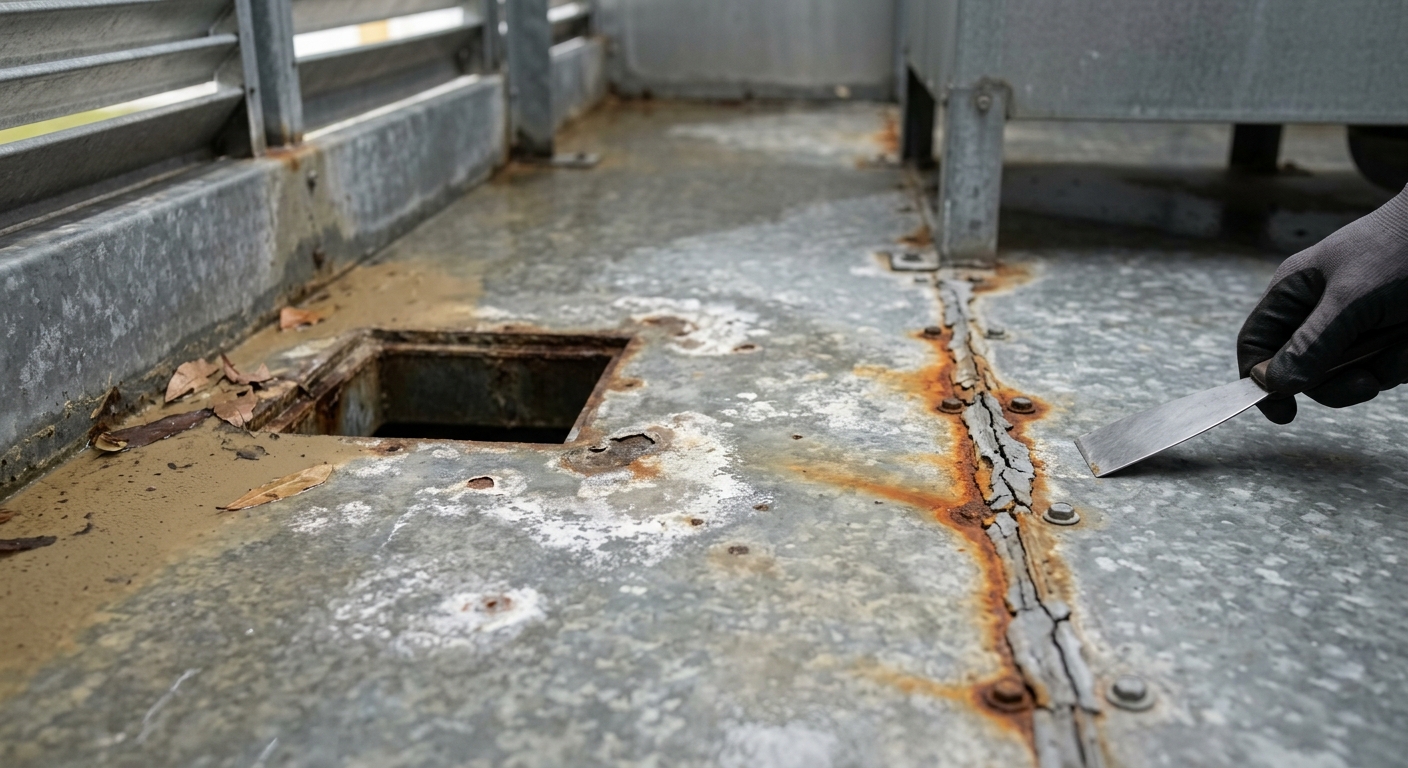
Most corrosion failures in packaged galvanized-steel cooling towers start in the cold water basin, because the basin stays wet, collects sediment, and holds water against seams and fasteners during shutdowns. Hot-dip galvanizing protects steel by placing a layer of zinc between the steel and the water, and the zinc corrodes first. When that layer is consumed, or when it was never properly passivated at startup, the zinc forms white, waxy deposits known as white rust and the steel beneath it begins to pit. The Cooling Technology Institute addresses this mechanism in its guideline on treating galvanized cooling towers to prevent white rust (CTI WTG-142), which centers on water chemistry at startup and during operation.
Seams are the second failure point. Basin panels are joined with sealant and fasteners, and the sealant ages faster than the steel. Water that finds a path through a seam wets the underside of the basin and the supporting steel, unseen until a drip reaches the roof. Under-deposit corrosion is the third. Sediment and biofilm trap water against the metal and shelter bacteria whose byproducts attack it, which is why DOE’s fact sheet names microbiologically influenced corrosion alongside the more familiar forms. Routine basin cleaning, covered in Advanced Air Systems’ chiller and cooling tower maintenance tips, limits that sediment.
Above the basin, the distribution deck, casing panels, fan deck, and structural frame decide whether a tower is a restoration candidate. A sound basin sitting on a frame that has lost section points to structural repair or replacement, and no lining changes that finding.
| Component | What corrosion looks like | What it means for restoration |
|---|---|---|
| Cold water basin floor | White rust, rust bloom, pitting, isolated pinholes | Usually restorable if adequate steel thickness remains after blasting |
| Basin seams and sump | Weeping sealant, rust streaks, active drips | Restorable with seam repair, reinforcement, and a lining |
| Hot water distribution deck | Pitting near nozzles, rust staining, perforation | Restorable where plate is sound; perforated plates replaced |
| Casing panels and louvers | Coastal surface rust, fastener corrosion | Exterior coating or panel replacement |
| Structural frame and supports | Section loss, rust swelling at connections | Engineering review; often points to replacement |
| Fill and drift eliminators | Scale, fouling, sagging or collapse | Not coated; replaced while the tower is open |
When do cooling tower protective coatings make sense, and when do they fall short?
Cooling tower coating restoration makes sense when corrosion is broad but shallow, the steel keeps enough thickness to support itself after blasting, the structure is sound, and the tower still matches the building’s cooling load. Under those conditions, the basin is blasted to bare metal, perforations are repaired, seams are reinforced, and an immersion-grade lining returns it to watertight, protected service with far less disruption than a tower change-out.
Restoration falls short under four conditions. The first is widespread perforation, where patch plates would cover more of the basin than original steel. The second is section loss in the frame, supports, or anchorage, which a lining cannot restore and which, on a rooftop, matters for wind resistance as much as for water. The third is a tower that is undersized, inefficient, or built around fill and fan components the owner intends to replace anyway. The fourth is a water treatment program that caused the damage and has not changed; a new lining returned to the same chemistry will be attacked from the same direction, at its seams and edges first.
A coating protects the steel that remains and restores nothing that has already been lost. Life-extension figures published by coating manufacturers and applicators come from case histories of specific towers and say little about a different tower, water program, or coastal roof. Where the comparison is close, the replacement side of the decision is set out in when repair or retrofit stops paying.
| Path | When it fits | Where it falls short |
|---|---|---|
| Spot repair and seam sealing | Isolated leaks; basin otherwise sound | Leaves surrounding corrosion active; repeat visits likely |
| Full basin restoration with lining | Broad, shallow corrosion; sound structure | Cannot fix section loss, a poor design, or an unchanged water program |
| Component rebuild (basin, deck, fill, mechanical) | Sound frame; several worn components | Longer outage; on small towers the total can approach replacement |
| Tower replacement | Structural loss, wrong capacity, or end of service life | Highest cost; permit, crane pick, anchorage design, and roof work |
What drives the cost and schedule of a cooling tower coating restoration?
The installed cost of a cooling tower coating restoration depends more on the preparation and access around the coating than on the coating itself, and two proposals that both read “recoat basin” can describe very different work. Advanced Air Systems does not publish pricing, and published per-square-foot figures for coating work rarely state the surface preparation grade, the steel condition, or the access method behind them. List each driver below in every proposal so bids are compared on the same scope.
Surface preparation sets the baseline for everything that follows. The coating manufacturer’s product data sheet names the required preparation, usually by reference to an AMPP (formerly SSPC and NACE) surface preparation standard, along with the dry film thickness range and the cure time before the basin can be refilled. A bid that omits the preparation standard, the film thickness, and the inspection method is an incomplete coating specification. Steel repair is the second variable, because its extent is unknown until the basin is blasted; isolated leaks found before then can be handled as commercial HVAC repairs while the restoration is planned.
| Driver | Why it moves cost or schedule | How to pin it down before award |
|---|---|---|
| Surface preparation | Abrasive blasting, containment, and media removal on a roof | Preparation standard named; containment method stated |
| Steel repair | Extent unknown until the basin is blasted | Unit prices for patch plates and pit filling, with a not-to-exceed amount |
| Fill and component removal | Full basin access often requires removing fill | Removal, disposal, and reinstall or replacement stated |
| Coating system and film thickness | Number of coats and cure time set the outage | Product data sheet attached; film thickness and holiday testing specified |
| Weather and humidity | Dew point limits restrict Florida application windows | Environmental limits and monitoring stated; weather days defined |
| Temporary cooling | Needed if remaining cells cannot carry the load | Rental equipment, connections, and duration scoped |
| Return to service | Cleaning and disinfection before restart | Water treatment provider’s procedure built into the schedule |
What changes when the cooling tower serves an occupied Florida building?
A cooling tower restoration on an occupied building is planned around the chiller plant’s ability to keep cooling while part of its heat rejection is out of service. Multi-cell towers are usually restored one cell at a time while the remaining cells carry the load, and the engineer or plant operator should confirm those cells can handle the expected weather. Single-cell towers need a shutdown window, temporary cooling, or both, and in South Florida the cooler months from December through March are the usual window.
Safety on the roof and inside the tower governs the method. A drained basin, a tower plenum, or a remote sump can meet the definition of a permit-required confined space under OSHA’s confined space standard, 29 CFR 1910.146, and coating work adds solvent vapor and limited ventilation to the hazards. The contractor’s confined space program, air monitoring plan, and rescue plan belong in the proposal, before award. Abrasive blasting and spray application on a roof also require containment, so blast media and overspray stay off the roof membrane, neighboring equipment, parked cars, and the building’s outdoor air intakes.
Returning the tower to service is a water management event. CDC’s guidance on controlling Legionella in cooling towers directs owners to clean and disinfect according to manufacturer recommendations before startup and after shutdown, and to take towers offline for cleaning and disinfection at least annually. Scheduling the restoration alongside that annual offline cleaning turns two outages into one. When the work grows into component replacement or the roof needs protection, Advanced Air Systems’ in-house crane, sheet metal, and roofing divisions support the same team that provides its chiller and cooling tower services.
Which codes and water management rules apply to a cooling tower coating restoration?
Replacing a rooftop cooling tower brings a permit, an anchorage design for wind, and, in Miami-Dade and Broward counties, High-Velocity Hurricane Zone requirements; whether in-place coating and repair need a permit is a local determination. As of October 2026, the Florida Building Code, 9th Edition (2026) takes effect December 31, 2026, and Miami-Dade County’s permitting notice on the 9th Edition states that permit applications and plans submitted on or after that date must comply with the new edition. The building official and engineer of record decide which edition governs a scope, and the rooftop anchorage issues are covered in planning a commercial HVAC project in South Florida.
Water management applies on every path. ANSI/ASHRAE Standard 188-2021 establishes minimum legionellosis risk management requirements for building water systems. For hospitals, critical access hospitals, and long-term care facilities, CMS memorandum QSO-17-30 expects water management plans that consider the ASHRAE standard and the CDC toolkit, and it lists cooling towers among the devices that can spread Legionella. Record the restoration’s shutdown, cleaning, and restart steps in the building’s water management plan.
Cooling tower coating restoration checklist: who owns each decision?
A defensible restoration decision assigns each question to the person qualified to answer it, in the order the work will happen.
- Owner or asset manager: State how many more years the tower must serve and whether a chiller plant change is planned, because restoration is judged against that horizon.
- Facility manager or plant operator: Document leak locations, make-up water trends, past repairs, and which cells can carry the load during an outage.
- Mechanical engineer of record: Confirm the tower still matches the cooling load and evaluate the frame, supports, and anchorage before a coating scope is written.
- Water treatment provider: Review the treatment history for the conditions that damaged the basin, and write the return-to-service cleaning and disinfection procedure.
- Coating applicator: Provide the product data sheets, surface preparation standard, film thickness, cure time, inspection and holiday testing method, and warranty terms in writing.
- HVAC contractor: Price steel repair as unit costs, scope fill and component replacement, and submit the confined space and containment plans.
- Property manager: Approve roof and air intake protection, and send tenant notices before blasting and spray days.
- Owner: Place the restored tower on a preventive maintenance program with a basin inspection at every offline cleaning.
Frequently Asked Questions
How long do cooling tower protective coatings last?
No single number applies. Service life depends on surface preparation, film thickness, the steel left after repair, water chemistry, and how the basin is cleaned. Manufacturers and applicators report results in years for specific towers, and those histories do not transfer to a different tower or water program. Ask for written warranty terms and the operating conditions that void them.
Can you coat a cooling tower basin that is already leaking?
Often, yes, if the leaks are at seams or isolated pinholes and the surrounding steel is sound after blasting. Perforations are repaired with welded patch plates or a repair compound the coating manufacturer approves before the lining goes on. Widespread perforation across the basin floor points to basin replacement or a new tower.
Is coating a cooling tower cheaper than replacing it?
For a structurally sound tower, restoration avoids the crane pick, permit, and anchorage design that come with a rooftop replacement. The comparison has to include steel repair, fill replacement, temporary cooling, and remaining service life. DOE’s cooling tower guidance recommends weighing retrofit and maintenance options against the cost of a new tower before choosing.
What causes white rust in a galvanized cooling tower?
White rust is a porous zinc corrosion product that forms when galvanized surfaces are exposed to water chemistry outside the range the zinc needs to passivate, most often during startup. It consumes the protective zinc layer and exposes the steel to pitting. The Cooling Technology Institute’s white rust guideline and the tower manufacturer’s water quality limits set the treatment targets.
How long is a cooling tower out of service for a basin coating?
The outage depends on surface preparation, the steel repair found after blasting, the number of coats, the cure time on the coating data sheet, and humidity during application. Cleaning and disinfection before restart add time. Ask each bidder for a day-by-day schedule per cell and the weather limits that would extend it.
Does a cooling tower coating restoration require a permit in Florida?
Replacing a rooftop cooling tower requires a permit. Whether in-place cleaning, coating, and repair need one depends on the jurisdiction and on whether structural or anchorage work is involved. Confirm with the building department before the contract is signed, and note that applications filed on or after December 31, 2026 follow the 9th Edition of the Florida Building Code.
Restoring the right towers and replacing the rest
Cooling tower protective coatings earn their cost on towers with sound structure, adequate steel, the right capacity, and a water program that has been corrected. On those towers, a properly prepared and inspected lining returns the basin to watertight service with a shorter outage than a change-out. On towers with structural loss or the wrong capacity, the same money postpones a replacement the building will still need. A condition assessment, a written coating specification, and a return-to-service plan tied to the building’s water management program are what separate the two cases.
Written by The Technical Team at Advanced Air Systems. Established in 1994, Advanced Air Systems is 100% employee-owned and a division of Advanced Roofing Inc., serving commercial buildings from offices in Fort Lauderdale, Miami, and West Palm Beach.
To schedule a cooling tower condition assessment, call (954) 332-1418 or request a free quote. Building owners in Miami-Dade can also review local service details on the commercial HVAC Miami page.