At a glance: A summer school HVAC replacement in South Florida is mostly a planning job. Florida law keeps district schools from opening before August 10, so the construction window is fixed, and it overlaps hurricane season. This guide explains what fails first in humid classroom systems, compares repair, change-out, retrofit, chiller, and redesign scopes with their limits, lists what drives cost and schedule, covers the December 31, 2026 code change and the January 1, 2027 VRF deadline, and ends with a role-by-role checklist for summer 2027.
A school HVAC replacement South Florida districts want finished in summer 2027 is decided in the planning months before the equipment ships, and for most campuses those months run from now through March. Florida law bars district schools from opening before August 10, the summer window sits inside hurricane season, and a project that slips becomes a half-finished rooftop unit change-out or chiller swap in an occupied, humid building when students return. This article does not argue that every aging system belongs on the 2027 list, because a repair on equipment with documented service life left is often the better use of a capital budget, and the replace-or-repair call belongs to the district’s engineer and facilities staff.
Why does every school HVAC replacement South Florida districts schedule for summer 2027 need to start now?
The need for school HVAC work is documented at the federal level. The U.S. Government Accountability Office’s June 2020 report GAO-20-494 on public school building systems estimated that 41 percent of public school districts need to update or replace HVAC systems in at least half of their schools, about 36,000 schools nationwide, and officials at about half of the 55 schools GAO visited described HVAC problems such as aging systems that leaked and damaged floors and ceiling tiles. The U.S. Department of Energy’s guidance on prioritizing HVAC upgrades in K-12 schools treats HVAC as a priority efficiency measure because it also delivers ventilation and filtration.
The South Florida school calendar compresses the window for that work. Section 1001.42(4)(f), Florida Statutes, provides that district schools may not open earlier than August 10 of each year, and Broward County Public Schools’ approved 2026-27 calendar sets the last day of school at May 28, 2027. Teacher planning days narrow that window at both ends.
Two regulatory dates also fall between now and the first permit application for a summer 2027 job. The 9th Edition (2026) of the Florida Building Code takes effect December 31, 2026, according to the Florida Building Commission’s 2026 code update workplan, and Miami-Dade County’s notice to permit applicants states that permit applications and plans submitted on or after that date must comply with the new edition. Under EPA’s Technology Transitions program, variable refrigerant flow (VRF) equipment using higher-GWP refrigerants that was manufactured or imported before January 1, 2026 may be installed only until January 1, 2027.
What actually fails in a South Florida school HVAC system?
Most South Florida school HVAC complaints are moisture problems before they are temperature problems. A full classroom adds heat and moisture faster than an office of the same size, and the outdoor air required for ventilation arrives warm and saturated for most of the year. EPA’s IAQ Tools for Schools program notes that mold and mildew problems are particularly pronounced in the Southeast where humidity is high, and EPA’s framework for effective school IAQ management recommends holding indoor relative humidity between 30 and 60 percent.
Equipment that removes sensible heat without removing enough moisture leaves a room cool and clammy. An oversized packaged rooftop unit reaches the thermostat setpoint quickly and shuts off before its coil runs long enough to condense water out of the air, so the space stays humid while ceiling tiles, gym floors, and stored books absorb the moisture. Replacing that unit with a larger one repeats the error. Right-sizing is a load-calculation question for the district’s mechanical engineer, and it includes the outdoor air ventilation load that EPA’s framework ties to current ASHRAE Standard 62.1 rates.
Coastal campuses add corrosion. Salt-laden air attacks aluminum condenser coil fins and the steel bases and curbs under rooftop equipment, so a unit near the water can lose capacity well before an identical unit inland. Condensate systems fail quietly: a clogged pan or a dried-out trap sends water into the ceiling plenum, which is why EPA’s framework asks school staff to confirm that condensate pans drain.
| Symptom | Likely mechanism | What it means for summer scope |
|---|---|---|
| Rooms feel cool but clammy; musty odor | Oversized or short-cycling equipment; untreated outdoor air | Load calculation and dehumidification strategy before any equipment is selected |
| Stained ceiling tiles near air handlers | Clogged condensate pans, failed traps, sweating uninsulated piping | Condensate and insulation repairs; may not need a new unit |
| Repeated compressor or fan motor failures | End-of-life equipment or electrical faults | Replacement candidate; document the failure history for the board |
| Corroded coils and rusted bases on coastal roofs | Salt-air corrosion | Coastal coil protection in the specification; curb and roof inspection with the roofer |
| Hot and cold rooms on one system | Failed dampers, controls faults, or duct leakage | Controls and test-and-balance scope; new equipment alone will not fix it |
| Chilled water plant cannot hold supply temperature | Aging chiller, fouled tubes, or cooling tower degradation | Engineering study; chiller replacement is often a multi-break decision |
School HVAC repair vs. replace: which K-12 HVAC upgrades fit a summer window?
K-12 HVAC upgrades fall into five scopes, and each fits the summer window differently. The right choice depends on failure history, ductwork and controls, the roof under the equipment, and the working days the campus can give the contractor. Like-for-like rooftop unit change-outs and targeted HVAC retrofits usually fit one summer; chiller and cooling tower replacements and full redesigns often do not. Each falls short somewhere.
| Scope | What it addresses | Fits one summer? | Where it falls short |
|---|---|---|---|
| Targeted repair (compressors, motors, coils, condensate) | Specific failures on equipment with service life left | Usually | Does not fix a bad load calculation or end-of-life equipment; repeated major repairs on aging units cost more over time |
| Like-for-like rooftop unit change-out | Failed or end-of-life packaged units | Often, when curbs match or adapters are designed in advance | Copies any original sizing error; curb, roof, and electrical problems surface during demolition |
| Retrofit (controls, economizers, dehumidification, VFDs) | Humidity, ventilation, and energy performance of existing equipment | Often, if parts are ordered early | Cannot rescue equipment at end of life; needs commissioning to deliver results |
| Chiller or central plant replacement | Aging chillers, cooling towers, and pumps | Sometimes; large plants are often phased across breaks | Longest design effort and equipment lead times; may need temporary cooling |
| System redesign (for example DOAS or VRF) | Chronic humidity and ventilation problems | Rarely for a whole campus | Highest design and permitting effort; VRF refrigerant dates apply |
Repairs have limits in both directions. A compressor replacement on a mid-life unit with a clean coil can be the right call; a third compressor on a unit past its service life usually is not. The same honesty applies to contractor selection. A commercial HVAC contractor organized around occupied buildings may not be the lowest bid on a two-system private school replacement, and the district’s HVAC contractor selection criteria should weigh schedule reliability alongside price.
What drives cost and schedule on summer HVAC projects for schools?
For a summer 2027 project in South Florida, the engineering assessment and scope should be complete by early winter, board approval and bidding by early spring, and equipment orders, submittals, and permits by late spring. That sequence lets crews mobilize the week school closes, finish installation in June and July, and complete testing and commissioning before teachers return in August.
Advanced Air Systems does not publish pricing, and published per-ton or per-square-foot figures for school projects rarely state the assumptions behind them. Each variable below should appear as a line item or stated assumption in every bid the district compares.
| Driver | Effect on budget and schedule | Who confirms it |
|---|---|---|
| Equipment type and lead time | Chillers, large rooftop units, and custom air handlers ship on manufacturer schedules; a late order can push installation past the window | Manufacturer ship date, in writing, before award |
| Curb and structural fit | Mismatched curbs need adapters or new curbs, which reopens the roof | Mechanical and structural engineers |
| Roof condition under equipment | Equipment removal is the least disruptive time to repair the roof beneath it | Roof consultant or roofing contractor |
| Electrical capacity | New equipment with different electrical characteristics can require panel, feeder, or disconnect changes | Electrical engineer |
| Crane access and pick plan | Picks over walkways or occupied areas need closures and timing outside program hours | Contractor’s lift plan; campus administration |
| Code edition and refrigerant rules | FBC 9th Edition applies to permits submitted on or after Dec. 31, 2026; EPA VRF installation date of Jan. 1, 2027 | Engineer of record; building official (as of Nov. 3, 2026) |
| Testing, balancing, and commissioning | Must finish before teachers report; skipped commissioning shows up as fall comfort complaints | Commissioning agent; district facilities staff |
What changes when a South Florida school stays occupied during summer work?
Summer school, camps, extended-year services, and administrative offices keep parts of many campuses running, and the work plan has to treat them as tenants. Each building loses cooling only inside an agreed shutdown window, crane picks over walkways happen before programs start or after they end, and the principal and facilities office receive written notice of every outage before it begins.
Humidity control continues after the old equipment comes out. A classroom wing left without air conditioning in July can absorb enough moisture to damage new finishes, flooring adhesives, and stored materials, so the plan should include temporary cooling or dehumidification for any space left unconditioned beyond a threshold the district’s facilities and environmental staff agree on in advance. Daily cleanup, photo progress reports, and one point of contact for the principal round out the plan.
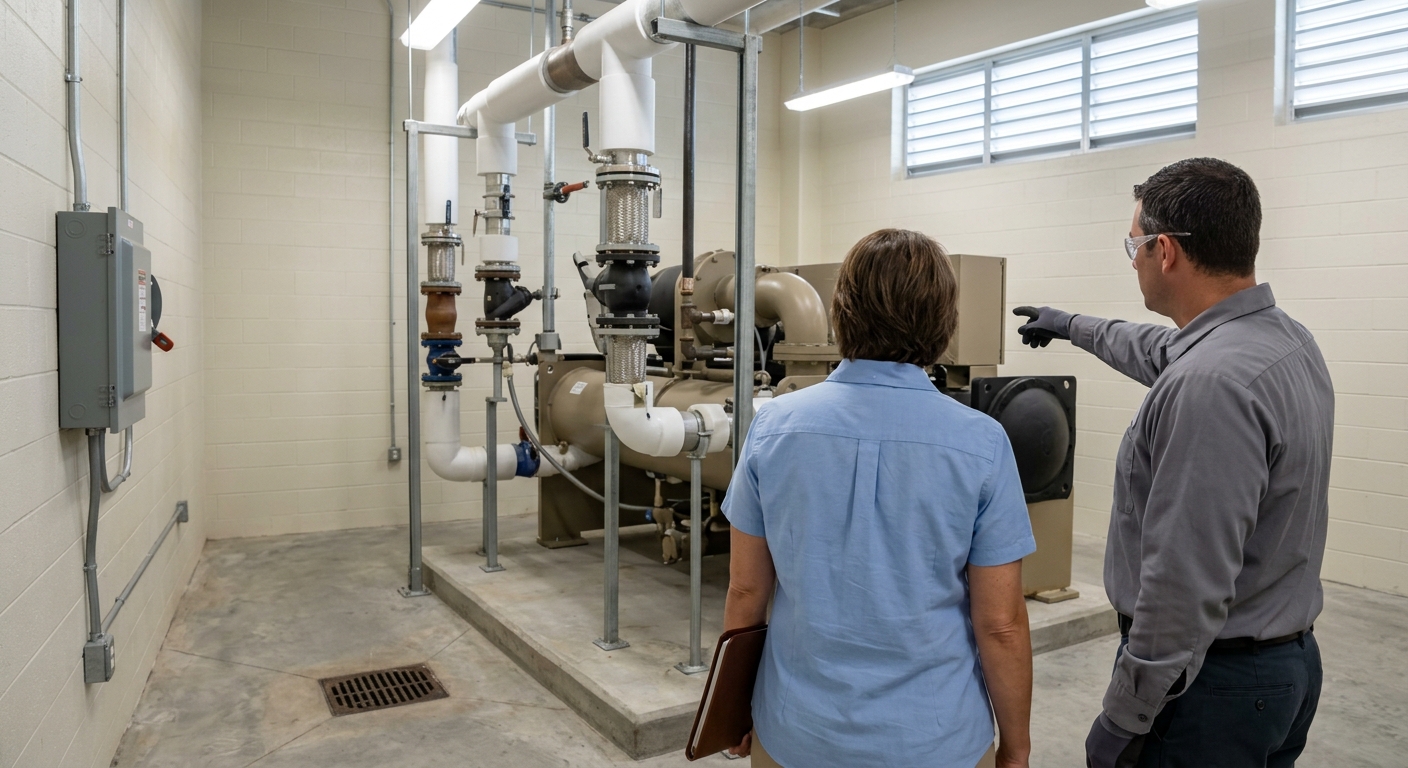
The summer window also sits inside the Atlantic hurricane season, which NOAA’s National Hurricane Center defines as June 1 through November 30. The contractor’s plan should state how open curbs are dried in each day and how staged equipment is secured when a storm watch is issued. In Miami-Dade and Broward, rooftop equipment attachment falls under the High-Velocity Hurricane Zone provisions of the Florida Building Code and Florida product approval requirements, and the engineer of record and building official determine what a specific installation needs. No rooftop installation is hurricane-proof; equipment and attachments are designed to rated pressures that a storm can exceed.
Rooftop coordination is where summer schedules slip. Advanced Air Systems is a division of Advanced Roofing Inc., and the group’s in-house divisions include roofing, sheet metal, cranes, and lightning protection, so curb, flashing, and crane work can run under one schedule from the Miami commercial HVAC office or the Fort Lauderdale commercial HVAC office. Districts using separate contractors should write the roofer’s curb and flashing scope into the HVAC bid documents; Advanced Roofing’s commercial re-roofing team is one source for that roofing scope.
Which code, refrigerant, and calendar dates apply to summer 2027 school projects?
As of November 3, 2026, the Florida Building Code 8th Edition (2023) is in effect and the 9th Edition (2026) takes effect December 31, 2026. Miami-Dade County’s notice states that permit applications submitted on or after that date must comply with the 9th Edition, and that online submissions after 4 p.m. on December 30, 2026 fall under it as well. Designs for summer 2027 permits should be drawn to the 9th Edition. Public district schools also follow the Florida Department of Education’s State Requirements for Educational Facilities, and charter and private schools should ask their design professional which requirements apply.
EPA’s Technology Transitions rules set the refrigerant path. EPA’s May 2026 reconsideration rule, effective July 27, 2026, removed the installation deadline for residential and light commercial air conditioning and heat pump systems built from components manufactured or imported before January 1, 2025. EPA did not extend the January 1, 2027 installation date for higher-GWP VRF equipment set in its December 2024 VRF rule. The engineer confirms which subsector applies. New equipment generally uses A2L refrigerants such as R-454B or R-32, which are mildly flammable and require trained technicians, A2L-rated tools, and installation to ASHRAE 15 and UL 60335-2-40 as adopted by code. The transition does not require replacing a working R-410A system, and A2L equipment can cost more to buy and install. Confirm each date again in the month the project is bid.
What should a school facility director confirm before approving a summer HVAC project?
Each item below names the role that owns it, so the list can move directly into a board packet or a project kickoff agenda.
- Facilities director: rank buildings by failure history, humidity complaints, and age, and order engineering assessments this fall.
- Mechanical engineer of record: confirm load calculations, ventilation rates, and dehumidification before selecting equipment, and state the governing code edition on the drawings.
- Roof consultant or roofing contractor: inspect the membrane, curbs, and flashing under every unit scheduled for removal, and price curb and roof work inside the HVAC bid.
- Electrical engineer: verify feeders, panels, and disconnects against the new equipment’s electrical data.
- Procurement officer: set a bid date that leaves time for board approval and equipment orders, and require each bidder to state manufacturer ship dates in writing.
- Principal and summer program coordinator: publish the summer program footprint so shutdown windows and crane days can be scheduled around it.
- Contractor: deliver a written shutdown schedule, crane pick plan, daily dry-in procedure, and storm-watch securing plan before mobilization.
- Commissioning agent and facilities staff: finish testing and balancing before teachers report, and collect warranty registrations, O&M manuals, and as-builts.
- Facilities director: enroll new equipment in a preventive maintenance program so manufacturer warranty conditions stay met.
Frequently Asked Questions
How long does it take to plan a summer school HVAC replacement?
For a South Florida campus, plan on most of a school year. Engineering assessment and design belong in the fall and early winter, bidding and board approval in late winter, and equipment orders, submittals, and permits in spring, so crews can mobilize when school closes. Chillers, large air handlers, and multi-building scopes need more lead time than a few rooftop unit change-outs. Ask the engineer and each bidder for written durations for your specific scope.
Can a school replace a chiller in one summer?
Sometimes. A single chiller swap with matching piping connections, early equipment delivery, and a rigging plan settled in advance can fit inside a summer. A full central plant with cooling towers, pumps, and controls is often phased across several breaks or supported by temporary cooling. The district’s mechanical engineer should set the phasing after reviewing lead times, electrical capacity, and the campus summer program schedule.
Does the Florida Building Code 9th Edition affect summer 2027 school HVAC projects?
Yes, for most projects. The 9th Edition (2026) takes effect December 31, 2026, and Miami-Dade County states that permit applications submitted on or after that date must comply with it. A summer 2027 project permitted in spring 2027 will generally fall under the new edition, including its Mechanical and Energy Conservation volumes. The engineer of record and the local building official confirm which edition governs a specific permit.
Do schools have to replace R-410A HVAC systems because of the EPA refrigerant rules?
No. EPA’s Technology Transitions rules restrict new equipment and new installations, and they do not require replacing a working system; existing R-410A equipment can continue to be serviced. The rules matter when a school buys new equipment, especially VRF systems, where higher-GWP equipment faces a January 1, 2027 installation date. Confirm the current rules on EPA’s website before the project is bid.
What happens if a summer HVAC project is not finished before students return?
The remaining work becomes occupied-building work. Classrooms may need temporary cooling, crane picks and shutdowns move to nights and weekends, and humidity control gets harder in August heat. Build float into the schedule, require a recovery plan in each bid, and decide in advance which buildings can move to a winter or spring break phase if equipment arrives late.
Should K-12 HVAC upgrades include controls and ventilation work, or just new equipment?
Usually both. New equipment does not correct leaky ductwork, failed dampers, poor controls, or a bad load calculation, and those problems often drive the humidity and comfort complaints that started the project. Include controls, test-and-balance, and commissioning in the scope, and have the engineer confirm ventilation rates. Energy savings depend on runtime, utility rates, and installation quality.
Planning summer 2027 school HVAC work in South Florida
A summer school HVAC replacement in South Florida succeeds or fails on decisions made months before the equipment arrives. The August 10 statutory opening date, late-May and early-June closing dates, hurricane season, the December 31, 2026 code change, and the January 1, 2027 VRF installation date all fix the schedule from outside, and none of them moves for a late design. The district decides which buildings have documented failure histories, which problems are humidity and controls problems, and which repairs still make sense. Districts that finish engineering this winter and bid by early spring keep the summer for construction and commissioning.
Written by The Technical Team at Advanced Air Systems. Established in 1994, Advanced Air Systems is 100% employee-owned and a division of Advanced Roofing Inc., with commercial HVAC offices in Fort Lauderdale, Miami, and West Palm Beach.
To scope a summer 2027 HVAC project for your campus, request a free quote or call Advanced Air Systems at (954) 332-1418.