At a glance: Commercial duct sealing South Florida owners can defend starts with a leakage test, and duct cleaning starts with an inspection that finds contamination. This guide explains why the two problems differ, how leaks waste cooling and pull humidity into Florida buildings, how manual sealing, aerosol sealing, replacement, and NADCA-standard cleaning compare, what drives cost and results, how the work runs in an occupied building, what the Florida Building Code requires as of November 2026, and who owns each decision.
Commercial duct sealing South Florida buildings can justify starts with a leakage test, and duct cleaning is a separate decision made only when an inspection finds debris, mold, or contamination inside the system. Treating the two as one maintenance line costs owners money, because a building that pays for cleaning when the real problem is leaking supply duct keeps losing conditioned air, and a building that seals duct lined with wet, moldy insulation locks the problem inside. Florida field research has measured small commercial duct systems far leakier than the national construction standard and tied that leakage to indoor humidity and mold. This article explains how to tell which problem a building has; it does not argue that every building needs either service or replace the mechanical engineer’s diagnosis.
Why are duct leakage and duct cleaning separate problems in South Florida buildings?
Duct leakage is an airtightness failure and duct contamination is a cleanliness failure, and each has its own evidence, test, and fix. Leakage is measured by sealing a section of duct, pressurizing it, and recording how much air escapes. Contamination is found by opening the system and inspecting the air handler, coils, and duct interiors. A clean duct interior says nothing about the joints.
Florida has the most relevant field data on leakage in small buildings. The Florida Solar Energy Center tested uncontrolled airflow in 70 small commercial buildings in the 1990s and reported duct leakage averaging 341 CFM25 per 1,000 square feet of floor area in the 46 buildings where it was measured, about three times the rate in Florida homes and 70 times the SMACNA construction standard of the time. A companion FSEC study of 18 of those buildings found that repairing uncontrolled airflow, most often by duct repair, cut cooling energy use by an average of 15.1 percent.
Larger buildings vary widely. Lawrence Berkeley National Laboratory researchers measured ten large commercial duct systems at operating conditions and reported in 2005 that three leaked less than 5 percent of inlet airflow while seven leaked between 9 and 26 percent, with branch duct downstream of VAV boxes among the leakiest parts. The Florida data is three decades old and limited to small buildings, so only a test shows what a particular building leaks today.
The timing question this year is the code edition. The Florida Building Code, 9th Edition (2026), takes effect December 31, 2026, and Miami-Dade County’s permitting notice states that applications submitted on or after that date must comply with it. Duct work permitted in 2027 can face different energy code text than the same work permitted in 2026.
How does commercial duct leakage waste cooling and raise humidity?
A duct leak costs energy according to where the leaked air goes. Supply air escaping into a return plenum inside the building is mostly recirculated, so the penalty is fan energy and weak delivery to far rooms. Supply air escaping into a vented attic, rooftop curb, or exterior chase is conditioned air sent outdoors. Return leaks in those spaces pull hot, humid air in for the coil to dehumidify.
| Duct location | Where leaked supply air goes | What a return leak pulls in | Practical effect on the building |
|---|---|---|---|
| Location categories follow FSEC’s grouping of ducts inside both the air and thermal barriers, inside the air barrier only, or outside both (FSEC-CR-1666-97). | |||
| Ceiling return plenum inside the conditioned space | Back to the return; mostly recirculated | Plenum air that is already conditioned | Lost delivery to far rooms, extra fan energy, uneven cooling |
| Vented attic or roof cavity above an insulated ceiling | Outdoors through attic vents | Hot, humid attic air | Added cooling and moisture load; negative building pressure |
| Rooftop unit curb and duct exposed on the roof | Outdoors | Outdoor air, and rainwater at failed joints | Direct energy loss; water entry and corrosion at the curb |
| Shafts and chases open to garages or exterior walls | Into the chase | Air from garages, chases, or wall cavities | Odors, contaminants, and moisture drawn into occupied floors |
Leaks also shift building pressure. When supply leaks to the outdoors exceed what returns, the building runs negative and draws humid outdoor air through gaps in the envelope. Sealing is still not a guaranteed humidity fix. In one FSEC-monitored Florida building, duct repair cut cooling energy by 31 percent while indoor relative humidity rose from 72 to 76 percent, and humidity fell to 58 percent only after an attic exhaust fan was turned off.
Rooftop packaged units add a South Florida leak location at the curb, where joints see sun, rain, and unit movement. These losses are why commercial AC unit change-outs should include a duct review. A new high-efficiency rooftop unit connected to leaking or undersized duct still delivers less air than its schedule says, and a commercial HVAC air balancing report can look correct while a disconnected branch above the ceiling dumps air into the plenum.
Contamination follows a different path. Dust settles where air velocity drops, and it becomes a problem mainly when moisture arrives, usually from condensation on poorly insulated duct, a failed drain pan, or humid air pulled in through leaks. An inspection that finds mold inside a duct should also find the moisture source feeding it.
Commercial duct sealing or commercial duct cleaning: which does the building need?
In short, commercial duct sealing in South Florida is warranted when a pressure test shows leakage above the design leakage class, when building pressure runs negative, or when far zones lose airflow. Commercial duct cleaning is warranted when an inspection finds visible debris, microbial growth, or pest contamination. A building can need one, both, or neither.
The industry reference for cleaning is ACR, The NADCA Standard for Assessment, Cleaning, and Restoration of HVAC Systems, updated in a 2025 edition, and it starts with inspection rather than a calendar. NADCA’s commercial checklist recommends inspecting commercial air handlers, supply duct, and return duct each year and examining at least 10 percent of system components. EPA’s duct cleaning guidance, which is written for homes, does not recommend routine cleaning and notes little evidence that cleaning the ducts alone improves system efficiency.
| Option | What it fixes | Best fit | Where it falls short |
|---|---|---|---|
| Sources: LBNL (Modera et al., Energy & Buildings, 2002); NADCA commercial checklist; EPA duct cleaning and mold remediation guidance. | |||
| Manual sealing with mastic or mastic and fabric | Leaks at transverse joints, seams, takeoffs, and curb connections | Exposed duct, accessible plenums, rooftop curbs | Cannot reach leaks behind hard ceilings or inside shafts; results depend on surface preparation |
| Aerosol-based interior sealing | Many small leaks across a closed duct system, sealed from inside | Concealed duct with distributed small leaks | Does not reconnect separated duct or close large gaps; LBNL field tests sealed 66% and 86% of leakage area, not all of it |
| Duct section replacement | Failed liner, crushed or disconnected flex, corroded or undersized sections | Wet or moldy lined duct; end-of-life flexible duct | Highest cost per foot; ceiling access, phasing, and a permit may apply |
| Source-removal cleaning to the NADCA standard | Debris, dust deposits, and other non-adhered contamination | Inspection-confirmed contamination; after construction dust or a water event | Seals no leaks; disturbs settled dust unless containment and negative pressure are maintained |
| Interior coatings, encapsulants, or biocides | Residue bound to duct interiors after cleaning | Limited cases specified by the engineer or remediation consultant | EPA treats encapsulating duct interiors as a different practice from sealing leaks; product labels govern use |
| Inspect, test, and monitor only | Nothing physical; documents condition | Clean interiors, passing test results, no complaints | Leaves any untested leakage in place |
Aerosol sealing deserves a measured description. In LBNL’s field tests in two large commercial buildings, injected sealant closed 66 percent of the leakage area within 2.5 hours in one building and 86 percent within 5 hours in the other, and the aerosol passed through VAV boxes without affecting their calibration. It suits concealed duct with many small leaks, after manual repair of large openings.
Lined duct changes the answer. EPA’s mold remediation guide for schools and commercial buildings notes that porous materials that are wet and growing mold may have to be discarded, because mold can be difficult or impossible to remove from them. Internally insulated duct with mold growth is usually a replacement scope under HVAC retrofits and custom ductwork, and the moisture source is fixed first. The ventilation and filtration steps in our guide to commercial indoor air quality in South Florida usually come before any cleaning decision.
What drives the cost and results of duct leakage testing, sealing, and cleaning?
Access, pressure class, and liner condition move a duct budget more than any other factors. Duct above a lay-in ceiling can be reached tile by tile, while duct behind drywall or inside a shaft points toward aerosol sealing or replacement. Liner condition decides whether cleaning is possible at all.
| Driver | Why it moves cost or results | Source |
|---|---|---|
| Figures carry the units and sources stated in each row. No company pricing is stated. | ||
| Access: open plenum, lay-in ceiling, hard ceiling, or shaft | Sets labor hours and whether manual sealing is possible at all | LBNL (2005) on concealed low-pressure branch duct |
| Duct pressure class and specified leakage class | Sets the test pressure and the pass line; a tighter class means more sealing | FBC Mechanical 8th Ed. Sec. 603.3; FBC-EC 8th Ed. Table C403.2.9.2 |
| How much duct is tested | Representative sections cost less than whole systems but can miss leaky branches | FBC-EC 8th Ed. Table C403.2.9.2; LBNL (2005) |
| Liner and insulation condition | Wet or moldy liner turns a cleaning scope into replacement | EPA mold remediation guide, Chapter 3 |
| Containment for cleaning | Negative pressure, HEPA collection, and verification add equipment and time | NADCA commercial checklist, Secs. 3.3, 3.4, 3.10 |
| Cleanliness verification method | Visual inspection is fastest; the NADCA Vacuum Test (pass at 0.75 mg per 100 sq cm or less) adds lab time | NADCA commercial checklist, Secs. 5.2 to 5.5 |
| After-hours work in occupied space | Premium labor and phased zones | Owner’s operating hours and tenant leases |
Published cost data for commercial duct work is thin and old. FSEC’s 18-building study reported an average repair cost of $455 against cooling savings of $195 per year, in 1996 dollars for small buildings, so neither figure is a current price. No current, independent per-square-foot figure for commercial duct sealing or cleaning in Florida was located. Savings depend on duct location, run hours, and the utility rate, so ask for unit pricing tied to tested results, with retesting in the scope. A preventive maintenance program that records curb and joint condition each visit gives the next test a baseline.
What changes when ducts are sealed or cleaned in an occupied Florida building?
Duct work in an occupied building happens inside the tenants’ air supply, so the schedule protects them first. Leakage testing caps registers and takes a section of duct offline, which makes it evening or weekend work in offices and medical suites. Manual sealing above lay-in ceilings runs zone by zone, with tiles replaced the same shift. Aerosol sealing keeps a section closed and pressurized for hours, so it is scheduled as a shutdown with written notice to tenants.
Cleaning carries more risk to occupants than sealing because it disturbs settled dust. NADCA’s checklist names the release of disturbed particles into occupied areas as the primary concern and requires continuous negative pressure in the section being cleaned, verified with a manometer, plus HEPA filtration on vacuums that exhaust indoors. EPA’s commercial mold guidance advises against running an HVAC system known or suspected to be contaminated with mold and recommends scheduling remediation during off-hours.
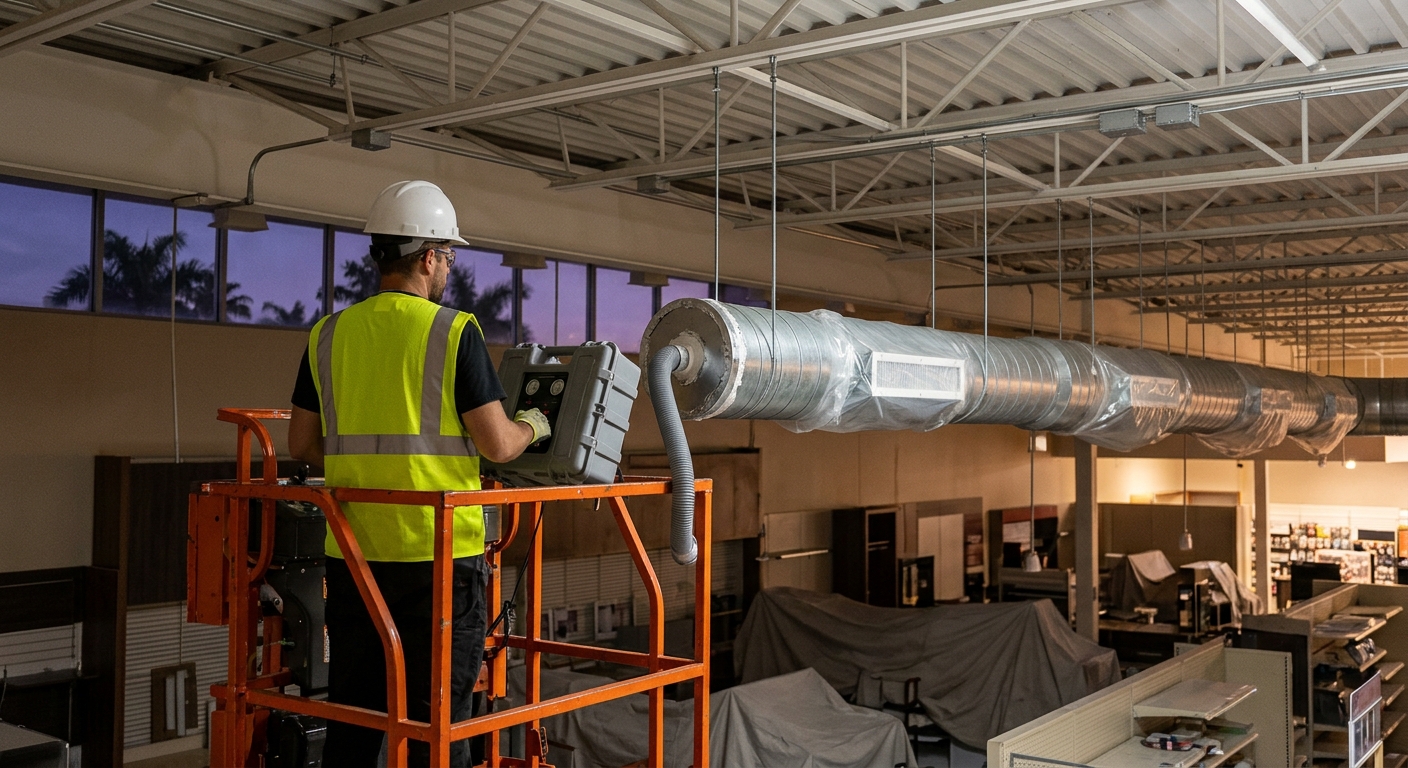
South Florida’s cooler months, roughly November through March, are the practical window for zone shutdowns. Curb and duct joints on the roof sit next to the membrane, so that work is coordinated with the roof warranty holder. Advanced Air Systems has in-house sheet metal, roofing, and crane divisions, which keeps curb sealing, duct fabrication, and roof work under one contractor. A single small suite with dusty grilles and no complaints does not need a duct program; a filter and register cleaning visit is enough.
What does the Florida Building Code require for commercial duct sealing and leakage testing?
As of November 3, 2026, the Florida Building Code, Energy Conservation, 8th Edition (2023) sets commercial duct sealing and testing requirements in Table C403.2.9.2. For high-pressure systems designed to operate above 3 inches water gauge (the 4-inch pressure class), the tested leakage class at the design pressure must be Leakage Class 6 or lower under the SMACNA HVAC Air Duct Leakage Test Manual, and testing may be limited to representative sections. Lower-pressure metal duct must still be sealed with the closure systems the code lists.
The Florida Building Code, Mechanical, 8th Edition classifies ducts by operating pressure from 0.5 to 10 inches of water column and points leak testing to the Energy Conservation volume. LBNL found few specifications require testing low-pressure duct, so owners who want it tested should write it into the scope. The 9th Edition (2026), based on the 2024 International Codes, takes effect December 31, 2026, and the mechanical engineer should state which edition governs the permit. In Miami-Dade and Broward, rooftop curbs also fall under High-Velocity Hurricane Zone provisions, and the building official decides code questions.
Commercial duct sealing South Florida checklist: who owns each decision?
- Property or facility manager: Log comfort, humidity, and dust complaints by zone for a month, and pull past test and balance reports and any duct test results.
- Mechanical engineer: Identify duct pressure classes, state the leakage class and test sections in the specification, and review whether sealing will change ventilation or humidity behavior.
- Test and balance agency or testing firm: Test representative sections by the SMACNA method before and after sealing, and report test pressure, leakage class, and building pressure.
- HVAC contractor: Inspect rooftop curbs and accessible joints, propose sealing or replacement by location, and include retesting in the price.
- NADCA-certified cleaning contractor (only where inspection supports cleaning): Document the inspection, maintain containment and negative pressure, and verify cleanliness by the method the specification names.
- Remediation consultant (if mold is found): Write the remediation scope and decide which lined duct is replaced.
- Roof warranty holder: Approve work at curbs and roof penetrations before it starts.
- Owner or asset manager: Approve a scope only after a test result and an inspection report exist, and require post-work test data at close-out, verified through commissioning after a retrofit where equipment also changed.
Frequently Asked Questions
How often should commercial ductwork be cleaned?
There is no fixed interval in the industry standard. NADCA’s commercial checklist recommends inspecting commercial air handlers and supply and return duct each year and cleaning when inspection finds debris, microbial growth, or other contamination. A cleaning contract with no inspection report behind it pays for a schedule rather than a finding.
What is duct leakage testing for commercial buildings?
Duct leakage testing seals the openings on a section of ductwork, pressurizes it with a calibrated fan, and measures the airflow needed to hold the test pressure. The result is converted to a leakage class under the SMACNA HVAC Air Duct Leakage Test Manual and compared with the code or project specification. The report should state test pressure, duct surface area, measured leakage, and pass or fail per section.
Is commercial duct cleaning worth it?
It is worth it when an inspection documents contamination, such as visible debris, microbial growth, pest material, or construction dust. It is a weak purchase for energy savings alone, and EPA’s guidance, written for homes, notes little evidence that cleaning only the ducts improves efficiency. Before signing, ask for inspection photos, the negative-pressure plan, and the cleanliness verification method.
Does duct sealing lower humidity in a Florida building?
Usually, because return leaks in attics and chases pull humid air into the system and supply leaks to the outdoors can depressurize the building. The result is not automatic. In one FSEC-monitored Florida building, indoor humidity rose from 72 to 76 percent after duct repair and fell to 58 percent only after an attic exhaust fan was shut off. Have the engineer review humidity control before and after sealing.
Does Florida code require duct leakage testing on commercial buildings?
For high-pressure systems, yes. As of November 2026, Table C403.2.9.2 of the 8th Edition Florida Building Code, Energy Conservation, requires ducts designed above 3 inches water gauge to test at Leakage Class 6 or lower on representative sections by the SMACNA method. Owners who want low-pressure duct tested should write it into the scope. The 9th Edition takes effect December 31, 2026, so confirm the governing edition with your engineer.
Test the ducts before paying to clean them
The evidence supports a test-first order. Florida field studies found commercial duct leakage common and costly in cooling energy and humidity, while the case for cleaning rests on inspection findings rather than energy savings. A leakage test and a NADCA-style inspection show whether a building needs sealing, cleaning, replacement of lined duct, or nothing yet. Aerosol sealing leaves large gaps for manual repair, tighter ducts can change humidity behavior, and cleaning closes no leaks. A scope built on measured results, with retesting at close-out, is one a board can defend. Owners can reach our commercial HVAC contractor in Fort Lauderdale, commercial HVAC services in Miami, and West Palm Beach and Jupiter commercial HVAC teams.
Written by The Technical Team at Advanced Air Systems. Established in 1994, Advanced Air Systems is 100% employee-owned and a division of Advanced Roofing Inc., serving occupied commercial buildings across South Florida.
To schedule a duct and rooftop curb inspection or price duct repair for your building, request a free quote or call (954) 332-1418.