
At a glance: Commercial HVAC energy efficiency upgrades cut operating costs most reliably when they follow a sequence: find and fix operating faults, reduce the load, upgrade fans and controls, then replace equipment at a size the reduced load supports. This guide explains where HVAC energy goes in a Florida building, compares the main upgrade types with their limits, lists the variables that set payback, covers work in an occupied building and the 2026 incentive and code dates, and ends with a checklist assigned by role.
The commercial HVAC energy efficiency upgrades that lower a Florida building’s operating costs most reliably are usually the least glamorous ones, done in order: correcting how the existing system runs, cutting the load it serves, and fixing fans and controls before any new equipment is sized. Owners who start with replacement and skip that sequence often buy a high-efficiency unit sized to an old, inflated load, then pay for it in short cycling, humidity complaints, and savings that never appear on the utility bill. With the federal 179D deduction closed to projects that began construction after June 30, 2026, there is also less outside money to absorb a mistake. This article lays out the sequence and the evidence behind it; it does not replace an energy audit and promises no specific savings figure for any building.
Why are commercial HVAC energy efficiency upgrades worth re-ranking in 2026?
HVAC is one of the largest controllable operating costs in a commercial building, and in Florida nearly all of it is paid in electricity. The U.S. Energy Information Administration’s summary of its 2018 Commercial Buildings Energy Consumption Survey reports that electricity supplied 69 percent of commercial building energy use in the South Census Region, compared with 60 percent nationally, and that ventilation alone accounted for about 10 percent of total commercial building energy use. Packaged equipment carries much of that load. The U.S. Department of Energy’s Better Buildings rooftop unit toolkit states that packaged units, including rooftop units (RTUs), serve more than half of U.S. commercial floor space.
Three dated changes now shape how a Florida owner ranks the options. The federal 179D deduction for energy-efficient commercial building property no longer applies to property whose construction begins after June 30, 2026, according to the Department of Energy’s 179D program page. Florida Power & Light’s Business HVAC Program Standards, effective September 1, 2025, tie commercial rebates to equipment that exceeds Florida Building Code requirements and calculate the larger rebates per kilowatt of summer peak demand removed. And DOE’s confirmation notice in the Federal Register sets January 1, 2029 as the compliance date for new minimum efficiency standards on air-cooled commercial package air conditioners and heat pumps of 65,000 Btu/h and larger. As of October 2026, an upgrade plan has to account for all three.
Where does a Florida building’s HVAC energy actually go?
Most HVAC energy in a commercial building is spent by compressors and fans running longer, harder, or for more hours than the occupants need. In a hot, humid climate the cooling coil does two jobs at once: it lowers air temperature, the sensible load, and condenses water out of the air, the latent load. Outdoor air brought in for ventilation carries a heavy latent load for much of the Florida year, so every cubic foot of ventilation air beyond what the code and the occupants require costs compressor energy on both counts.
Waste builds up quietly between service visits. Economizer dampers stick, sensors drift out of calibration, schedules get overridden and never reset, supply fans run at full speed around the clock, and coil condition and refrigerant charge degrade. ENERGY STAR’s Building Upgrade Manual places retrocommissioning first in its five-stage upgrade sequence for this reason, and it notes that many existing HVAC systems are oversized to begin with. Oversizing costs more in Florida than in most places. A unit that satisfies the thermostat quickly shuts off before the coil has removed enough moisture, and EPA’s guidance on moisture and mold in buildings recommends keeping indoor relative humidity below 60 percent.
| Waste mechanism | What the facility team sees | Upgrade that addresses it |
|---|---|---|
| Controls and schedule drift | Units running nights and weekends; zones fighting each other | Retrocommissioning; reset schedules, setpoints, and sequences |
| Constant-speed supply fans | Fan energy flat regardless of occupancy | Multi-speed or variable-speed fan control |
| Excess ventilation air | Humid spaces and high bills in mild months | Demand-controlled ventilation; energy recovery where the design allows |
| Failed or misapplied economizer | Damper stuck open or shut; unexplained humidity or energy use | Repair and recalibrate, or have the engineer confirm whether it should operate in this climate |
| Oversized or aging equipment | Short cycling, clammy spaces, repeated compressor repairs | Right-sized replacement after load reduction |
| Degraded coils and charge | Rising run hours for the same weather | Preventive maintenance and coil cleaning |
Which commercial HVAC energy efficiency upgrades pay off first?
The commercial HVAC upgrades that most often pay off first are retrocommissioning, which fixes how existing equipment runs; controls retrofits on rooftop units, such as fan speed control and demand-controlled ventilation; variable frequency drives on pumps and fans; and a maintained preventive program. Equipment replacement comes after those steps, sized to the reduced load.
The evidence for that order comes from national laboratory data. Lawrence Berkeley National Laboratory’s meta-analysis of 643 commissioned buildings found median whole-building energy savings of 16 percent in existing buildings, at a median cost of $0.30 per square foot and a median payback of 1.1 years, in 2009 dollars. For rooftop units with service life left, Pacific Northwest National Laboratory field-tested an advanced controls retrofit on 66 RTUs in eight buildings. Normalized annual RTU energy use fell by 22 to 90 percent, with an average of 57 percent, and the laboratory’s project report attributes much of the savings to fan energy.
Those are study results, not predictions for a particular building. The PNNL field test covered four building types in four climates, and Florida results will differ with run hours, fan size, ventilation rates, and how much the existing controls already do. The table below sets each upgrade against its published evidence and its limits.
| Upgrade | What it changes | Published evidence | Where it falls short |
|---|---|---|---|
| Retrocommissioning | Schedules, setpoints, sequences, sensor calibration, damper operation | LBNL: 16% median whole-building savings, existing buildings (2009) | Savings fade without recommissioning and trend monitoring; does not fix failing equipment |
| RTU advanced controls retrofit | Multi-speed fan control, integrated economizer control, demand-controlled ventilation | PNNL field test: 22–90% RTU energy reduction, 57% average | Needs units with remaining life and compatible controls; smaller benefit on short-runtime units |
| Demand-controlled ventilation | Outdoor air matched to occupancy, typically by CO2 sensing | Part of the PNNL control package above | Sensors need upkeep; little gain in spaces with steady high occupancy; must still meet ventilation code |
| VFDs on pumps and fans | Motor speed matched to load | FPL rebates VFDs on HVAC pumps, up to $1,600 per summer kW reduced (2025 standards) | Little benefit on constant-load systems; motor compatibility must be checked |
| High-efficiency equipment replacement | New RTUs, VRF, or chillers | FPL rebates equipment that exceeds Florida Building Code minimums | Highest first cost; an oversized selection erodes savings and humidity control |
| Preventive maintenance | Coils, filters, belts, charge, condensate drains | ENERGY STAR treats tune-ups as part of retrocommissioning | Preserves efficiency; does not change the system design |
Advanced Air Systems performs commercial HVAC retrofits, including curb adaptors, ductwork, and technology enhancements, as well as commercial AC unit change-outs when replacement is the right call. Chilled-water buildings follow the same order at a larger scale: verify plant sequences, pump operation, and tower performance through chiller and cooling tower services before pricing a new machine. The equipment decision itself is covered in our guide to upgrading to an energy-efficient chiller system.
A contractor organized around multi-unit, occupied commercial buildings is also not the best value for every job. A single small-office split system with a thermostat problem rarely needs a commissioning study or a crane, and a local service technician may be the more economical choice.
What drives the cost, savings, and payback of an HVAC upgrade?
Payback on an HVAC efficiency upgrade is set by a handful of variables, and a proposal that does not state them cannot be compared with another. Advanced Air Systems does not publish pricing, and no national figure substitutes for a site assessment of the actual equipment and tariff.
| Variable | Why it moves the result | Source |
|---|---|---|
| Annual run hours | Savings scale with operating hours; PNNL found paybacks under 3 years at $0.05/kWh for RTUs larger than 53 kW running more than 14 hours a day | PNNL field evaluation |
| Utility rate and demand | Savings are valued at the building’s own tariff; peak-demand reductions earn FPL rebates per summer kW | FPL Program Standards (Sept. 1, 2025) |
| Starting condition | A poorly operated system has more to recover than a well-run one | LBNL commissioning assessment |
| Load reduced before replacement | Smaller loads support smaller, lower-first-cost equipment | ENERGY STAR Building Upgrade Manual |
| Rebate paperwork and timing | FPL requires AHRI certificates, invoices, and installation photos; equipment must run during summer on-peak hours (3–6 p.m. weekdays, June 1–Sept. 30) | FPL Program Standards |
| Tax treatment | 179D unavailable for property whose construction begins after June 30, 2026 | DOE 179D page |
Round projected savings down until they have been measured. The most defensible proposals set a baseline from a full year of utility bills or interval data, state the assumptions behind each savings estimate, and commit to trend logging after the work so the result can be verified against weather and occupancy.
What changes when the upgrades happen in an occupied Florida building?
Most efficiency upgrades in Florida commercial buildings happen while tenants, students, patients, or residents are inside, so the work plan matters as much as the measure list. Controls changes and economizer repairs are scheduled for nights or weekends, tested zone by zone, and trended for at least a week before the next change, so one bad sequence never reaches the whole building. Building operators should know which setpoints changed and why; otherwise the old overrides come back within a season.
Humidity is the test that matters in Florida. Every ventilation, fan-speed, and setpoint change should be checked against indoor relative humidity readings, because a fan slowed for energy savings or an outdoor air damper opened too far can push a space past EPA’s 60 percent guidance within days. Equipment replacements add crane picks, curb work, and shutdown windows, and our article on planning a commercial HVAC project in South Florida covers that sequence in detail.
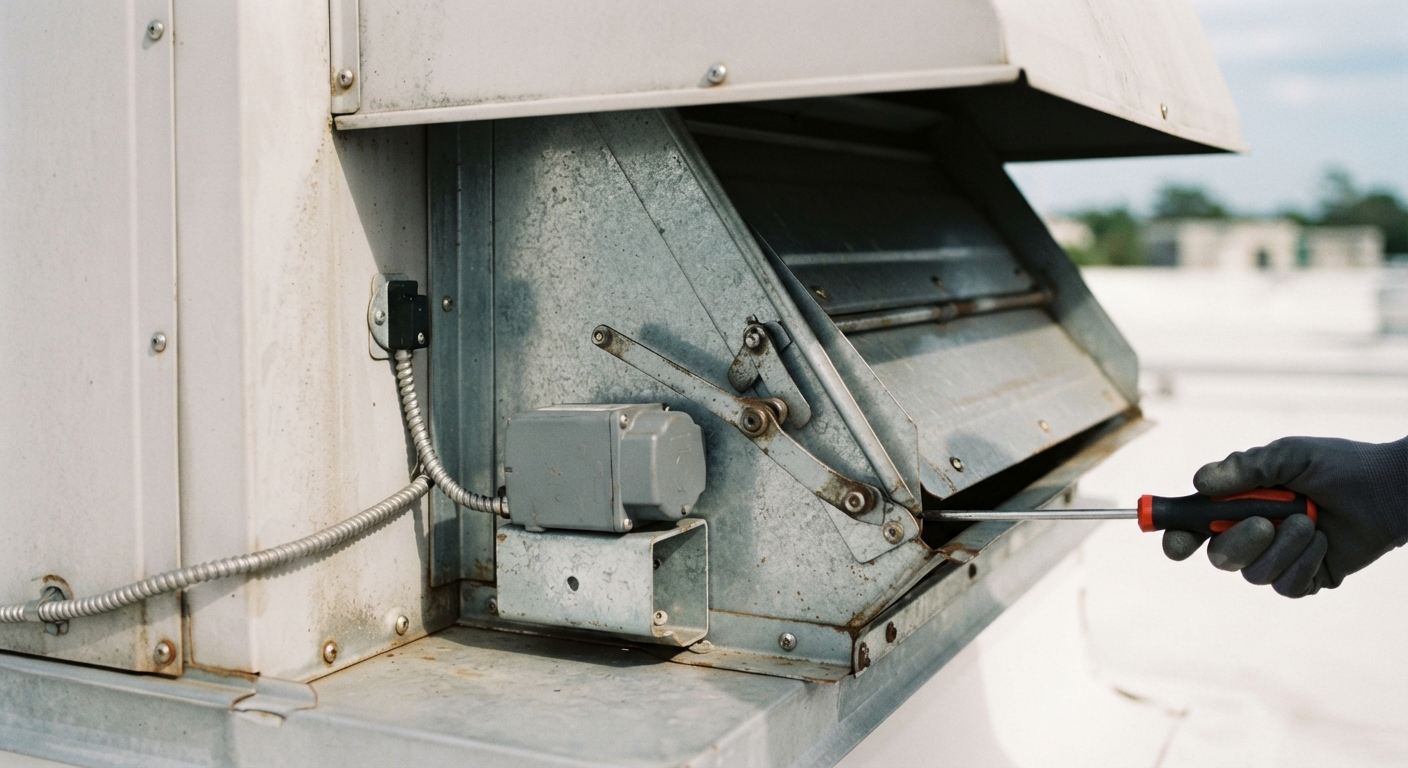
The roof is part of the HVAC load. A reflective roof surface lowers heat gain through the deck, and our sister company describes how reflective roof coatings reduce heat absorption on the Advanced Roofing site. Because Advanced Air Systems is a division of Advanced Roofing Inc. with in-house divisions for roofing, sheet metal, and crane work, curb changes and roof penetrations can be coordinated under one project team. A roofing contractor should still assess the roof’s remaining service life before new rooftop equipment goes on. The Atlantic hurricane season runs June 1 through November 30, and open curbs or staged equipment during those months need a written storm plan.
Which 2026 deadlines and code dates affect HVAC efficiency upgrades?
Four dates belong in the project schedule, each current as of October 2026 and each worth re-checking before contracts are signed. The 179D deduction is closed to property whose construction begins after June 30, 2026; projects that began on or before that date follow the rules on DOE’s 179D page, and only a tax advisor can confirm whether a specific project qualifies. FPL rebates require equipment that exceeds Florida Building Code efficiency requirements, and FPL’s Business HVAC program page asks customers to contact a program specialist before installing. Other Florida utilities run their own programs, so check the program for the building’s actual utility.
The Florida Building Code, 9th Edition (2026), takes effect December 31, 2026, and Miami-Dade County’s permitting notice states that permit applications and plans submitted on or after that date must comply with the new edition, including its Mechanical and Energy Conservation volumes. DOE’s January 1, 2029 compliance date for large air-cooled package units will shape what manufacturers ship during the next replacement cycle. Whether a given building triggers a code path, a rebate, or a deduction is a determination for the engineer of record, the building official, the utility, and the tax advisor.
Commercial HVAC efficiency upgrade checklist: who owns each step?
- Owner or asset manager: Set the ownership horizon and the decision metric, such as payback or net present value, before requesting proposals.
- Facility or property manager: Gather a year of utility bills, run-hour data, and humidity complaints by zone, and share them with every bidder.
- Engineer or commissioning provider: Run retrocommissioning first and deliver a findings list with estimated savings and the assumptions behind each.
- HVAC contractor: Price controls retrofits, demand-controlled ventilation, and VFDs for equipment with remaining life, and name the units that should be replaced instead, with the reason.
- Mechanical engineer: Recalculate sensible and latent loads after the first stages, then size any replacement equipment to the new load.
- Facility manager and utility program specialist: Confirm rebate eligibility and required documentation before equipment is ordered.
- Tax advisor: Confirm whether any project component began construction in time for 179D.
- Roofing contractor: Report the remaining service life of the roof under the equipment before curb work is scheduled.
- Owner: Require trend logs, close-out documents, and a preventive maintenance program so the savings persist.
Frequently Asked Questions
What are the best energy efficiency upgrades for commercial HVAC systems?
The upgrades with the strongest published record are retrocommissioning, controls retrofits on rooftop units, demand-controlled ventilation, and variable frequency drives on pumps and fans. Lawrence Berkeley National Laboratory found 16 percent median whole-building savings from commissioning existing buildings, and a PNNL field test of rooftop controls retrofits averaged 57 percent RTU energy savings. Equipment replacement belongs after those steps, sized to the reduced load, and results depend on run hours, rates, and starting condition.
Is it better to retrofit or replace commercial rooftop units?
Retrofit when the unit has years of service life left, its compressor and coils are sound, and its controls can accept fan speed control and demand-controlled ventilation. Replace when the unit has repeated compressor failures, corroded coils or cabinet, or a capacity that no longer fits the load. A condition survey of each unit, followed by a load calculation from the mechanical engineer, settles the question unit by unit.
How much can a commercial building save with HVAC efficiency upgrades?
No single percentage applies to every building. Published results range widely, from a 16 percent median whole-building saving for commissioned existing buildings in LBNL’s database to 22 to 90 percent RTU energy reductions in PNNL’s controls field test. Savings depend on operating hours, utility rates, ventilation requirements, and how far the system has drifted. A measured baseline and post-project trend data are the only reliable way to state a building’s result.
Does FPL offer rebates for commercial HVAC upgrades?
As of October 2026, FPL’s Business HVAC Program offers rebates on qualifying chillers, direct-expansion systems, and variable frequency drives on HVAC pumps under program standards effective September 1, 2025. Equipment must exceed Florida Building Code efficiency requirements and operate during FPL’s summer on-peak hours, and rebates require documentation such as AHRI certificates. Confirm eligibility with an FPL program specialist before ordering; customers of other utilities should check their own utility’s programs.
Can energy efficiency upgrades make humidity worse in a Florida building?
Yes, if they are made without checking humidity. Slowing supply fans, raising setpoints, increasing outdoor air, or installing oversized equipment can each reduce how much moisture the cooling coil removes. EPA recommends keeping indoor relative humidity below 60 percent. Trend humidity alongside energy after every change, and have the mechanical engineer account for latent load before any equipment is resized.
Sequence the upgrades first, then size the equipment
Commercial HVAC energy efficiency upgrades pay back most reliably in Florida when they follow the order the evidence supports: correct how the system runs, reduce the load, upgrade fans and controls, and only then select new equipment at the size the building now needs. National laboratory data show large savings from the early steps, and the closing of 179D for new projects makes each dollar of verified savings worth more than a projected one. A plan that tracks humidity alongside energy, documents rebate eligibility before ordering, and measures the result afterward will hold up when it reaches an owner or a board. Local service details are on our commercial HVAC services in Miami page.
Written by The Technical Team at Advanced Air Systems. Established in 1994, Advanced Air Systems is 100% employee-owned and a division of Advanced Roofing Inc.
Request a free HVAC assessment through our free quote page or call (954) 332-1418.