At a glance: A commercial HVAC retrofit upgrades fans, controls, drives, and coils on equipment that still has service life, and in South Florida it pays best on long-running rooftop units and chilled-water plants. This guide explains what wears out on aging systems, which retrofit measures have field evidence behind them, why economizers save little in climate zone 1A, how EPA’s 2026 refrigerant rules treat repairs, which costs and utility rules to pin down, and a role-by-role checklist for deciding whether to retrofit or replace.
A commercial HVAC retrofit South Florida owners can defend begins with one test: whether the existing equipment has enough service life left to carry the investment. Where compressors, coils, and cabinets are sound, targeted upgrades to fan control, ventilation control, commissioning, and coil protection can lower operating cost and fix comfort complaints for far less than a change-out budget. Where the equipment is failing mechanically, retrofit money buys a few seasons and a second project, and a replacement chosen without a load review can carry the original humidity problem into a new unit. This article covers where retrofits pay in Florida’s humid climate and where they fall short; it does not size equipment or make code determinations, which belong to the building’s mechanical engineer and building official.
Why is the retrofit question sharper for South Florida buildings in 2026?
A retrofit upgrades the parts of an existing HVAC system that drive energy use and comfort, such as controls, fans, drives, and coils, while the compressors and refrigerant circuit stay in service. Two federal sources make that distinction worth money in 2026. EPA’s Technology Transitions table of HFC restrictions, last updated August 28, 2026, restricts the installation of new residential and light commercial air-conditioning systems that use refrigerants above 700 GWP, and it states that components used to repair existing systems are not subject to those installation restrictions. A building that keeps a sound R-410A unit in service can keep repairing and upgrading it, so the line between repairing an existing system and installing a new one decides which rules apply. Each item in a retrofit scope should say which side of that line it falls on.
The second source is sequencing guidance. EPA’s ENERGY STAR Building Upgrade Manual recommends a five-stage order for existing buildings: retro-commissioning, lighting, supplemental load reductions, air distribution, and the heating and cooling plant last. Each earlier stage reduces the cooling load, and the manual notes that many existing HVAC systems are oversized to begin with, so a plant decision made after the load drops is often a smaller one. On the code side, the Florida Building Code, 9th Edition (2026) takes effect December 31, 2026, so a retrofit permitted near the turn of the year should confirm which edition its submittals follow.
What is actually wearing out on an aging South Florida rooftop unit?
Aging commercial air-conditioning equipment rarely fails all at once; it loses capacity and control in stages, and each stage points to a different fix. A packaged rooftop unit in Broward or Miami-Dade runs for most of the year, so its supply fan, compressors, and condenser coil accumulate far more operating hours than the same unit would in a northern climate. Many older units run the supply fan at one constant speed whenever the building is occupied. That fan moves full airflow and conditions full ventilation air even when the space needs a fraction of it.
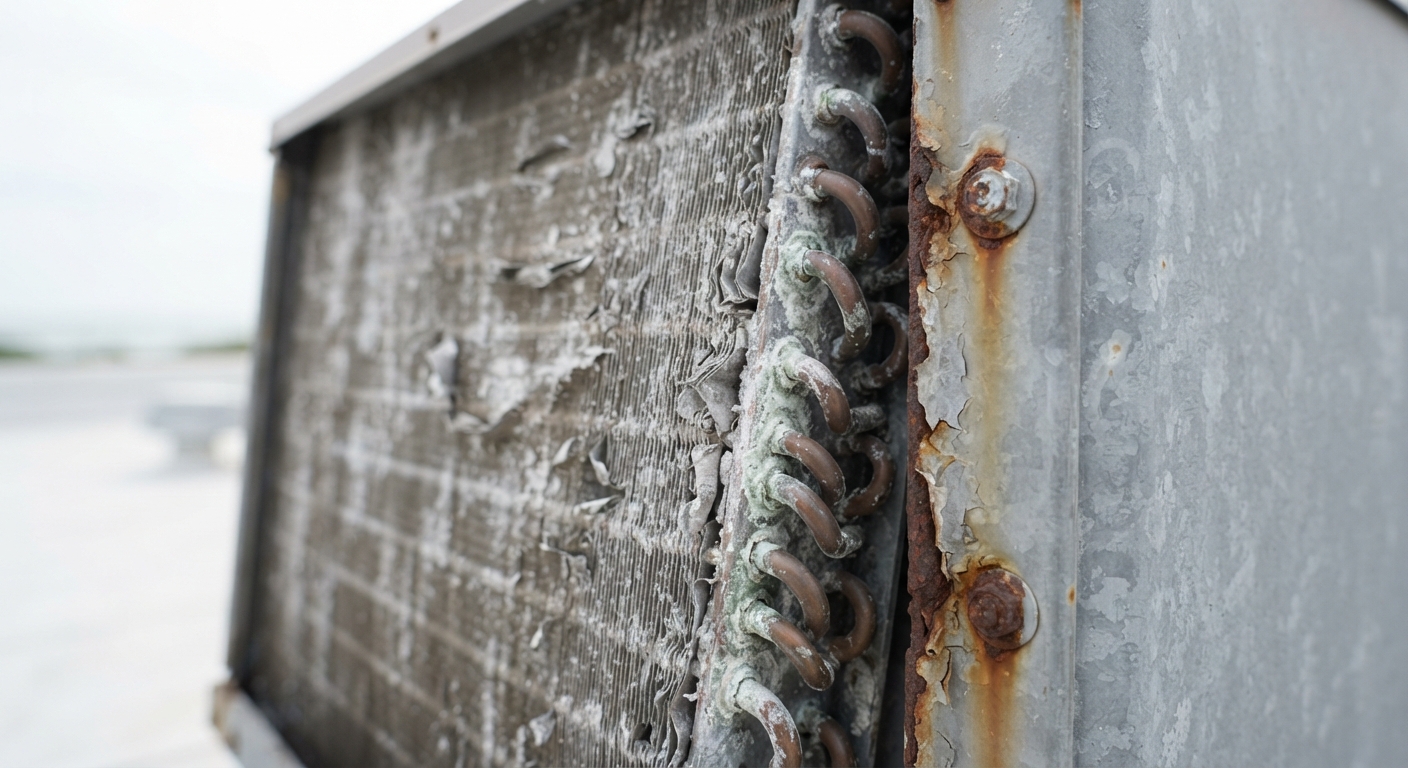
Moisture is the second mechanism. Outdoor air in South Florida carries a heavy latent load, and a cooling coil removes that moisture only while it runs cold enough, and long enough, for condensate to form and drain. Coastal exposure adds the third. Salt air attacks condenser fins and cabinet fasteners, and a coil with corroded or flattened fins rejects heat poorly, which raises head pressure and compressor work. Advanced Air Systems’ current conditions reports for rooftop units describe the unit-by-unit inventory that separates these conditions before anyone prices a solution.
| Condition | What is happening physically | Retrofit response | Points toward replacement when |
|---|---|---|---|
| Constant-speed supply fan | Full airflow and full ventilation air every occupied hour | Multi-speed or variable fan control; demand-controlled ventilation | Fan motor, bearings, and cabinet are at end of life |
| Persistent humidity complaints | Coil cycles off before removing enough moisture; ventilation air adds latent load | Controls tuning, ventilation reset, dedicated dehumidification where the engineer specifies it | Load review shows the unit is badly oversized for current use |
| Corroded condenser coil | Salt air degrades fins and tube joints; heat rejection drops | Coil cleaning, coil replacement, protective coating | Corrosion has reached the base pan, curb, or refrigerant joints |
| Repeated compressor failures | Mechanical wear on end-of-life equipment | Limited; a new compressor on a failing unit buys time | Two or more major failures, or refrigerant leaks that recur |
| Controls drift | Setpoints, schedules, and sensors no longer match the building | Retro-commissioning and sensor replacement | Controls are proprietary and no longer supported |
Which commercial HVAC retrofit South Florida measures pay in a humid climate?
Advanced rooftop unit controls are the best-documented retrofit for packaged equipment. Pacific Northwest National Laboratory field-tested a commercial retrofit controller on 66 rooftop units across eight buildings, combining multi-speed fan control, economizer control, and demand-controlled ventilation, and normalized annual rooftop unit energy fell by 22% to 90%, with an average of 57%. The PNNL report on the same field test found that fan energy made the dominant contribution to those savings. The test buildings were outside Florida, so the economizer share of the results does not transfer to Miami.
That caveat matters because economizers, which bring in cool outdoor air in place of compressor cooling, have little to work with here. ASHRAE Standard 90.1’s economizer table sets no economizer requirement in climate zones 0A through 1B, and DOE’s Building America climate guide places Miami-Dade, Broward, and Monroe counties in zone 1A, with Palm Beach County in zone 2A, where requirements differ. In Broward and Miami-Dade, the fan-speed and ventilation-control parts of an advanced controller do the work. Whether to keep, repair, or seal an existing economizer is a decision for the mechanical engineer.
Retro-commissioning is the low-cost first step for buildings with central plants or building automation. Lawrence Berkeley National Laboratory’s review of commissioning projects found median whole-building energy savings of 16% in existing buildings, at a median cost of $0.30 per square foot in 2009 dollars and a median payback of 1.1 years. Those figures are medians across many building types and climates; they describe what commissioning has found, and no single building should budget on them. On chilled-water plants, Advanced Air Systems’ chiller and cooling tower services cover the drive, pump, and tower work that commissioning findings often call for.
| Retrofit measure | What it changes | Best fit | Where it falls short |
|---|---|---|---|
| Advanced RTU controls (multi-speed fan, DCV) | Fan speed and ventilation follow actual load | Constant-volume rooftop units with long run hours | Field evidence comes from outside Florida; economizer savings are small in zone 1A; ventilation must still meet code |
| Retro-commissioning | Setpoints, schedules, sequences, and sensors | Buildings with automation, chillers, or many zones | Savings fade without ongoing maintenance; it finds problems but does not fix worn equipment |
| VFDs on chiller-plant pumps and tower fans | Motor speed follows load | Chilled-water plants with constant-speed pumps | The plant and chiller must tolerate variable flow; the engineer confirms compatibility |
| Condenser coil replacement and coating | Restores heat rejection; slows corrosion | Coastal units with sound compressors | Adds no capacity and does not fix sizing; coating quality and coverage vary |
| Conversion to VRF or new packaged units | Replaces the refrigerant system | End-of-life equipment or major renovation | This is a replacement, with new-system refrigerant rules and a higher first cost |
Advanced Air Systems’ commercial air-conditioning retrofit services include curb adaptors, custom ductwork, exhaust fans, equipment relocation, and controls upgrades. A contractor organized around multi-unit, occupied buildings is not the right fit for every job. A single small office unit with a failed thermostat needs a service call, and a building whose units are all past their service life needs a replacement plan, handled through commercial AC unit change-outs. For owners weighing a move to variable refrigerant flow, Advanced Air Systems was named a Daikin VRV Pro Contractor in October 2016.
What drives the cost, schedule, and results of an HVAC retrofit?
Retrofit pricing depends on the equipment inventory more than on square footage, and Advanced Air Systems does not publish prices. Published savings figures, including the averages above, depend on run hours, utility rate, equipment size, and the condition of what is being retrofitted. PNNL’s field study reported that units larger than 53 kW of cooling capacity running more than 14 hours a day had paybacks under three years even at an electricity price of $0.05 per kWh, which ties the fastest returns to large units with long daily schedules.
| Driver | Why it moves the result | How to pin it down before award |
|---|---|---|
| Run hours per year | Fan and ventilation savings scale with operating hours | Trend data or automation schedules by zone |
| Equipment size and count | Fixed cost per unit against savings per ton | Unit inventory with tonnage, age, and refrigerant |
| Remaining service life | A retrofit’s value ends when the unit fails | Condition report and compressor history per unit |
| Utility tariff and demand charges | Sets the value of each kWh and kW saved | 12 months of bills and the tariff name |
| Utility program rules | Can offset part of eligible equipment cost | FPL program standards checked before ordering |
| Access and crane needs | Rooftop work may need lifts, picks, or after-hours labor | Site walk and pick plan |
Florida Power & Light’s Business HVAC Program Standards, effective September 1, 2025, cover commercial customers installing high-efficiency chillers, packaged and split DX systems, and variable frequency drives on HVAC pumps, in new construction or retrofit installations. The program requires new equipment that exceeds Florida Building Code efficiency levels and calculates most incentives on summer peak kW reduction. FPL sets eligibility and amounts, so confirm any incentive in writing before purchase and leave it out of the base budget.
What changes when the building stays open during a retrofit?
Most commercial HVAC retrofits in South Florida happen in buildings that keep operating, and retrofit work has one advantage there: much of it happens inside an existing cabinet or control panel. A controls or drive retrofit takes one unit offline at a time, so zones can be sequenced, and the outage window for each unit should be stated in the proposal. Spaces that cannot lose cooling, such as server rooms, medical suites, and food service, get temporary cooling or after-hours work.
Advanced Air Systems is a division of Advanced Roofing Inc., and the company’s in-house divisions include roofing, sheet metal, cranes, and lightning protection. On a retrofit that touches the roof, such as a coil replacement that needs a pick or a curb that needs new flashing, one project team can schedule the lift, protect the membrane, and coordinate with the roof warranty holder. The pre-project planning steps for commercial HVAC work in South Florida in an earlier article apply to any retrofit that moves equipment.
Tenant communication follows the same order as the work. Each zone’s outage window is posted before it starts, and the property manager receives a daily note on what was completed. Hurricane season runs June 1 through November 30, so rooftop work during those months needs a written plan for securing loose panels, tools, and staged equipment if the National Hurricane Center issues a watch.
Which code, refrigerant, and incentive rules apply to a retrofit in 2026?
As of October 2026, three sets of rules shape a retrofit scope. On refrigerants, EPA’s sector table lists January 1, 2025 as the installation compliance date for new residential and light commercial systems above 700 GWP, with no installation date for systems whose specified components were all manufactured or imported before that date, and separate dates for variable refrigerant flow systems. Repair components for existing systems fall outside those installation restrictions.
On energy code, the Florida Building Code, Energy Conservation, 8th Edition (2023) exempts existing buildings unless they qualify as renovated buildings, which the code ties to alterations costing more than 30% of the structure’s assessed value. Collier County’s chief building official interprets that provision to exempt mechanical change-outs below the 30% threshold, and other counties publish their own interpretations. Whether a retrofit triggers energy code compliance, and which edition governs after the 9th Edition takes effect, is a determination for the building official and the engineer of record. Rooftop equipment that is moved or re-curbed in Miami-Dade and Broward also falls under High-Velocity Hurricane Zone attachment provisions.
Retrofit or replace: a checklist for the people who decide
The checklist below assigns each decision to the person who can make it. That way the recommendation that reaches an owner or board arrives with its evidence attached.
- Facility or property manager: Pull 24 months of service tickets and comfort complaints by zone, and list each unit’s age, tonnage, and refrigerant.
- HVAC contractor: Provide a condition report per unit covering compressor history, coil condition, cabinet and curb corrosion, and fan motor status.
- Mechanical engineer: Review cooling and latent loads, ventilation rates, and whether each unit is sized for current use before any measure is specified.
- Mechanical engineer and contractor: Sort units into retrofit, monitor, and replace groups, and state the expected remaining service life behind each call.
- Owner or asset manager: Compare the retrofit cost per unit against that unit’s remaining life and the replacement budget it defers.
- Property manager: Confirm FPL program eligibility in writing before any equipment is ordered.
- Building official: Confirm permit requirements and whether energy code provisions apply to the scope.
- Owner: Require post-retrofit trend data so savings are measured, and enroll the equipment in a preventive maintenance program so commissioning gains hold.
Frequently Asked Questions
What is a commercial HVAC retrofit?
A commercial HVAC retrofit upgrades parts of an existing system, such as fan controls, drives, ventilation controls, sensors, or coils, while the compressors and refrigerant circuit stay in service. Its purpose is to lower operating cost or fix comfort problems on equipment that still has useful life. Once the refrigerant system itself is replaced, the project becomes a replacement and follows the rules for new systems.
Is it worth retrofitting a 15-year-old rooftop unit in Florida?
It depends on condition more than age. A 15-year-old unit with sound compressors, an intact coil, and long run hours can be a strong candidate for fan and ventilation controls. The same unit with repeated compressor failures or corrosion reaching the base pan is a replacement candidate. A per-unit condition report and the engineer’s load review should decide it.
Do economizers save energy in Miami and Fort Lauderdale?
Usually very little. Miami-Dade and Broward counties are in climate zone 1A, where ASHRAE Standard 90.1 sets no economizer requirement because outdoor air is rarely cool and dry enough to replace compressor cooling. Palm Beach County is in zone 2A, where requirements differ. The mechanical engineer should decide whether an existing economizer is kept, repaired, or sealed.
Can I keep repairing my R-410A equipment in 2026?
Yes. EPA’s Technology Transitions restrictions apply to installing new systems, and EPA states that components used to repair existing systems are not subject to those installation restrictions. A sound R-410A unit can be serviced and upgraded with controls or drives. Refrigerant cost over the unit’s remaining life belongs in the retrofit-or-replace comparison.
How much energy can advanced rooftop unit controls save?
In PNNL’s field study of 66 rooftop units, advanced controls reduced normalized annual unit energy by 22% to 90%, averaging 57%, with fan energy providing most of the savings. Those buildings were outside Florida. Results depend on run hours, unit size, ventilation needs, and climate, so a measured baseline before installation is the only reliable comparison.
Does an HVAC retrofit require a permit in South Florida?
Many retrofit scopes do, particularly work involving equipment replacement, electrical changes, or rooftop attachment, and the building department makes that call. Energy code applicability depends on whether the project makes the building a renovated building under the Florida Building Code, Energy Conservation. Confirm both with the building official before the schedule is set.
Retrofit the equipment that has life left, and replace the equipment that does not
The evidence points one direction for sound equipment with long run hours. Fan-speed and ventilation controls, retro-commissioning, and coil protection address the largest losses at a fraction of a change-out budget. It points the other way for units with repeated compressor failures or structural corrosion, where retrofit spending delays a replacement the building will fund anyway. Florida’s climate shifts the details: economizer savings are small in zone 1A, and humidity control decides comfort. A unit-by-unit condition report, an engineer’s load review, and a written incentive check turn that judgment into a plan an owner can approve.
Written by The Technical Team at Advanced Air Systems. Established in 1994, Advanced Air Systems is a 100% employee-owned commercial HVAC contractor and a division of Advanced Roofing Inc., with offices in Fort Lauderdale, Miami, and West Palm Beach.
To schedule a condition assessment of your rooftop units or central plant, request a free quote or call (954) 332-1418. Local teams provide commercial HVAC services in Miami and commercial HVAC services in Fort Lauderdale.