
At a glance: Commercial rooftop unit replacement in South Florida is best decided unit by unit, from age, repair history, coil condition and efficiency, before a summer failure forces the choice. This guide covers the signals that point to replacement, how repair, controls retrofit and replacement compare, what drives installed cost, what efficiency gains federal research supports, the refrigerant, DOE and Florida Building Code dates that apply, and how the work runs on an occupied building. It ends with a decision checklist assigned by role.
A commercial rooftop unit replacement in South Florida should be decided from a unit-by-unit inventory of age, repair history, coil condition and efficiency, months before a failure forces the decision. Owners who wait until a compressor fails in August buy whatever equipment is in stock, accept a like-for-like swap that carries old sizing and humidity problems forward, and schedule a crane pick around tenants who already have no cooling. Planned replacement lets the owner choose the refrigerant path, the efficiency level, the curb details and an installation window in the cooler months, and research from the U.S. Department of Energy and Lawrence Berkeley National Laboratory shows that the efficiency gain is real but depends heavily on controls, sizing and installation quality. This article does not argue that every older unit should come off the roof; a unit with service life left and a clean repair history is often worth keeping, and sizing, structural and code determinations belong to the building’s mechanical engineer and building official.
Why does commercial rooftop unit replacement look different in 2026?
Three regulatory calendars now overlap on every South Florida rooftop unit decision. The first is refrigerant. EPA’s Technology Transitions table of HFC restrictions by sector, last updated August 28, 2026, sets a 700 global warming potential (GWP) limit for new residential and light commercial air conditioning systems and, under the reconsideration rule effective July 27, 2026, lists no installation deadline where all components were manufactured or imported before January 1, 2025. Remaining R-410A inventory can still be installed; new production uses lower-GWP refrigerants such as R-454B and R-32.
The second is federal efficiency. DOE’s direct final rule for air-cooled commercial package air conditioners and heat pumps, published May 20, 2024 and confirmed in September 2024, sets minimums in a new metric, integrated ventilation, economizing and cooling (IVEC), for units of 65,000 Btu/h (about 5.4 tons) and larger manufactured on or after January 1, 2029. Units built today meet the January 1, 2023 standard in integrated energy efficiency ratio (IEER).
The third is the building code. The Florida Building Code, 9th Edition (2026) takes effect December 31, 2026, and Miami-Dade County’s permitting notice on the 9th Edition states that permit applications submitted on or after that date must comply with the new edition, so the submittal date belongs in the project schedule. Rooftop anchorage and High-Velocity Hurricane Zone requirements are covered in our guide to planning a commercial HVAC project in South Florida.
How do you know a rooftop unit is due for replacement?
Replace a commercial rooftop unit when it is more than about 10 years old and needs an expensive repair, when salt-air corrosion has spread across the coil and cabinet, when it still runs on R-22, or when the building needs humidity control the old unit cannot deliver. In other cases, a repair or a controls retrofit usually costs less over the next several years.
A packaged rooftop unit wears out in South Florida through four compounding mechanisms. Salt and moisture corrode coil fins and the cabinet, which raises head pressure and makes the compressor work harder on every cycle. Compressors and fan motors wear with run hours, and South Florida buildings cool for most of the year. Refrigerant leaks cut capacity. Older single-speed, constant-volume controls waste fan energy and limit moisture removal.
Published service lives for rooftop units vary widely, and the difference lies in how they are measured. Lawrence Berkeley National Laboratory researchers describe a typical useful life in the 10 to 20 year range, while DOE’s 2024 rulemaking estimates an average equipment lifetime of 21 to 30 years depending on equipment class, a modeled national average that includes units kept running with repairs. Neither figure decides a specific unit; coastal exposure, run hours and maintenance history move each unit along the range.
DOE’s Advanced Rooftop Unit Campaign published a practical screen in its decision guidance on RTU replacement or retrofit. It lists units as replacement candidates when they are more than 10 years old, in poor condition with expensive repairs, unable to deliver needed humidity control, sit in a building undergoing a comprehensive retrofit, or run R-22. Units larger than 7 tons, under 10 years old, with five or more years of life left and constant-speed fans suit an advanced controller retrofit instead.
| Signal on the roof | What is happening physically | What it usually points toward |
|---|---|---|
| Flaking coil fins, rust at the cabinet base | Salt-air corrosion reduces heat rejection and weakens the cabinet and curb seal | Replacement when corrosion is widespread; coil work when it is isolated |
| Repeated compressor failures | Mechanical wear, often accelerated by high head pressure or charge problems | Replacement on end-of-life equipment |
| Rising refrigerant recharges | A leak in the coil or brazed joints | Repair if the leak is found and the unit has life left |
| Humidity complaints at normal temperatures | An oversized or constant-speed unit cycles off before it removes enough moisture | Load review and redesign before any replacement |
| Unit still running on R-22 | Older refrigerant that DOE’s campaign lists as a replacement indicator | A planned replacement before the next major failure |
Repair, retrofit, or replace: which option fits each rooftop unit?
Every rooftop unit has four realistic paths, and a roof with twenty units will usually use more than one of them. Advanced Air Systems performs commercial air conditioning repairs, HVAC retrofits and commercial rooftop unit change-outs, and the comparison below treats each path on its merits, including where it falls short.
| Path | When it fits | Where it falls short |
|---|---|---|
| Repair and keep | The unit has years left, failures are isolated and the coil is sound | Repeated repairs on end-of-life equipment cost more over time, and original sizing errors remain |
| Controls retrofit (advanced controller, variable-speed fan) | Newer, larger units in good condition, per DOE’s campaign screen | Does not fix a corroded coil, a failing compressor or an undersized duct system |
| Like-for-like replacement | Building use is unchanged and the old unit performed well | Carries forward sizing and humidity problems; a new footprint may need a curb adapter |
| Replacement with redesign | Humidity complaints, tenant changes, added load or roof work planned | Engineering time, longer submittals and possible duct and electrical work |
The refrigerant choice sits inside any replacement path. Installing remaining R-410A inventory is allowed under EPA’s current table and can shorten lead time, while servicing that equipment over its life depends on refrigerant supply as the AIM Act phasedown continues. Lower-GWP equipment avoids that exposure and adds installation requirements of its own. The refrigerant transition does not by itself require replacing a working R-410A unit, and lower-GWP equipment can cost more to buy and install.
A contractor organized around multi-unit, occupied buildings is also not the right fit for every job; for a single small unit on a one-story office, a local service contractor’s bid may be the right answer.
What drives the cost and the efficiency gain of a rooftop unit replacement?
Installed cost
Advanced Air Systems does not publish pricing, and the per-ton ranges that dominate search results rarely state the unit size, efficiency, curb condition or crane access behind them, so they cannot be compared to a bid. The installed price turns on the work around the equipment: the crane pick, curb adapters or new curbs, roof flashing, electrical changes, duct repairs, permits and engineering, and after-hours labor. Ask every bidder to price each as a separate line item.
Operating cost is the other half of the budget, and federal sources put numbers on it. The figures below carry their assumptions and dates; none is a forecast for a specific building.
| Figure | Source and date | Assumptions and limits |
|---|---|---|
| Older, inefficient RTUs can waste $1,000 to $3,700 per unit per year | DOE Better Buildings Advanced RTU Campaign, published July 2016 | Varies with building size and type; 2016 equipment baseline and prices |
| An ENERGY STAR commercial AC is cost-effective if priced no more than $2,665 above a less efficient model; the best available model saves up to $3,624 over its life | DOE Federal Energy Management Program guidance, updated June 2024 (2022 dollars) | Federal example unit and federal energy price assumptions; units under 240,000 Btu/h |
| Simple payback for DOE’s 2029 standard levels is shorter than the 21 to 30 year average equipment life | DOE direct final rule, May 20, 2024 | National averages comparing baseline and standard-level new equipment; it does not compare an old unit with a new one |
| 61 percent average daily HVAC energy savings for an RTU replacement package with advanced controls | Lawrence Berkeley National Laboratory, December 2022 | Side-by-side laboratory test against an office baseline; controls drove much of the savings |
Utility incentives can offset part of the premium for higher efficiency. Florida Power & Light’s Business HVAC Program Standards, effective September 1, 2025, list per-unit incentives for packaged direct-expansion systems that exceed Florida Building Code efficiency requirements and require documentation that includes an AHRI certificate. FPL sets the amounts and the eligibility rules, so confirm both before equipment is ordered and treat any incentive as a possible offset until it is approved.
Efficiency gains
The efficiency gain comes from a more efficient compressor and coil, variable-speed fans and staged compressors that perform well at part load, and controls that stop the unit from conditioning air nobody needs. DOE’s Advanced RTU Campaign states that upgrading RTUs can reduce energy use by 30 to 50 percent, and the LBNL study credited ASHRAE Guideline 36 controls as a key contributor to its 61 percent result while recording difficulties commissioning them. A new unit on old ductwork with the old constant-fan schedule captures only part of the savings.
In a humid climate, efficiency and moisture removal pull against each other. DOE’s federal purchasing guidance for light commercial heating and cooling equipment notes that units designed for greater moisture removal perform better in humid climates, and that oversizing, improper charging and leaky ducts cause efficiency losses, occupant discomfort and shorter equipment life. An oversized unit satisfies the thermostat and shuts off before it dries the air. Right-sizing is a load calculation, including latent load, for the mechanical engineer.
What changes when the building stays open during rooftop unit replacement?
Most rooftop unit replacements in South Florida happen above tenants who keep working, so the schedule is built around them. Units come down zone by zone, each outage sized so the new unit is set, connected and started within the window, and server rooms, medical suites and food service get temporary cooling or an after-hours cutover. The property manager receives written notice of every shutdown window before it starts.
The crane pick is the most visible step. Picks over parking lots and entrances are scheduled for early mornings or weekends where the site allows, with the pick zone barricaded. Advanced Air Systems is a division of Advanced Roofing Inc., and its in-house crane division works with the air conditioning, roofing and solar divisions, which removes the scheduling dependency on an outside crane subcontractor.
The curb is where HVAC and roofing meet. A different footprint needs a curb adapter or a new curb, and removing the old unit can expose wet insulation or a damaged membrane. Openings should be watertight the same day, with flashing approved by the roof warranty holder. If the roof is near the end of its life, coordinating the change-out with commercial re-roofing by Advanced Roofing avoids lifting the same equipment twice.
Timing matters as much as sequencing. Summer is when a cooling outage hurts tenants most, and the Atlantic hurricane season described on our hurricane season resource page runs through November 30. Planned replacements scheduled between December and April get cooler weather and shorter outage risk, and the permit date decides which code edition applies.
Which refrigerant, efficiency and code dates apply to a rooftop unit replacement?
Four dates define the regulatory window for a South Florida rooftop unit replacement as of October 2026. Each should be re-checked against its source on the day a contract is signed.
| Rule | Date | What it means for a replacement |
|---|---|---|
| DOE IEER minimums for commercial package AC (65,000 Btu/h and larger) | In force since January 1, 2023 | The current federal floor for any new unit of that size |
| EPA Technology Transitions reconsideration rule | Effective July 27, 2026 | No installation deadline for residential and light commercial systems with all components made or imported before January 1, 2025 |
| Florida Building Code, 9th Edition (2026) | Effective December 31, 2026 | Permit applications submitted on or after that date must comply with the new edition |
| DOE IVEC minimums for commercial package AC | Manufactured on or after January 1, 2029 | IVEC 14.3 for 65,000 to 135,000 Btu/h units with electric or no heat; 13.8 and 12.9 for the larger classes |
Whether a specific unit falls into EPA’s light commercial category, which code edition governs a given permit, and what attachment design the High-Velocity Hurricane Zone requires in Miami-Dade and Broward are determinations for the equipment manufacturer, the engineer of record and the building official.
Rooftop unit replacement checklist: who owns each decision?
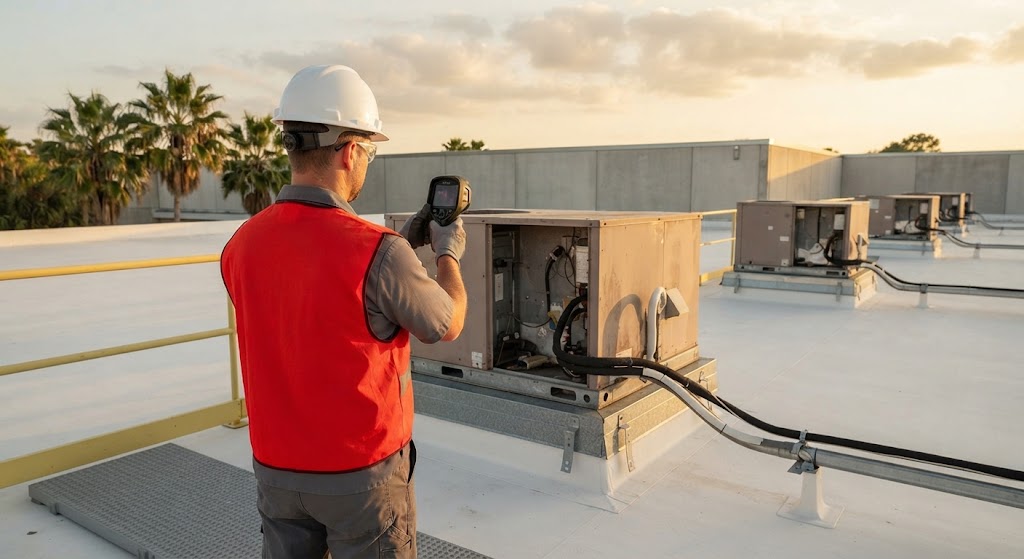
- Facility or property manager: Inventory every unit by age, tonnage, refrigerant, repair spend over the last three years, coil and cabinet condition and the zones it serves. A rooftop unit current conditions report documents this with photos, age, size and pressure and amperage readings.
- Owner or asset manager: Rank units by risk and assign each to a budget year so failures become scheduled projects.
- Mechanical engineer: Confirm the load calculation, including latent load, before any unit is upsized, downsized or redesigned.
- HVAC contractor: Price crane, curb, electrical, duct and after-hours work as separate line items, and state the refrigerant and lead time for each unit.
- Roofing contractor or roof consultant: Report the remaining service life of the roof under the units and approve the curb flashing details.
- Owner and HVAC contractor: Confirm utility incentive eligibility before ordering, and set up a preventive maintenance program from day one to keep the new equipment’s efficiency and warranty.
Frequently Asked Questions
How long does a commercial rooftop unit last in South Florida?
Published figures range widely. Lawrence Berkeley National Laboratory researchers describe a typical useful life of 10 to 20 years, while DOE’s 2024 rulemaking models an average lifetime of 21 to 30 years across national shipments, including units kept running with repairs. Coastal salt air, year-round run hours and maintenance history push a South Florida unit toward the shorter end, so condition and repair history matter more than the age alone.
Is it better to repair or replace a 15-year-old rooftop unit?
It depends on the repair and the unit’s condition. DOE’s Advanced Rooftop Unit Campaign lists units older than 10 years that need expensive repairs as good replacement candidates. A 15-year-old unit with a sound coil and cabinet and an isolated, inexpensive failure can be worth repairing. Repeated compressor failures or widespread coil corrosion point to replacement.
How much does commercial rooftop unit replacement cost?
Advanced Air Systems does not publish pricing, and published per-ton ranges rarely state the assumptions behind them. The installed price depends on tonnage and efficiency level, crane access, curb adapters or new curbs, roof flashing, electrical changes, duct repairs, permits and after-hours labor. Ask every bidder to price each of those as a separate line item so proposals compare on the same scope.
Can a contractor still install an R-410A rooftop unit in 2026?
For residential and light commercial systems, EPA’s Technology Transitions table lists no installation deadline where all components were manufactured or imported before January 1, 2025, under the reconsideration rule effective July 27, 2026. Remaining inventory can be installed. The manufacturer and the design engineer should confirm the category for a specific unit, and owners should weigh refrigerant supply over the unit’s service life.
How much energy does a new rooftop unit save?
Savings depend on the old unit, the new unit’s efficiency, the controls, sizing and run hours. DOE’s Advanced Rooftop Unit Campaign cites 30 to 50 percent energy reductions from upgrading RTUs, and an LBNL laboratory study measured 61 percent HVAC savings for a replacement package that included advanced controls. A new unit installed on leaky ducts with old control settings will capture far less.
Do I need a new roof curb when replacing a rooftop unit?
Not always. A replacement with the same footprint can often reuse a sound curb, while a different footprint needs a curb adapter or a new curb. Removing the old unit is the moment to inspect the curb, the insulation and the membrane around it, and the roof warranty holder should approve the flashing detail before work starts.
Planning rooftop unit replacement before the next failure
A commercial rooftop unit replacement is cheapest and least disruptive when it is planned from an inventory before a breakdown forces it. Federal research supports a real efficiency gain whose size depends on controls, sizing and installation, and published lifetimes are too wide to decide any unit by age alone. The 2026 refrigerant rule, the December 31, 2026 code change and the 2029 DOE standard set the calendar around those choices. Local project details are on our Miami commercial HVAC and Fort Lauderdale commercial HVAC pages.
Written by The Technical Team at Advanced Air Systems. Established in 1994, Advanced Air Systems is 100% employee-owned and a division of Advanced Roofing Inc., serving commercial buildings across South Florida. Learn more about employee ownership at Advanced.
Request a rooftop unit replacement plan. Call (954) 332-1418 or request a free quote from Advanced Air Systems for an inventory-based assessment of your rooftop units.