At a glance: In a South Florida high-rise, replacing water-source heat pumps works best as one board-run program. This guide explains how unit, valve, and loop failures interact; compares component repair, chassis replacement, full-unit replacement, and system conversion; lists the drivers that move budget and schedule; covers access and shutdowns in occupied apartments; dates the EPA refrigerant rule and the December 31, 2026 Florida Building Code change; and assigns each decision to the attorney, engineer, reserve professional, insurer, or contractor.
Water source heat pump replacement South Florida condo associations take on in 2026 works best as a building program run by the board, with the declaration read, the condenser water loop tested, and one replacement path chosen before the first unit comes out of a closet. Towers that let each owner buy a heat pump on a separate schedule risk mixed refrigerants, mismatched cabinets, seized valves, and new compressors on untested loop water, which shortens equipment life and sends leaks into the apartments below. This article covers how the system fails, what each replacement path can fix, and who owns each decision. It does not argue that every unit must be replaced now, that water-source systems should be abandoned, or what any particular declaration requires.
Why are South Florida condo towers facing heat pump replacement decisions in 2026?
Refrigerant, code, and reserve rules all changed in 2026, and each one affects what a condo board can buy, permit, or fund when its heat pumps wear out. In a tower served by water-source heat pumps, each apartment typically has its own unit on a shared condenser water loop.
The refrigerant rules come first. EPA’s Technology Transitions sector tables set a 700 global warming potential limit for residential and light commercial air conditioning and heat pump systems, with a January 1, 2025 compliance date. EPA’s May 2026 final rule fact sheet states that the agency finalized revisions on May 21, 2026 that let systems manufactured or imported before January 1, 2025 continue to be installed, and the U.S. Small Business Administration’s Office of Advocacy reports the rule took effect July 27, 2026. Bids may now mix remaining R-410A inventory with A2L units. Trane’s Axiom vertical stack data sheet, for example, lists R-454B with factory-installed leak detection as required by UL 60335-2-40.
The code changes next. The Florida Building Commission has set December 31, 2026 as the effective date of the 9th Edition (2026) Florida Building Code, and Miami-Dade County’s 9th Edition permitting notice states that portal applications submitted after 4 p.m. on December 30, 2026 must comply with the new edition. A phased program can straddle both editions.
Reserve rules are the third change. Florida’s structural integrity reserve study statute, F.S. 718.112(2)(g), names plumbing and electrical systems among its components, plus any item costing more than $25,000 (adjusted for inflation) whose failure would harm a listed component. Air conditioning is not named. Whether loop risers belong in the study is for the reserve study professional and attorney to decide.
What is actually failing in a high-rise water-source heat pump system?
A high-rise water-source heat pump system fails in three places: the unit, the connection between the unit and the riser, and the loop that serves every unit. Each unit holds a compressor, a reversing valve, a refrigerant-to-water heat exchanger, an air coil, a blower, and a drain pan, packaged in a cabinet beside the supply and return risers. A rooftop cooling tower or fluid cooler rejects the loop’s heat outdoors. In South Florida that cycle runs most of the year, so a fouled heat exchanger or rusted drain pan fails under load, inside an occupied home.
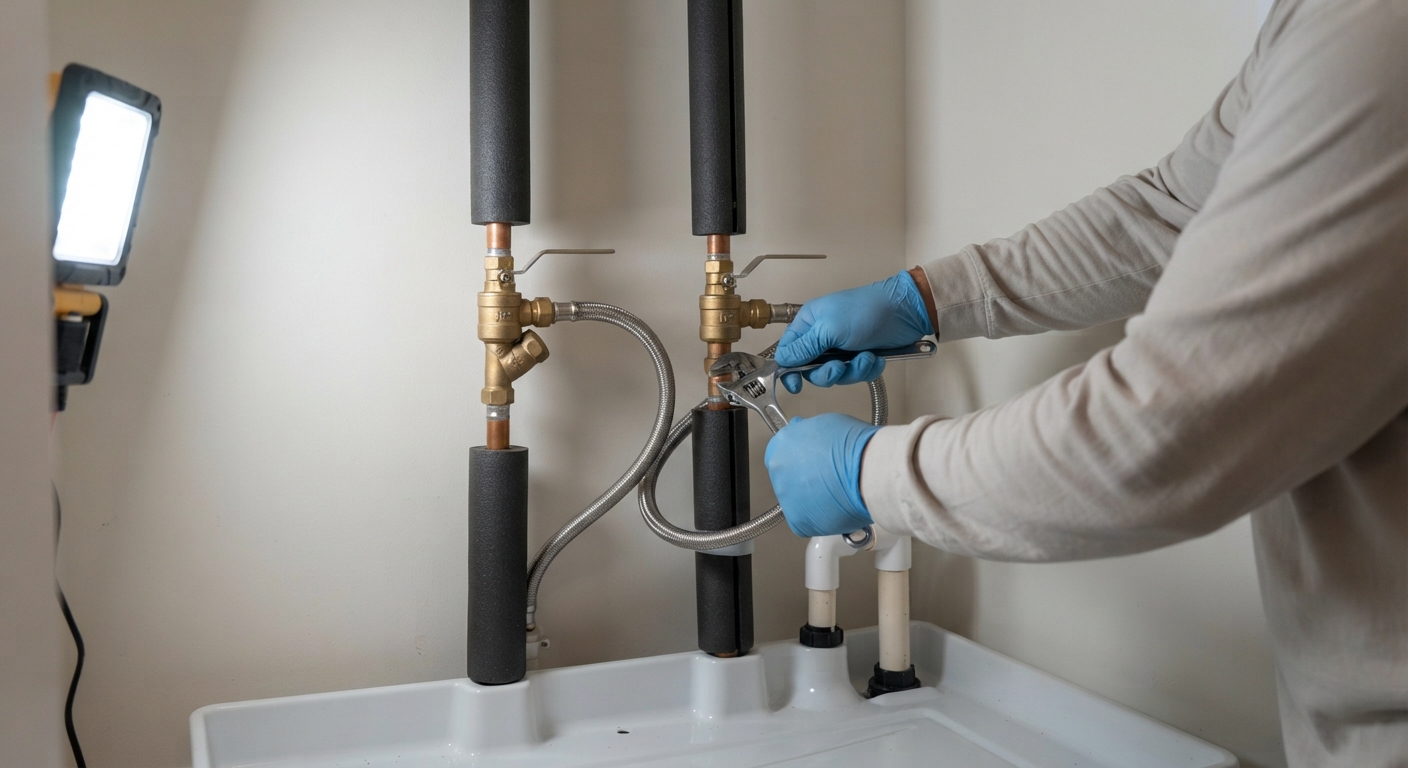
Each unit ties to the risers through hoses and isolation valves, and a valve that has not been exercised in years may not close, which turns a one-unit swap into a drain-down of the whole stack. The loop is the third failure point. Scale, corrosion products, and biological growth raise the temperature of the water the units receive and restrict flow through their heat exchangers, and a new unit installed on a fouled loop inherits that condition on its first day.
For an open cooling tower, CDC’s guidance on controlling Legionella in cooling towers calls for a water management program and identifies scale, corrosion, sediment control, and system cleaning as critical. A loop survey and cooling tower and chiller services belong in the program scope next to the heat pumps.
| Failure point | What fails | What residents and staff notice | Who usually decides |
|---|---|---|---|
| Heat pump unit | Compressor, reversing valve, refrigerant leaks, fouled refrigerant-to-water heat exchanger, blower motor | Warm air, short cycling, noise, high indoor humidity | Unit owner or association, per the declaration |
| Drain pan and condensate line | Corroded pans, clogged traps, failed drain connections | Ceiling or wall stains and leaks into the apartment below | Per the declaration; association attorney confirms |
| Hoses and isolation valves | Aged hoses, seized valves, clogged strainers | Unit cannot be isolated for service; whole-stack shutdowns | Often the association; confirm in the declaration |
| Condenser water loop | Scale, corrosion, fouling, low flow, cooling tower or fluid cooler wear | Many units underperform at the same time | Association, with its mechanical engineer and water treatment vendor |
Chassis, full unit, or conversion: the water source heat pump replacement South Florida towers actually need
Heat pump replacement in a condo tower follows one of four paths, and the right one depends on cabinet condition, riser and valve condition, and how many units are failing. Component repair keeps an otherwise sound unit running. A chassis replacement slides a new compressor-and-coil assembly into the existing cabinet, which works only where a manufacturer builds a compatible chassis. ClimateMaster, for example, describes its Tranquility SH vertical stack chassis replacement series as fitting legacy ClimateMaster and California Heat Pump cabinets without cabinet removal or riser stack modification. A full unit replacement also removes the cabinet, which opens closet walls in every apartment. A system conversion to variable refrigerant flow or another design starts with an engineering study.
| Path | When it fits | What it fixes | Where it falls short |
|---|---|---|---|
| Component repair | Unit has service life left and one failed part | Restores the unit at the lowest first cost | Leaves cabinet corrosion, valves, and refrigerant type unchanged; repeated compressor failures point to replacement |
| Chassis replacement | Cabinets and risers are sound and a compatible chassis exists | New compressor, coils, controls, and refrigerant with minimal wall work | Depends on manufacturer compatibility; keeps the old cabinet, drain pan, and hoses unless replaced separately |
| Full unit (cabinet and chassis) | Cabinets are corroded or incompatible, or drain pans leak | Resets the whole unit and its riser connections | Opens walls in occupied apartments; longer downtime per unit; higher cost per unit |
| System conversion (VRF or other) | Loop, tower, and risers are at end of life, or the board wants a different system | Can remove dependence on the condenser water loop if the design uses air-cooled equipment | Requires engineering, new piping routes and equipment locations, possible owner approval, and the longest schedule |
No path fits every tower. A chassis program limits work inside apartments, and it assumes the cabinet, drain pan, and valves have another service cycle in them, an assumption that should be tested on a sample of units before the board commits. Repair remains the right answer for a unit with years left. A conversion can make sense when the loop equipment itself is failing, and it is the most disruptive choice. Chassis and full-unit programs are air conditioning unit change-outs, while controls and efficiency upgrades that keep existing equipment in place fall under HVAC retrofits for Florida buildings. The mechanical engineer should compare the paths before any bid goes out.
What moves the budget and schedule on a high-rise condo AC replacement?
The cost of a high-rise condo AC replacement program is set more by the building’s condition and the program’s structure than by the price of the heat pump itself. No federal or Florida agency publishes a cost range for water-source heat pump replacement in condominiums, so this article gives none. Ask bidders for unit prices against a defined scope, with alternates, so the board can compare bids line by line. Our guide to planning a commercial HVAC project in South Florida covers bid preparation.
| Driver | Why it moves cost or schedule | Who confirms |
|---|---|---|
| Cabinet compatibility | Decides chassis-only versus full unit, and whether walls are opened | Manufacturer representative and contractor, from a field sample |
| Isolation valve and hose condition | Seized valves force riser drain-downs and add valve replacement to the scope | Contractor survey; engineer sets the replacement standard |
| Refrigerant of available equipment | A2L units carry leak detection and installation requirements; R-410A supply is limited to pre-2025 inventory (EPA, as of November 2026) | Manufacturer submittal; engineer of record |
| Electrical match | New units must match or be served by the existing circuits; mismatches add electrical work | Electrical engineer or licensed electrician |
| Loop condition | Flushing, treatment, strainers, and tower work may need to precede unit installation | Mechanical engineer and water treatment vendor |
| Access and logistics | Freight elevator time, closet dimensions, finish repair, and resident availability set daily production | Property manager and contractor |
| Program structure | A building-wide program allows one specification and stack-by-stack scheduling; owner-by-owner purchasing does not | Board, on advice of the association attorney |
Operating cost after replacement depends on the efficiency rating, loop water temperature, runtime, and the utility rate. DOE covers water-source heat pumps as commercial package equipment on its water-source unitary heat pump standards page, and its December 2023 test procedure final rule incorporated an updated industry test standard and a seasonal cooling efficiency metric. Compare ratings on the same test basis. A manufacturer’s figure, such as the efficiency of up to 16 EER Trane lists for its Axiom vertical stack water-source heat pumps, is a rating at test conditions; results in a specific tower depend on the variables above.
What changes when residents live in the tower during replacement?
Heat pump replacement in an occupied condo tower happens inside people’s homes, so the schedule is built around access to each apartment. F.S. 718.111(5) gives the association an irrevocable right of access to each unit during reasonable hours when necessary to maintain, repair, or replace common elements or portions of a unit it maintains under the declaration. Workable programs run one stack at a time, publish the schedule weeks ahead, and confirm each appointment the day before.
Daily work follows a fixed order. The crew reserves and pads the freight elevator, protects the corridor and the apartment floor, closes the unit’s isolation valves, and recovers refrigerant before the old equipment is disconnected, because EPA’s Section 608 safe disposal requirements govern refrigerant removal from equipment dismantled on site. The property manager sends notice before every riser shutdown, and each finished unit is started, leak-checked, and photographed for the records.
Rooftop work on the cooling tower or fluid cooler affects every apartment at once. On Advanced Air Systems’ Treasures on the Bay Condominium project in North Bay Village, a high-rise condominium where an outdated rooftop system was replaced with a 100-ton dedicated outdoor air system, the existing system was shut down on a Friday evening and the new one was running by Saturday morning, with the company’s in-house crane and sheet metal divisions handling transport and ductwork. Loop shutdowns deserve the same defined window and tested restart.
Which Florida code and federal refrigerant rules apply as of November 2026?
As of November 24, 2026, the code edition follows the permit application date, with the 9th Edition applying on or after December 31, 2026, and EPA allows installation of qualifying pre-2025 inventory. A2L refrigerants are classified as mildly flammable, and their installation falls under ASHRAE Standards 15 and 34 and UL 60335-2-40 as adopted through the code; the building official decides what applies to each permit. Recheck both items when the contract is signed. Advanced Air Systems serves Miami-Dade and Broward towers from its Miami commercial HVAC office and its Fort Lauderdale commercial HVAC headquarters.
Condo law sits beside the codes. Under F.S. 718.113, maintenance of the common elements is the association’s responsibility, the declaration may assign certain limited common elements to the owners who use them, and material alterations or substantial additions to the common elements need the approval the declaration specifies or, if it is silent, 75 percent of the voting interests. F.S. 718.111(11)(f) excludes appliances and certain other items within a unit that serve only that unit from the association’s property coverage, and it does not name air conditioning equipment, so coverage boundaries for heat pumps belong with the association’s attorney and insurance agent.
Condo heat pump replacement checklist: who owns each decision?
Assign and document each decision before bidding.
- Association attorney: Confirm who owns, maintains, and insures the heat pumps, valves, and risers, and whether a program needs an owner vote.
- Board: Decide between a building-wide program and owner-by-owner replacement, and adopt one equipment specification for the tower.
- Community association manager: Build an inventory of every unit with model, age, refrigerant, cabinet type, valve condition, and service history.
- Mechanical engineer: Survey the loop, tower, pumps, and sample cabinets; recommend a path; and confirm unit capacities.
- Water treatment vendor: Test the loop water and report on scale, corrosion, and biological control before new units go in.
- Reserve study professional: Determine whether risers and loop equipment belong in the structural integrity reserve study.
- Insurance agent: Confirm what association and owner policies cover.
- Contractor: Submit unit prices for chassis and full-unit alternates, valve and hose replacement, phasing, refrigerant recovery records, and A2L installation compliance.
- Building official: Confirm the permit path and code edition for each phase.
After installation, a documented preventive maintenance program for commercial HVAC keeps manufacturer maintenance requirements on record.
Frequently Asked Questions
Who pays for water source heat pump replacement in a Florida condo?
The declaration decides. F.S. 718.113 makes the association responsible for maintaining common elements and lets the declaration assign certain limited common elements to the owners who use them. Some buildings make the heat pump the owner’s responsibility and the risers the association’s; others divide it differently. Have the association attorney read your declaration first.
How long do water source heat pumps last in a South Florida high-rise?
No single verified service-life figure exists for water-source heat pumps in Florida towers. Life depends on runtime, loop water quality, maintenance, drain pan condition, and installation. The failure pattern is a better test than age, and repeated compressor or heat exchanger failures, corroded cabinets, and unsupported parts point toward replacement. A mechanical engineer’s sample survey should set the schedule.
Can we still install R-410A water source heat pumps in 2026?
Yes, from existing stock. As of November 2026, EPA’s revised Technology Transitions rule lets residential and light commercial systems manufactured or imported before January 1, 2025 continue to be installed. New production is held to a 700 GWP limit, so R-410A supply is finite. Confirm availability, warranty, and parts support with the manufacturer before standardizing.
Can a new heat pump chassis fit our existing cabinet?
Sometimes. Some manufacturers publish chassis replacement series for their own legacy cabinets, and at least one lists compatibility with another brand’s cabinets. Fit depends on cabinet dimensions, connection locations, electrical requirements, and cabinet condition. Get compatibility confirmed in writing and test a chassis in a sample apartment before approving a building-wide program.
Should a condo replace water source heat pumps with VRF?
Conversion to variable refrigerant flow can make sense when the loop, cooling tower, and risers are near the end of their service life. It is a redesign that changes equipment locations, piping routes, and electrical service, and it may trigger approval requirements under the declaration. Have a mechanical engineer compare life-cycle cost and disruption for both paths.
Does a building-wide heat pump replacement program need an owner vote?
It depends on the declaration and on whether the work is a material alteration of the common elements. Under F.S. 718.113(2), such alterations need the approval the declaration specifies or, if it is silent, 75 percent of the total voting interests. Get a written opinion from the association attorney before announcing the program.
A replacement program the tower can live with for the next cycle
Water-source heat pump replacement in a South Florida high-rise succeeds or fails on decisions made before the first unit is swapped. The declaration decides who owns and pays for each part. The loop and the valves decide whether a new unit runs as rated. The refrigerant rules and the December 31, 2026 code change decide what can be bought and permitted. A board that assigns those questions to its professionals and replaces units under one specification gives owners a program they can follow and a record they can check.
Written by The Technical Team at Advanced Air Systems. Established in 1994, Advanced Air Systems is a 100% employee-owned commercial HVAC contractor and a division of Advanced Roofing Inc., serving occupied Florida buildings with in-house crane, sheet metal, and roofing support.
To scope a heat pump replacement program for your tower, request a free HVAC estimate or call (954) 332-1418.