At a glance: A building automation system South Florida owners already have is often the cheapest HVAC improvement left in the building, if it can still be serviced, reprogrammed, and trusted. This guide explains what a BAS controls and where it fails in a humid climate, compares retuning, adding analytics, partial migration, and full replacement with their limits, lists what drives cost and results, covers cutover in an occupied building, and sets out the code, cybersecurity, and ownership terms that belong in the contract, ending with a checklist by role.
A building automation system South Florida owners already paid for is usually the least expensive HVAC upgrade left in the building, provided someone can still read it, change it, and trust what it reports. Most commercial HVAC controls in occupied Florida buildings run on schedules, setpoints, and sequences that have drifted since commissioning, and many run on proprietary hardware that will age out years before the chillers and air handlers it controls. Getting this wrong costs the owner twice, through a controls system replaced on a vendor’s timeline instead of the owner’s, or a new high-efficiency unit run by the same broken logic that wasted energy and let humidity climb under the old one. This article covers how to choose between retuning, extending, and replacing a BAS and what to put in the contract; it does not size equipment, promise a savings figure for any building, or replace the controls engineer’s design.
Why does the building automation system South Florida buildings depend on age out first?
A building automation system (BAS) is the network of sensors, controllers, and software that starts, stops, and modulates a building’s HVAC equipment and records what that equipment did. Lawrence Berkeley National Laboratory researchers, in a 2020 paper on modernizing building automation hardware and software, report that most existing buildings have suboptimal HVAC controls that waste energy and cause discomfort, and that the limited capabilities of older BAS hardware restrict how much a retrocommissioning project can correct.
Miami-Dade County’s own facilities show the pattern. A September 2021 county request to replace the building automation system at the South Miami-Dade Cultural Arts Center describes a theater complex that opened in 2011 whose controls had become obsolete within a decade. Replacement parts were no longer manufactured, the system communicated over a proprietary protocol, and it lacked remote access, trending, maintenance scheduling, and alerts. The engineer’s assessment gave the air handlers about 20 years of remaining life and the chillers about 15. The equipment had years left, and the controls had none.
The Florida Building Code, 9th Edition (2026), takes effect December 31, 2026, and Miami-Dade County’s permitting notice on the 9th Edition states that permit applications and plans submitted on or after that date must comply with the new edition, which includes updated Mechanical and Energy Conservation volumes. The federal Cybersecurity and Infrastructure Security Agency also updated its Internet Exposure Reduction Guidance in August 2026, directing organizations to find internet-reachable control systems, remove access that is not needed, and secure the rest, including connections set up by outside integrators.
What does a building automation system control, and where does it break down?
A BAS works in four layers, and each one fails in its own way. Field devices (sensors and actuators) measure conditions and move equipment. Controllers run the sequences of operation, the written logic that decides what each piece of equipment does in response. A network carries data between controllers and up to a supervisory server, and a front end gives operators schedules, graphics, trends, and alarms.
In South Florida the most expensive failures hide behind a satisfied thermostat. A humidity sensor that has drifted high drives a dehumidification sequence that overcools and reheats. An outdoor air damper whose actuator has failed open floods the coil with humid air for months, and the only symptoms are a damp smell and a higher bill. EPA’s guidance on moisture and mold in buildings recommends keeping indoor relative humidity below 60 percent, ideally between 30 and 50 percent. A BAS that trends humidity by zone is how a facility team shows it is meeting that target.
The second failure is human and gradual. Schedules get overridden for an event and never reset, setpoints get widened after complaints, and alarms that fire constantly get silenced. An ASHRAE Journal report on Guideline 36 explains that custom control sequences are often simplified to keep them easy for operators, sometimes to the point that they no longer comply with ASHRAE Standards 90.1 and 62.1. Guideline 36 replaces those one-off sequences with standardized high-performance ones.
| BAS layer | What it does | Typical failure | What the facility team sees |
|---|---|---|---|
| Field devices | Measure temperature, humidity, pressure, and CO2; move dampers and valves | Sensor drift, failed actuators, devices disconnected during renovations | Complaints in one zone; humidity above target while temperatures look normal |
| Controllers | Run the sequence of operation for each unit or system | Obsolete hardware, lost program files, logic edited without records | Equipment that runs on logic nobody can explain |
| Network | Carries data between controllers and the supervisory server | Proprietary protocol, unreliable links, unmanaged remote access | Points that drop offline; service limited to one vendor; cybersecurity exposure |
| Front end and alarms | Schedules, trends, graphics, notifications | No trends configured, alarm floods, unsupported software | Data nobody reviews; alarms acknowledged and ignored |
Persistent zone complaints with sound sensors may point to airflow; see commercial HVAC air balancing. In chilled-water buildings, plant sequences usually live in the same BAS, so coordinate controls work with chiller and cooling tower services.
Retune, extend, or replace: which BAS retrofit fits the building?
A BAS retrofit ranges from reprogramming the existing system to replacing every controller and the front end, and the right scope depends on two questions: whether the hardware can still be supported, and whether it can run better sequences.
Software layered on top of an existing BAS is the lowest-disruption way to extend it. The U.S. Department of Energy’s summary of the Smart Energy Analytics Campaign reports that participants using fault detection and diagnostic (FDD) software reached median energy savings of 9 percent after two years, and those using energy information systems reached 4 percent, across 96 organizations and nearly 6,000 buildings (2019 report). DOE notes those whole-building savings cannot be credited to the software alone.
Partial migration keeps working field controllers and replaces the supervisory layer, often through a gateway to BACnet, ASHRAE Standard 135. ASHRAE’s technical FAQ on BACnet describes it as a protocol designed to integrate control products made by different manufacturers. A gateway buys time and visibility; the old controllers keep their old limits. Full replacement is the deepest option, and the LBNL paper reports California and New York demonstrations of BAS retrofits using Guideline 36 sequences aimed at more than 20 percent whole-building savings.
| Option | What changes | Published evidence | Where it falls short |
|---|---|---|---|
| Retune the existing BAS | Sensor calibration, schedules, setpoints, sequence corrections | LBNL (2020): older BAS hardware limits what retrocommissioning can fix | Savings fade without trending; cannot fix unsupported hardware |
| Add analytics or FDD | Software reads BAS data and flags faults and waste | DOE (2019): 9% median savings with FDD after two years | Needs reliable data and staff time to act on findings |
| Partial migration | New front end, trending, and alarms; legacy field controllers kept behind a gateway | No independent savings data located; value is continuity and visibility | Old controllers keep their limits; the gateway is another failure point |
| Full replacement, open protocol, Guideline 36 sequences | New controllers, sequences, front end, and many sensors | LBNL (2020): demonstrations aimed at more than 20% whole-building savings | Highest cost and cutover risk; sequences must be specified and commissioned |
| Unit-level controls on rooftop units | Controller and sensors on each packaged unit | Varies with run hours and starting condition | Little central visibility unless the units are networked |
In short, a building automation system for a South Florida commercial building should trend humidity as closely as temperature, run on an open protocol that more than one contractor can service, keep remote access behind a secured gateway, and come with its program files, passwords, and licenses turned over to the owner.
Buildings served mostly by packaged rooftop units may get more from unit-level controls retrofits, which our guide to commercial HVAC energy efficiency upgrades compares with other measures. Advanced Air Systems’ commercial air conditioning retrofit work includes new control systems and temperature and humidity controls on existing systems, as its retrofit page describes, and some units are better candidates for an AC unit change-out than for new controls. A full BAS can be more than a small building needs. A single-story office with three rooftop units may be well served by networked unit controllers.
What drives the cost and results of a commercial HVAC controls upgrade?
The cost and result of a commercial HVAC controls upgrade are set by the number of points, the condition of what is already installed, and how much the owner specifies. Advanced Air Systems does not publish pricing, and no national figure substitutes for a survey of the existing controls, devices, and network.
| Variable | Why it moves cost or results | Source |
|---|---|---|
| Point count and end-device condition | Every sensor, actuator, valve, and damper is verified, repaired, or replaced; failed devices are common in older systems | Miami-Dade County BAS replacement scope (2021) |
| Existing protocol | Open protocols allow phased migration; proprietary systems may need gateways or full replacement | ASHRAE BACnet FAQ; Miami-Dade County (2021) |
| Sequences specified | Control contractors generally implement Guideline 36 sequences only when the specification calls for them | ASHRAE Journal (2021) |
| Run hours and utility rate | Savings are valued at the building’s own tariff and grow with operating hours | Owner’s utility bills and interval data |
| Staff time to use the system | Trends and FDD findings save energy only when someone acts on them | DOE Smart Energy Analytics Campaign (2019) |
| Test and balance after cutover | Air and water flows are rebalanced once the new controls are running | Miami-Dade County BAS replacement scope (2021) |
Round projected savings down until a year of trend data confirms them. A proposal that cannot name its baseline, its assumptions, and the trend points it will use to verify results should be treated as an estimate. Owners comparing bids should also ask which existing devices each bidder plans to reuse.
What changes when a BAS cutover happens in an occupied Florida building?
A BAS cutover in an occupied building is planned zone by zone, because during the switch each piece of equipment is briefly controlled by neither system. Before any controller comes out, the existing sequences, setpoints, schedules, and trend history are exported or documented so the new system can reproduce what worked; Miami-Dade’s 2021 scope required the new system to recreate the existing sequences for all equipment under BAS control. Each unit is switched during an unoccupied window and checked before the next one is touched.
In Florida, the first weeks after cutover are when humidity problems appear. New sequences that reset supply air temperature or slow fans to save energy can reduce how much moisture the coil removes, so humidity should be trended by zone alongside temperature, with an alarm set below the 60 percent EPA threshold. A certified test and balance confirms airflow after the controls work, and commissioning after a retrofit verifies that the sequences do what the specification says.
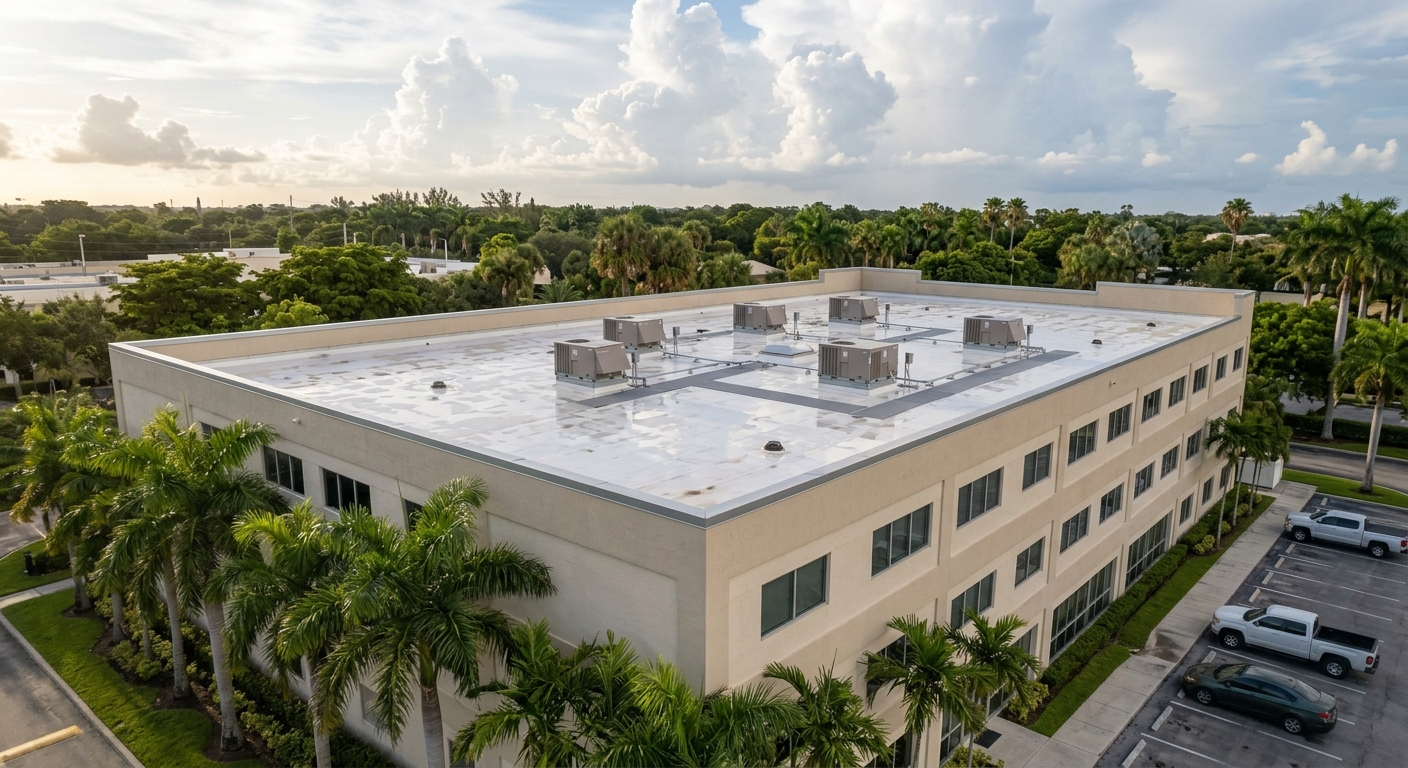
Hurricane season, which runs June 1 through November 30, adds two requirements. Controllers need a defined restart sequence after a power loss, and remote access used for post-storm monitoring must meet everyday security rules. Rooftop sensors and actuators also mean roof work. Advanced Air Systems is a division of Advanced Roofing Inc., and its in-house divisions for roofing, sheet metal, and cranes let curb and penetration work be coordinated under one project team.
Occupants should know which zones change each night and whom to call the next morning, and a log of every setpoint changed keeps old overrides from creeping back.
Which code, cybersecurity, and ownership terms belong in a BAS contract?
As of October 2026, projects permitted on or after December 31, 2026 fall under the Florida Building Code, 9th Edition, and whether a controls replacement triggers energy code provisions is a determination for the engineer of record and the building official.
Cybersecurity belongs in the scope, with the owner’s IT team or security consultant approving the design. CISA’s exposure-reduction steps translate directly into contract language: inventory every internet-reachable BAS device, remove remote access that has no operating purpose, change default passwords, require multifactor authentication, keep software patched, and route necessary remote access through a secured gateway or VPN rather than directly to a controller. Advanced Air Systems is an HVAC contractor, and network design stays with the owner’s IT authority.
Ownership terms decide who can service the system later. The contract should deliver administrator credentials, software licenses registered to the owner, the as-built points list, the programmed sequences and source files, and network drawings. A BACnet system gives an owner the option of more than one service contractor only when those files are delivered; an open protocol paired with withheld program files still leaves the building dependent on one vendor.
Building automation upgrade checklist: who owns each step?
- Owner or asset manager: State the goal (energy, comfort, uptime, or replacing unsupported hardware) and the ownership horizon in the request for proposals.
- Facility manager: Export schedules, setpoints, and alarms, plus a year of trends and utility bills, and list zones with recurring complaints.
- Controls engineer: Survey the existing BAS, state which controllers are still supported, and recommend retuning, partial migration, or replacement with the reasons.
- Mechanical engineer: Write or review the sequences of operation, including dehumidification and outdoor air control, and specify Guideline 36 sequences where they fit the system types.
- HVAC contractor: Verify end devices and identify units to replace before new controls go on them.
- IT team or security consultant: Approve the BAS network design, remote access method, and credential policy against CISA’s exposure-reduction steps.
- Test and balance agency: Balance air and water systems after cutover under the certification the owner requires.
- Facility manager and service contractor: Review humidity and energy trends monthly and fold controls checks into the preventive maintenance program.
- Procurement: Compare bidders on open-protocol commitments and file turnover, using a guide to selecting an HVAC contractor.
Frequently Asked Questions
What does a building automation system do in a commercial building?
A building automation system runs and monitors HVAC equipment through sensors, controllers, and software. It schedules air handlers and rooftop units, modulates dampers, valves, and fans to hold temperature, humidity, and ventilation targets, and records trends and alarms. Its value depends on accurate sensors, sound sequences, and someone reviewing what it reports.
How much energy can a BAS retrofit save?
Results vary by building. DOE reported 9 percent median whole-building savings for sites using fault detection and diagnostic software after two years (2019), and LBNL described Guideline 36 retrofit demonstrations aimed at more than 20 percent. Run hours, rates, starting condition, and staff follow-through drive the outcome, so a measured baseline and a year of trends are the proof.
Should we upgrade or replace an old building automation system?
Retune or extend when the controllers are still supported and the problems are schedules, setpoints, or sensors. Replace when parts are no longer manufactured, only one vendor can service the protocol, or the system cannot trend and alarm. A controls engineer’s survey of each controller should make that call before bids are requested.
What is an open protocol building automation system?
It is a system that communicates through a published standard, most commonly BACnet (ASHRAE Standard 135), so devices and software from different manufacturers can share data. That lets an owner add equipment or change service contractors without replacing everything, provided credentials, licenses, points lists, and program files are delivered at close-out.
How should a building automation system be protected from cyberattacks?
Follow CISA’s exposure-reduction steps: find every BAS device reachable from the internet, remove remote access that is not needed, change default passwords, require multifactor authentication, patch software, and route necessary access through a secured gateway or VPN. The owner’s IT team or security consultant should approve the design.
Can a building automation system help control humidity in Florida?
Yes, with accurate humidity sensors and sequences written for a humid climate. The BAS can trend relative humidity by zone, limit outdoor air to what ventilation requires, and alarm before conditions pass EPA’s 60 percent guidance. It cannot overcome oversized equipment or leaky ductwork, which need mechanical fixes.
Specify a building automation system the owner can keep running
A building automation system in a South Florida building pays back when it reports accurately, runs sequences written for a humid climate, and stays serviceable for as long as the equipment it controls. Miami-Dade’s own cultural arts center shows the cost of the opposite: sound chillers and air handlers waiting on controls that could no longer be repaired. National laboratory data support retuning and analytics as early steps and open-protocol replacement with high-performance sequences when the hardware is past support. The contract terms, from file turnover to secured remote access, decide whether the next upgrade is the owner’s choice or a vendor’s. Humidity trends belong beside energy trends from the first day. Local service details are on our commercial HVAC services in Miami page.
Written by The Technical Team at Advanced Air Systems. Established in 1994, Advanced Air Systems is 100% employee-owned and a division of Advanced Roofing Inc.
Request an HVAC assessment through our free quote page or call (954) 332-1418.