At a glance: Rebuilding a cooling tower makes sense when the casing, basin, framing, and rooftop support steel are sound and the tower still meets the plant’s load. Replacement makes sense when any of those has failed or the plant has changed. This guide explains what wears out, compares six repair, rebuild, and replacement scopes with their limits, lists the drivers of cooling tower repair cost and replacement cost, covers phasing on occupied buildings, and flags the December 31, 2026 code date and Broward County’s local rules for new and replacement towers.
A cooling tower rebuild is the better use of capital when the tower’s structure, cold water basin, and support steel are sound and the tower still matches the plant’s load, and replacement is the better use when any of those has failed. For cooling tower replacement South Florida owners are weighing, the first test is section loss in steel exposed for years to salt air and concentrated tower water, because new fill and fans cannot restore a frame that has thinned. A wrong call costs money in both directions: a rebuild on a failing structure buys parts that outlast the steel under them, and an unneeded replacement spends crane time, a permit cycle, and capital. This article does not price either path for a specific building; it sets out the tests, the late-2026 code and local rules, and who signs off on each step.
Why is the cooling tower rebuild-or-replace decision sharper for South Florida buildings in late 2026?
Three documented facts sharpen the decision this year: service-life figures that disagree, coastal corrosion, and a code change on December 31, 2026. ASHRAE’s median service-life table in the HVAC Applications Handbook lists 20 years for galvanized metal and wood cooling towers and 34 years for ceramic towers, figures ASHRAE describes as economic life. ASHRAE now gathers field data through its Service Life and Maintenance Cost Database, which held records for 38,946 pieces of equipment in 345 buildings as of July 31, 2026. The U.S. Forest Service facilities guidance for cooling tower replacement uses a shorter 15-year life expectancy. One is a multi-building median, the other a budgeting assumption, and neither describes a specific tower.
NASA’s Corrosion Technology Laboratory at Kennedy Space Center reports that ASM International classified the marine environment at the Cape as the most corrosive in North America. That finding is specific to the Cape, but coastal buildings from Palm Beach to Miami-Dade sit in similar salt-laden air, as our article on salt-air corrosion on South Florida HVAC equipment explains. Inside the tower, evaporation concentrates minerals in the recirculating water, which is why the Department of Energy’s Best Management Practice #10 for cooling tower management ties tower water management to cycles of concentration and blowdown control and states that properly operated towers should not have leaks or overflows.
Miami-Dade County’s notice on the 9th Edition code change states that the Florida Building Code, 9th Edition (2026) takes effect December 31, 2026, and that permit applications and plans submitted on or after that date must comply with it. The owner’s engineer should confirm which edition governs before the design is final.
What is actually wearing out in an aging cooling tower?
A cooling tower fails component by component. An open-circuit tower serving a water-cooled chiller sprays warm condenser water over fill while a fan pulls air through it; a small share of the water evaporates, cooling the rest, which drains to the cold water basin and returns to the chiller. Parts that see water, treatment chemicals, and vibration every operating hour wear first. Parts that carry load wear last, and they decide the outcome.
Galvanized steel protects itself by sacrificing its zinc coating. Once the zinc is consumed at a seam, a basin floor, or a support connection, the base steel corrodes and loses thickness, which engineers call section loss. Fill loses capacity when scale, silt, and biofilm close its passages. Damaged drift eliminators let more water leave as drift, and an unbalanced fan sends vibration into the framing that carries it.
Fill, eliminators, nozzles, fans, drives, and motors are expected to be replaced during a tower’s life, and replacing them is what a rebuild does. The casing, basin, internal framing, and rooftop support steel are expected to last the life of the tower. The Centers for Disease Control and Prevention’s cooling tower module adds a water-quality reason to inspect closely: CDC recommends high-efficiency drift eliminators and offline cleaning and disinfection at least annually, and a pitted, crevice-filled basin is harder to keep clean.
| Component | How it fails on a South Florida roof | Rebuild remedy | Points toward replacement when |
|---|---|---|---|
| Fill (heat transfer media) | Scale, silt, and biofilm block passages; fouled fill sags | Replace fill in kind or with media selected for the site’s water | Fill was renewed recently and capacity is still short of the load |
| Drift eliminators | Cracked, shifted, or missing sections raise drift loss | Replace eliminator packs | The members that hold the eliminators are corroded through |
| Water distribution (hot water basin, nozzles) | Clogged or broken nozzles; uneven flow over the fill | Clean or replace nozzles; reseal the hot water basin | The hot water basin is perforated across a wide area |
| Fan, gear reducer or belt drive, shaft, bearings, motor | Bearing wear, misalignment, vibration, motor failure | Rebuild or replace the mechanical package; add or replace a variable frequency drive | Fan deck or motor supports show section loss |
| Cold water basin | White rust, pitting, and seam leaks | Repair seams; restore and line the basin | Perforation or section loss across the basin floor |
| Casing, internal framing, rooftop support steel | Section loss at connections and bearing points | Replace individual members where an engineer confirms the rest is sound | Section loss is widespread or anchorage no longer meets current wind design |
Cooling tower rebuild vs. replacement: what does each option buy, and where does it fall short?
Rebuild a cooling tower when the casing, basin, framing, and rooftop support steel pass an engineer’s inspection and the tower still meets the plant’s heat load. Replace it when the structure shows widespread section loss, when the tower is undersized or the wrong type for the plant, or when a relocation requires new anchorage.
| Option | What it addresses | Best fit | Where it falls short |
|---|---|---|---|
| Targeted repair | One failed part: a motor, gear reducer, or leaking seam | A mid-life tower with a single failure | Leaves the rest of an aging tower unchanged; repeated calls on an old tower add up |
| Mechanical rebuild | Fan, gear reducer, shaft, bearings, belts, motor, drive | Sound structure with a worn drive train | Does nothing for fouled fill, basin corrosion, or capacity |
| Full internal rebuild | Fill, eliminators, distribution, mechanical package, basin repair | Sound casing and support steel; capacity still adequate | Longer outage; on small towers the total can approach replacement; cannot add capacity beyond the existing casing |
| Basin restoration with lining | Broad, shallow basin corrosion | Structure sound; the basin is the main problem | Cannot fix section loss elsewhere or a water program that caused the corrosion |
| Replacement in kind on existing supports | The entire tower | Tower structure failed; support steel sound or repairable | Crane pick, permit, and anchorage review; local rules for new and replacement towers apply |
| Replacement with redesign | The tower plus capacity, material, or footprint changes | Plant load changed, chiller replacement planned, or support steel failed | Highest cost and longest lead time; structural and roofing work; siting rules apply if the location changes |
Our article on cooling tower protective coatings explains when a basin lining is worth the outage and when it only delays replacement. A rebuild keeps the existing casing, so its capacity is capped at what the original casing, fan, and fill were built to deliver.
Replacement allows a new tower selected for the current load, in a different material or footprint, and if the chiller is also near the end of its life, both decisions belong in one study; our guide to chiller replacement versus overhaul covers the chiller side. A new tower placed into the same water program will corrode on a similar schedule, so water treatment belongs in either scope.
What drives cooling tower repair cost, rebuild cost, and replacement cost?
No government or standards-body source located for this article publishes a per-ton price for cooling tower repair, rebuild, or replacement in South Florida, and Advanced Air Systems does not publish pricing. Cost ranges found online rarely state the tower size, scope, building height, or crane plan behind them. The drivers below move bids and give competing proposals a common basis.
| Driver | Why it moves cost and schedule | What to ask for in the bid |
|---|---|---|
| Capacity and cell count | Larger and multi-cell towers carry more fill, eliminators, and steel; cells can be phased | Nominal tons, number of cells, and scope per cell |
| Structural condition | Section loss found after demolition turns a rebuild into member replacement or a new tower | Pre-bid inspection photos and a unit price for added steel |
| Rigging and crane | Building height, street access, and pick radius set crane size and after-hours work | Crane size, pick plan, street-use permits, and premium-time hours |
| Temporary cooling | A rental tower or chiller keeps an occupied building conditioned during the outage | Rental duration, piping connections, and power |
| Roof and support steel | New dunnage, curbs, and roof repair under the old tower | Roofing scope and who warrants it |
| Code and local requirements | Anchorage design, permits, and in Broward the controls and meters for new and replacement towers | Engineer of record, permit costs, and controls scope |
| Water treatment and startup | Cleaning and disinfection before the tower returns to service | Startup plan coordinated with the water treatment provider |
The useful comparison sets each option’s cost against the years of service it can credibly deliver, with the structural inspection setting how many years a rebuild may claim. Where the published lifespan sources disagree, plan on the shorter figure for a coastal building until an inspection supports more. A contractor built around occupied buildings, cranes, and roofing coordination is not always the lowest bid on a small single-cell tower on an accessible low-rise roof, where a tower specialist can be the better value.
How should cooling tower replacement South Florida projects be phased on an occupied building?
On an occupied building, the outage window shapes the scope. South Florida cooling load never falls to zero, so tower work is scheduled for the cooler months, when the plant runs at part load. Multi-cell towers can usually be rebuilt or replaced one cell at a time if the isolation valves hold, and single-cell towers usually need a temporary tower or chiller connected before the old one comes offline.
Replacement adds a crane pick, scheduled with the property manager for hours when the area below can be closed, and the lift falls under OSHA’s construction crane standard, 29 CFR 1926 Subpart CC. Advanced Air Systems’ in-house crane, sheet metal, and roofing divisions page lists boom trucks, 65-ton and 75-ton hydro cranes, and two mobile hydraulic tower cranes, which keeps the pick, the new dunnage, and the roof repairs on one schedule.
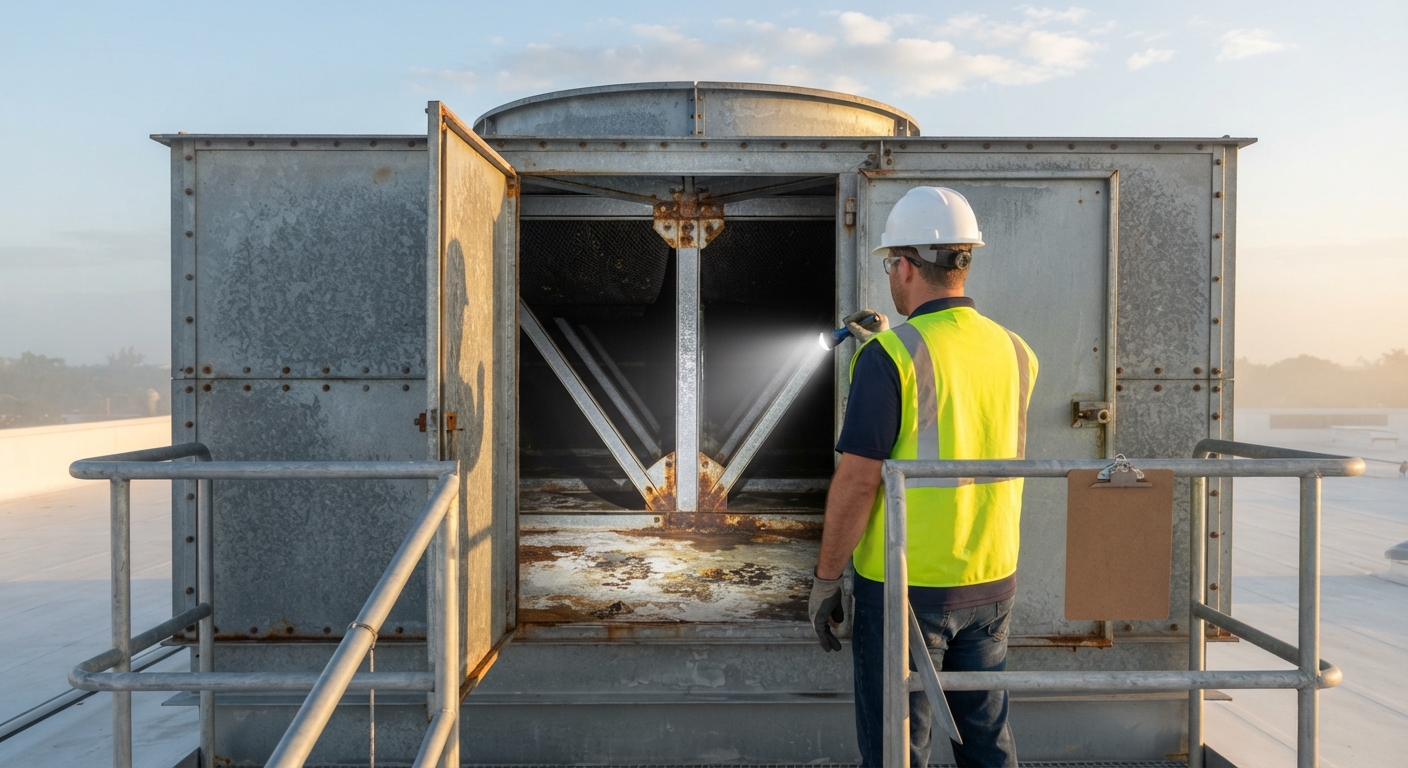
Work inside a drained basin can fall under OSHA’s permit-required confined spaces standard, 29 CFR 1910.146, so the safety plan should classify the space before mobilization. CDC recommends cleaning and disinfection before commissioning and startup, which ties the restart to the building’s cooling tower water management plan and its water treatment provider.
Tenants should receive written notice of each shutdown window, crane day, and restart date. Close-out documents should include photo reports, the disinfection record, the anchorage design, warranty registration, and a preventive maintenance program schedule that keeps warranty conditions documented.
Which codes and local rules apply to a cooling tower rebuild or replacement in late 2026?
Code exposure differs between the two paths, and the building official decides what applies. Section 301.15 of the Florida Building Code, Mechanical requires equipment, appliances, and supports exposed to wind to resist wind pressures determined under the Building volume, as quoted from the 2014 edition in a Florida Building Commission staff analysis. A replacement on new or modified supports brings anchorage into the engineer’s scope, and Miami-Dade and Broward apply the code’s High-Velocity Hurricane Zone provisions. No rooftop tower is hurricane-proof; anchorage is designed to code pressures, and storms can exceed them.
Broward County’s local technical amendments to the 8th Edition Mechanical volume require new cooling towers, including replacements, to operate with conductivity controllers and makeup and blowdown meters, achieve at least 8 cycles of concentration, with an annual affidavit filed with the local water provider. They also set drift limits of 0.002% of recirculated water for counterflow towers and 0.005% for crossflow towers, and tie siting to Section 7.2.1 of ASHRAE 188-2021, except for replacements in previously permitted locations. Revisions to the Section 908.8 amendments appeared on the Broward County Board of Rules and Appeals’ October 8, 2026 meeting agenda, so confirm the current text before design is final. Our article on commercial HVAC permitting in Miami-Dade and Broward covers the permit sequence.
As of November 2026, two more items belong on the engineer’s list: the minimum efficiency requirements for heat rejection equipment in the Florida Building Code, Energy Conservation volume, and NFPA 214, the standard on water-cooling towers, which covers fire protection for towers of combustible construction or with combustible fill. Which of these apply to a particular building is for the engineer of record, the building official, and the fire marshal to determine.
Cooling tower rebuild vs. replacement checklist: who owns each decision?
A rebuild-or-replace recommendation holds up in front of an owner or board when each test behind it has a named owner and a written result.
- Facility manager: assemble the tower’s age, capacity, cell count, and five years of repair history.
- Engineer of record: inspect the casing, basin, framing, support steel, and anchorage, document section loss, and state in writing whether the structure can carry another service cycle under the governing code.
- Mechanical engineer: confirm whether the tower meets the current load; size it with any planned chiller replacement.
- Water treatment provider: report cycles of concentration, corrosion monitoring, and Legionella history, and confirm the water management plan covers the outage and restart.
- Building official, through the permit submittal: confirm the permits the scope requires and, in Broward, whether the Section 908.8 controls, meters, and affidavit apply.
- Property manager or community association manager: set the outage window, tenant notices, and temporary cooling budget.
- Contractor: separate rebuild items, structural items, and allowances, with unit prices for hidden steel; Advanced Air Systems’ chiller and cooling tower services team prepares scopes this way.
- Owner, asset manager, or board: compare bids on the same assumptions and on cost per year of credible service, and approve the option the inspection supports.
Frequently Asked Questions
How long does a cooling tower last in South Florida?
Published figures run from 15 to 34 years. ASHRAE’s median service-life table lists 20 years for galvanized metal and wood towers and 34 years for ceramic towers, and U.S. Forest Service guidance uses 15 years for planning. Salt air and the water treatment program move a specific tower within that range, so a structural inspection predicts more than age does.
Is it cheaper to rebuild or replace a cooling tower?
A rebuild generally costs less up front because it reuses the casing, basin, and support steel and avoids most crane and structural work. It is cheaper over the asset’s life only if that structure lasts as long as the new parts. With widespread section loss or an undersized tower, rebuild money buys components for a frame that will need replacing anyway.
What is included in a cooling tower rebuild?
A cooling tower rebuild typically replaces the fill, drift eliminators, and distribution nozzles, renews the fan, drive, shaft, bearings, and motor, and repairs or lines the cold water basin. A full rebuild can also replace individual corroded framing members. It keeps the casing and the rooftop support steel, so the structural inspection decides whether a rebuild is the right scope.
How much does cooling tower repair cost?
Cooling tower repair cost depends on the failed component, the tower’s size and access, rigging needs, and after-hours work on an occupied building, so no single public figure applies. Ask for a scope that itemizes parts, labor, and rigging, and track repair spending over several years against a rebuild. Advanced Air Systems provides cooling tower repair services in Florida.
Does a cooling tower replacement need a permit in Broward or Miami-Dade?
Replacing a cooling tower involves mechanical and structural work that Broward and Miami-Dade review through permits, and the building official decides what a scope requires. In Broward, local amendments require new and replacement towers to run with conductivity controllers and makeup and blowdown meters and to reach at least 8 cycles of concentration.
How long is a cooling tower out of service for a rebuild or replacement?
Outage length depends on the scope, cell count, equipment lead time, and crane scheduling. Multi-cell towers can often be rebuilt or replaced one cell at a time while the other cells carry part load, and single-cell towers usually need temporary heat rejection. CDC recommends cleaning and disinfection before startup, which belongs inside the outage schedule.
Rebuild the sound towers and replace the ones whose structure is spent
A cooling tower’s structure predicts its future more reliably than its age. Published figures bracket the range, corrosion and the water program set where a tower falls inside it, and an engineer’s inspection shows whether new fill and fans will sit on a frame that can carry them. Where the structure is sound and the tower still meets the load, a rebuild is the disciplined choice. Where it is not, or where the plant has changed, replacement is the option that holds up in front of a board, with the December 31, 2026 code date and Broward’s rules in the schedule from the start. Either path needs a water program that will not repeat the damage.
Written by The Technical Team at Advanced Air Systems. Established in 1994, Advanced Air Systems is 100% employee-owned and a division of Advanced Roofing Inc., with offices in Fort Lauderdale, Miami, and West Palm Beach.
Plan your cooling tower project. To scope a cooling tower rebuild or replacement on an occupied building, request a free quote or call Advanced Air Systems at (954) 332-1418. Broward owners can also reach our commercial HVAC contractor in Fort Lauderdale office.