At a glance: Commercial HVAC replacement in Miami-Dade and Broward needs a mechanical permit from the building department that covers the parcel, and the path that permit takes sets the schedule. This guide explains how jurisdiction is decided in both counties, compares the exact change-out, plan-review, emergency, and private provider paths with their limits, lists what drives permit cost and timing, covers inspections in occupied buildings, dates the December 31, 2026 code change, and ends with a checklist assigned by role.
The commercial HVAC permit Miami-Dade and Broward building departments issue for a replacement is a scheduling decision as much as a compliance step, because the jurisdiction, the permit path, and the governing code edition are fixed before the first unit comes off the roof. Owners who leave the permit to the end of the bid tend to learn its requirements late, through an anchorage detail a reviewer rejects, a chiller replacement that needed plans, or a submittal that slips past December 31, 2026 and falls under a new code edition. The price of learning late is a moved crane date, tenants on temporary cooling longer than planned, or a unit re-anchored after a failed final inspection. This article explains what owners should expect in both counties; what a specific building requires is decided by its building official and engineer of record.
Why is commercial HVAC permitting in Miami-Dade and Broward different in late 2026?
Two dated facts shape every commercial HVAC replacement filed in South Florida this winter. The Florida Building Commission’s 2026 product approval briefing lists the 8th Edition (2023) Florida Building Code as the current code and gives December 31, 2026 as the effective date of the 9th Edition (2026). A notice from Miami-Dade’s Permitting and Inspection Center states that all permit applications and plans submitted on or after that date must comply with the new edition, and that applications filed through the county’s online portal after 4 p.m. on December 30, 2026 fall under the 2026 edition. The code is statewide, so Broward jurisdictions change editions on the same date; each building department sets its own intake cutoff. Both counties also sit in the High-Velocity Hurricane Zone (HVHZ), whose wind anchorage and rooftop clearance rules are covered in our South Florida commercial HVAC project planning guide.
The second fact is jurisdictional. Miami-Dade County has 35 municipalities, each with its own building official, and the county’s Department of Regulatory and Economic Resources (RER) handles buildings in the unincorporated area, according to Miami-Dade County’s municipal approval page. Projects inside a city can still need county reviews such as DERM and fire rescue. In Broward, the Broward County Building Code Division permits the unincorporated area and contracting cities, and other cities run their own departments. Broward’s Board of Rules and Appeals (BORA) sets countywide policy; its Policy 19-02 made a uniform air conditioning replacement data form mandatory in every Broward jurisdiction starting October 1, 2019.
Which building department issues the permit, and what does it review?
The building department for the parcel issues the permit, and a mailing address does not settle which department that is. A Miami mailing address can sit in the City of Miami, another municipality, or unincorporated Miami-Dade; the property appraiser’s record confirms it. The licensed contractor applies. Florida limits a Class B air-conditioning contractor to 25 tons of cooling and 500,000 Btu of heating in any one system, as the 2024 enrolled amendment to Section 489.105, Florida Statutes restates, so larger systems fall to a Class A air-conditioning contractor or a mechanical contractor, whose classifications carry no tonnage cap. Our pages on commercial HVAC services in Miami and commercial HVAC services in Fort Lauderdale describe each office’s scope.
Review covers more than the mechanical drawings. Section 301.15 of the Florida Building Code, Mechanical requires mechanical equipment, appliances, and supports exposed to wind to resist the wind pressures set by the Florida Building Code, Building, as quoted in a Florida Building Commission staff analysis. The City of Fort Lauderdale’s A/C install and change-out checklist (revision 7, March 2024) asks for tie-down details backed by sealed engineer anchoring details, a Miami-Dade Notice of Acceptance (NOA), or product approval documents, and adds structural review for package units on elevated metal frames. Miami-Dade’s mechanical inspection guidelines also have inspectors verify minimum equipment efficiencies and that cooling output does not exceed calculated loads.
| Party | What it controls on a commercial HVAC permit | Source |
|---|---|---|
| Municipal building official | Permit issuance, plan review, and inspections inside city limits (35 municipalities in Miami-Dade; Broward cities that run their own departments) | Miami-Dade County municipal approval page; Broward County Building Code Division (accessed Nov. 3, 2026) |
| Miami-Dade RER | Permits and inspections in unincorporated Miami-Dade; county reviews (DERM, fire rescue, impact fees, water and sewer) for projects inside cities | Miami-Dade County municipal approval page (accessed Nov. 3, 2026) |
| Broward County Building Code Division | Permits in unincorporated Broward and in cities that contract with the county | Broward County Building Code Division (accessed Nov. 3, 2026) |
| Broward Board of Rules and Appeals | Countywide policies and formal interpretations, such as Policy 19-02 (2019) and Formal Interpretation #36 (2025) | BORA documents (accessed Nov. 3, 2026) |
| Engineer of record | Load calculations, anchorage design, and sealed details where the jurisdiction requires them | FBC-M 301.15; City of Fort Lauderdale checklist rev. 7 (2024) |
| Licensed HVAC contractor | Application, document package, inspection requests, and corrections | F.S. 489.105; jurisdiction checklists |
Exact change-out, plan review, or emergency replacement: which permit path fits?
Replacing commercial HVAC equipment in Miami-Dade or Broward requires a mechanical permit from the building department that covers the parcel. Like-for-like change-outs usually move on a change-out data form with anchorage documents. Chillers, cooling towers, system changes, and larger units usually need plans, and a Broward emergency replacement can start before the application, which follows the next business day.
Broward’s Policy 19-02 requires the Broward County Uniform Data Form with each residential and light commercial air conditioning replacement application, and cities add their own checklists. The Town of Davie’s change-out checklist calls for the uniform form, an AHRI certificate, and sealed anchoring details or NOA documents, and it states that cooling towers, chillers, and refrigeration units must provide plans. In unincorporated Miami-Dade, the county’s mechanical fee sheet states that an exact change-out greater than 15 tons requires processing; the building department can confirm what that involves on a given job. Our page on commercial air conditioning unit change-outs describes how a replacement is evaluated before the unit is ordered.
Broward’s Formal Interpretation #36, effective September 12, 2025, states that any interruption in the work of an HVAC system shall be considered an emergency under the Broward amendment to Section 105.2.1, which allows emergency equipment replacement with the permit application submitted within the next working business day. Miami-Dade municipalities publish their own procedures; the Miami Shores Village emergency replacement form asks the contractor to notify the building department before starting and charges twice the permit fee when a system is replaced without that contact and without a permit. The emergency path moves the paperwork; anchorage, efficiency, and inspection requirements still apply.
Section 553.791, Florida Statutes, lets an owner or contractor retain a private provider for plans review, building inspections, or both, and requires the local jurisdiction to reduce the permit fee by the cost savings it realizes. Miami-Dade publishes its private provider procedures. A private provider can help a schedule-critical replacement, at the cost of one more professional to coordinate and pay.
| Permit path | Typical scope | What the application carries | Where it falls short |
|---|---|---|---|
| Exact change-out (data-form path) | Like-for-like replacement of split or packaged units in the residential and light commercial range | Uniform data form (Broward) or city change-out form; AHRI certificate; sealed anchoring details or NOA; signed contract (Davie and Fort Lauderdale checklists) | Does not cover capacity changes, relocations, or equipment a city requires plans for; unincorporated Miami-Dade processes exact change-outs over 15 tons (fee sheet, form rev. 10/26) |
| Plan-reviewed replacement | Chillers, cooling towers, refrigeration, system type changes, new installations | Mechanical plans, heat load, duct sizing, and energy calculations, tie-down details, structural review where required (Fort Lauderdale checklist rev. 7, 2024) | Design time and review cycles before issuance; review comments can move the crane date |
| Emergency replacement | Failed equipment serving an occupied space | Application within the next working business day in Broward (BORA FI #36, 2025); notice to the department where a city requires it | No requirement is waived; skipped procedures can carry penalty fees; a failed final inspection still has to be corrected |
| Private provider review or inspection | Schedule-critical projects | Private provider contract and affidavits under F.S. 553.791 | Added professional fee; the permit fee reduction equals only the jurisdiction’s realized savings |
What drives permit cost and schedule on a commercial HVAC replacement?
Permit fees are a small line next to engineering, crane, and shutdown costs, and they vary by jurisdiction. As of November 3, 2026, unincorporated Miami-Dade’s mechanical fee sheet (form revision dated 10/26) lists exact change-outs at $24.80 per ton and a $233.82 minimum fee for mechanical permits; city fee schedules differ, and fees should be re-checked when the application is filed. The schedule drivers carry more weight than the fee, and each one has a source and an owner.
- Plan review or not. A job that needs plans adds design time and review cycles before issuance.
- Anchorage documentation. Sealed anchoring details or an NOA have to match the equipment that arrives, so a substitution after approval can trigger a revision.
- Notice of commencement. Section 713.135, Florida Statutes exempts a direct contract to repair or replace an existing heating or air-conditioning system of less than $15,000, as Miami-Dade’s notice of commencement page confirms. Miami-Dade’s inspection guideline sheet still shows an older $7,500 figure; the statute governs.
- Permit validity. Miami-Dade’s June 30, 2026 advisory memo restates that a permit becomes invalid if work has not started within six months and that each approved inspection extends validity 180 days. The City of Sunrise’s building inspections page requires an approved inspection at least every 90 days.
- Submittal date. A filing that slips past December 31, 2026 has to be checked against the 9th Edition.
Installed cost and efficiency are covered in our guide to commercial rooftop unit replacement in South Florida. On phased projects, a named person should track inspection dates so no permit lapses between phases, and each phase’s tenant notice should name its inspection window.
What changes when the permitted work is in an occupied Florida building?
Inspections are scheduled events in an occupied building, and the shutdown plan has to leave room for them. Miami-Dade’s guidelines have inspectors verify that the permit card is posted and that plans and energy calculations are at the worksite. A failed rough or final inspection extends the time a zone runs on temporary cooling, and Sunrise takes phone inspection requests until 3 p.m. the day before, which sets the earliest re-inspection after a correction.
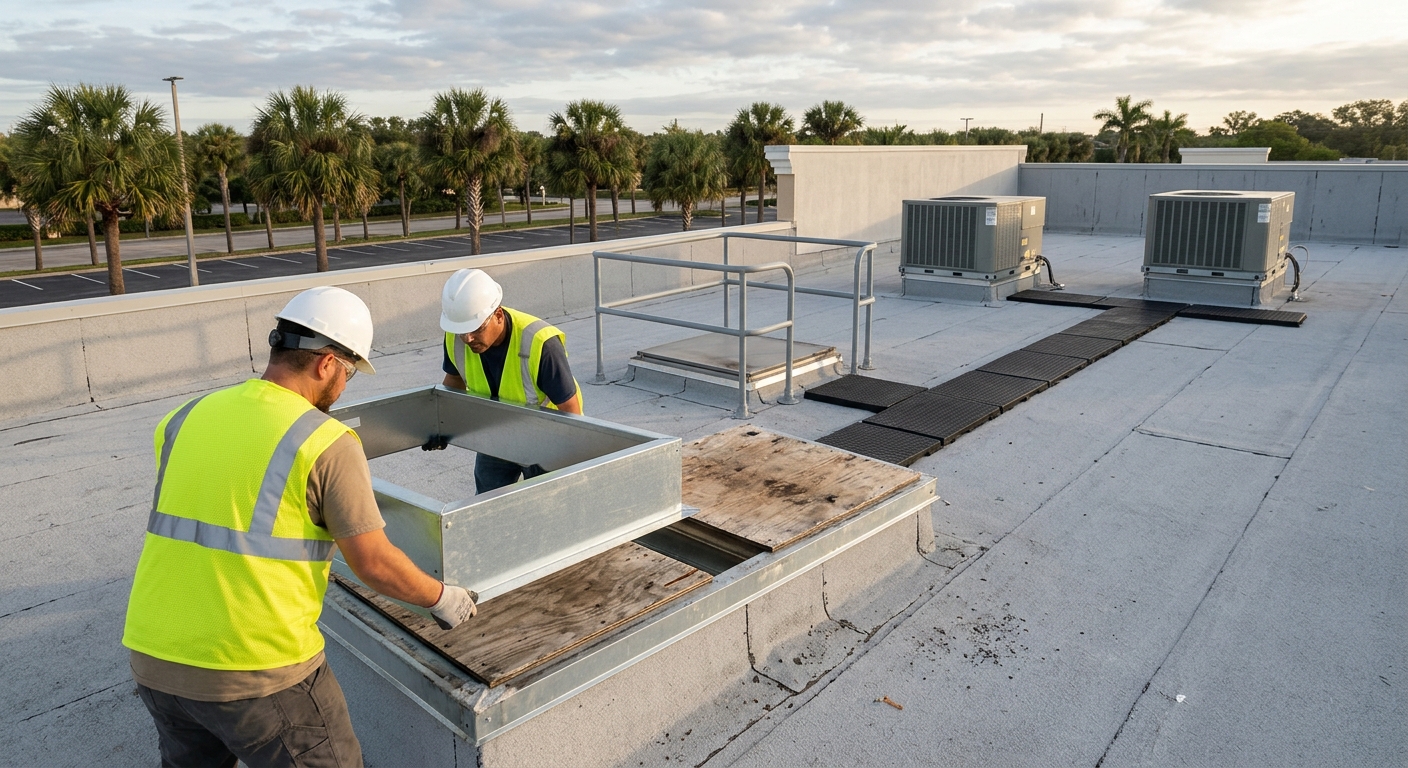
Roof access is part of passing. The same Miami-Dade guidelines list guards for appliances, fans, and roof hatches within 10 feet of a roof edge (with an exception for permanent fall-arrest anchorage), ladder access for elevated structures higher than 16 feet, and a rooftop receptacle outlet. They also list a minimum anchor bolt pull-out of 500 pounds under Miami-Dade’s Chapter 8 ordinance and commissioning under Energy Code Section C408.2 at final; see our guide to commercial HVAC commissioning after a retrofit.
On a rooftop replacement, the permit usually touches the roof. New curbs, curb adapters, and anchorage penetrations need flashing that keeps the roof warranty in force, and which licensed trade performs it is a question for the building department; see our guide to rooftop HVAC replacement coordination with the roofing contractor. Advanced Air Systems is a division of Advanced Roofing Inc., whose commercial re-roofing services can be sequenced with the HVAC work when the roof is due. Property managers should time tenant notices to inspection windows and set an HVAC contingency plan for AC failure before the old unit comes off.
Which code edition and statutes apply to a permit filed around December 31, 2026?
As of November 3, 2026, the 8th Edition (2023) Florida Building Code governs applications submitted before December 31, 2026, and the 9th Edition (2026) governs applications submitted on or after that date, per the Miami-Dade notice cited above. A replacement designed under the 8th Edition and filed in January needs its submittals checked against the 9th Edition, and the engineer of record decides whether the design changes. Other 2026 changes are narrower than they appear. House Bill 803, effective July 1, 2026, changed permit expiration for county-issued single-family dwelling permits, and Miami-Dade’s memo does not address commercial permits. Owners should re-check each dated item with the building department when the application is filed.
Commercial HVAC permit Miami-Dade and Broward checklist: who owns each step?
Each step below has an owner, and the permit moves fastest when each owner acts before the contract is signed.
- Property or facility manager: confirm whether the parcel sits in a city or in the unincorporated county from the property appraiser record before requesting bids.
- Owner: decide whether the replacement is planned or likely to become an emergency, and approve the contingency plan either way.
- Engineer of record: confirm load calculations, anchorage design, and which code edition the submittal follows when filing near December 31, 2026.
- HVAC contractor: name the permit path, list every document the jurisdiction’s checklist requires, and confirm the license class covers the system size.
- Owner: record the notice of commencement before the first inspection when the contract is $15,000 or more.
- Roofing contractor: confirm curb, flashing, and penetration scope and whether a separate roofing permit applies.
- Property manager: schedule tenant notices around inspection windows and keep roof access compliant for the inspector.
- Owner: file the final inspection record, approved plans, and AHRI certificate with the equipment records.
Frequently Asked Questions
Do I need a permit to replace a commercial AC unit in Miami-Dade?
Yes. Replacing commercial air conditioning equipment in Miami-Dade requires a mechanical permit from the parcel’s building department, which is a city department inside the 35 municipalities or the county’s RER in the unincorporated area. Like-for-like change-outs usually file with a change-out form and anchorage documents. In the unincorporated area, the county fee sheet notes that exact change-outs over 15 tons require processing.
What documents does a Broward HVAC permit require for a change-out?
A Broward change-out for residential or light commercial equipment carries the Broward County Uniform Data Form required by BORA Policy 19-02, plus the city’s checklist items. Common items include an AHRI certificate, sealed anchoring details or NOA documents, and the signed contract. Chillers and cooling towers generally require plans.
Can a failed commercial AC unit be replaced before the permit is issued?
In Broward, yes. BORA Formal Interpretation #36 treats any interruption of an HVAC system as an emergency, and the Broward amendment to Section 105.2.1 requires the permit application within the next working business day. Miami-Dade cities set their own emergency procedures. Code and inspection requirements still apply.
Does the 9th Edition Florida Building Code affect HVAC replacement permits?
Yes, for applications submitted on or after December 31, 2026. Miami-Dade’s notice states that those applications and plans must comply with the 9th Edition (2026), including portal filings after 4 p.m. on December 30, 2026. Earlier applications follow the 8th Edition (2023).
How long does a commercial HVAC permit stay valid in Miami-Dade and Broward?
Validity depends on the jurisdiction and on inspections. Miami-Dade’s June 2026 memo restates that a permit becomes invalid if work has not started within six months and that each approved inspection extends validity 180 days. The City of Sunrise in Broward requires an approved inspection at least every 90 days.
Who pulls the permit for a commercial HVAC replacement?
The licensed contractor applies for the permit, and the owner records the notice of commencement when the HVAC contract is $15,000 or more. Florida limits a Class B air-conditioning contractor to 25 tons of cooling and 500,000 Btu of heating in any one system, so the license class should match the equipment size.
Putting the permit on the replacement schedule from the first site visit
The permit path for a commercial HVAC replacement in Miami-Dade or Broward rests on facts an owner can learn early: which building department covers the parcel, whether the job is an exact change-out or needs plans, what anchorage documentation the reviewer will accept, and which code edition the filing date triggers. Each of those facts moves the crane date and the length of any shutdown, and confirming them before signing gives the engineer, contractor, and tenants a schedule that holds. The building official still decides compliance, and no contractor can promise an approval date.
Written by The Technical Team at Advanced Air Systems. Established in 1994, Advanced Air Systems is a 100% employee-owned commercial HVAC contractor and a division of Advanced Roofing Inc., with offices in Fort Lauderdale, Miami, and West Palm Beach.
To scope a replacement and its permit path in Miami-Dade or Broward, request a free commercial HVAC quote or call (954) 332-1418.