At a glance: An HVAC contingency plan decides, before summer, how a South Florida commercial building will respond when cooling fails: which zones are critical, which failures get repaired, bridged with temporary cooling, or replaced, where temporary equipment connects and draws power, and who approves the cost. This guide covers failure types, temporary cooling rental drivers, occupied-building issues, the Florida emergency permit path, the 2026 and 2027 code and refrigerant dates, and a checklist assigned by role.
An HVAC contingency plan for a South Florida commercial building is worth writing in the cooler months, because the decisions inside it are made poorly once a chiller or rooftop unit has already failed in an occupied building. The plan settles in advance which zones must stay cool, which failures get repaired, bridged with temporary cooling, or replaced, where temporary equipment connects and draws power, and who can approve the spending after hours. Without one, a July failure can mean days without cooling, humid finishes, angry tenants, and rental equipment already committed to other buildings before anyone calls. This article does not argue that every building needs standby equipment or a standing rental agreement; for many buildings the right plan is a fast repair path and a short list of fallbacks, and the plan should say which.
Why should an HVAC contingency plan be finished before summer 2027?
An HVAC contingency plan is a written procedure that names a building’s critical cooling zones, its repair and rental partners, the power and connection points for temporary equipment, the permit steps for an emergency replacement, and the person authorized to approve spending. It turns a cooling failure into a sequence of calls that were approved in advance.
Three dated changes land between now and the next cooling season. Miami-Dade County’s permitting notice states that the 9th Edition (2026) Florida Building Code takes effect December 31, 2026, and that permit applications submitted on or after that date must comply with it, so next summer’s emergency replacements fall under the new edition. EPA’s May 2026 final rule reconsidering Technology Transitions requirements removed the installation deadline for residential and light commercial air conditioning and heat pump systems built from components made or imported before January 1, 2025, and kept the provisions that let replacement condensing units be sold to repair existing split systems. EPA’s December 2024 final rule for variable refrigerant flow systems allows higher-GWP VRF systems built from components made or imported before January 1, 2026, to be installed only until January 1, 2027, with a narrow extension for projects that held a qualifying building permit.
Owners also carry refrigerant duties during a repair. EPA’s January 2026 fact sheet on leak repair requirements states that, beginning January 1, 2026, owners or operators of appliances holding 15 pounds or more of an HFC-containing refrigerant must calculate a leak rate whenever refrigerant is added, and comfort-cooling appliances above a 10 percent leak rate must be repaired within 30 days. The same fact sheet exempts the residential and light commercial air conditioning subsector and places chillers in their own subsector. A July top-off can start that clock.
The Pacific Northwest National Laboratory’s operations and maintenance best practice guidance for the Department of Energy reports that more than 55 percent of maintenance at an average facility is reactive, against less than 10 percent at top-performing facilities, and estimates that preventive maintenance saves 12 to 18 percent over a purely reactive program. A mostly reactive building enters summer knowing least about which equipment will fail next.
What fails in a commercial AC system, and what sets the repair timeline?
Most cooling failures in a commercial building fall into a few families, and each runs on a different clock. Contactors, capacitors, and fan motors fail suddenly and are often replaced in one visit when the part is on the service vehicle. Compressor failures, refrigerant leaks, and failed chiller components take longer, because the repair can require diagnosis, refrigerant recovery, ordered parts, and in some cases a crane pick or a permit. Condensate overflow switches shut units down to protect ceilings, which turns a clogged condensate drain into a cooling outage.
In South Florida the outage is measured in humidity as much as in temperature. A cooling coil removes moisture from the supply air while it cools it, so a stopped system stops dehumidification at the same moment. Outdoor air entering through doors and ventilation keeps adding moisture, and indoor relative humidity climbs while the space warms. Ceiling tile, carpet, drywall, and stored paper absorb that moisture, so a one- or two-day outage can leave cleanup work behind.
| Failure | Typical repair path | What controls the timeline |
|---|---|---|
| Contactor, capacitor, or fan motor | Diagnose and replace on site | Whether the part is stocked on the service vehicle |
| Refrigerant leak | Locate, repair, evacuate, recharge, verify | Leak location, refrigerant availability, EPA leak-rate duties where they apply |
| Compressor failure | Replace the compressor or condensing section | Parts lead time, equipment age, refrigerant type |
| Packaged rooftop unit beyond repair | Emergency replacement | Equipment availability, crane scheduling, curb fit, permit and anchoring documents |
| Chiller component failure | Repair on site or isolate the machine | Parts lead time, plant redundancy, temporary chiller connection |
| Condensate overflow shutdown | Clear the drain, reset the safety, inspect the pan | Access to the unit and the drain route |
Repair, temporary cooling rental, or emergency replacement: which path fits the failure?
A contingency plan assigns each likely failure to a path, because the right response to a failed capacitor differs from the right response to a failed compressor in August. The decision turns on how long the repair will take, how critical the zone is, and whether temporary equipment can physically reach and serve the space. Commercial air conditioning repairs restore the existing system and are the first path for most failures. Temporary cooling bridges a longer repair or a replacement. An emergency replacement makes sense when the equipment was already near the end of its service life, which is the same test as deciding when repair stops paying and replacement makes sense.
| Option | Best fit | Where it falls short |
|---|---|---|
| Emergency repair | Single-component failures on equipment with service life left | Depends on parts in stock; repeated repairs on end-of-life equipment cost more over time |
| Portable spot coolers | Small rooms, IT closets, short outages | Low capacity per unit; need condensate handling and space to reject heat; limited dehumidification across large areas |
| Trailer-mounted temporary chiller | Chilled water buildings with a prepared tie-in | Needs valved connections, a hose route, staging space, and large temporary power |
| Temporary packaged units, ducted in | Buildings with an accessible duct entry point | Duct routing through doors or openings affects security and the envelope; staging or a crane may be required |
| Emergency replacement | Failed equipment already due for replacement | Equipment availability, crane and permit timing; a rushed selection can skip load verification |
| Load shedding and relocation | Low-priority zones during short outages | Moves people and operations; unacceptable for critical spaces |
None of these paths makes a building immune to an outage. A repair can uncover a second failure, a rental unit can fail, and a replacement can wait on equipment. Owners of smaller buildings with one or two simple systems are often well served by a fast repair agreement and no rental arrangement at all, and a contractor organized around large occupied buildings is not the lowest-cost choice for every one of those buildings. The plan should be sized to the building’s risk.
What drives the cost and setup time of a temporary cooling rental?
A temporary cooling rental is priced and scheduled by a short list of site conditions, and most of them can be settled in November. Advanced Air Systems does not publish pricing, and rental rates vary by provider, capacity, and season, so this section lists the drivers rather than figures.
| Driver | Why it matters | Settle it in advance by |
|---|---|---|
| Capacity required, in tons | Sets the size and number of units | Having the engineer or contractor state the cooling load of each critical zone |
| Electrical power | Large temporary units need generator power or a temporary feed installed under NFPA 70 Article 590 | Identifying a disconnect location or generator pad and confirming capacity with an electrician |
| Connection points | Chilled water tie-ins or duct entry points decide whether temporary equipment can serve the space | Installing valved, capped tie-ins during a planned shutdown |
| Staging and access | Trailers and units need a level pad, truck access, and a clear hose or duct route | Marking a staging area on the site plan |
| Delivery terms | Rental availability during regional heat events is first come, first served | Pre-negotiating an agreement with stated delivery commitments |
| Rental duration | Cost accrues by the day or week | Matching the rental term to the repair or replacement schedule |
Tie-in connections are the item owners skip most often. A chilled water building without valved connections for a temporary chiller has to schedule a plant shutdown to cut them in, which is the disruption the emergency was supposed to avoid. Installing them during a planned off-season shutdown, coordinated with the building’s chiller and cooling tower services provider, removes the slowest step from an emergency setup. Rooftop-unit buildings need the same decision about where temporary ductwork enters.
What changes when an occupied Florida building loses cooling?
An occupied building turns a cooling failure into a communication and safety problem within hours. Tenants need to know which spaces are affected and for how long, operations staff need to know which loads to protect, and the property manager needs one person authorized to approve rental and repair costs after hours. Server rooms, pharmacies, and medical suites belong at the top of the critical zone list, with their acceptable temperature and humidity ranges written down.
Worker heat exposure belongs in the plan. OSHA’s proposed Heat Injury and Illness Prevention rule would exclude indoor work sites kept below 80°F and would require employers above an 80°F heat index trigger to provide measures such as drinking water, cooled break areas, and rest breaks. As of October 2026 that rule has not been finalized, so employers should confirm their current obligations with a safety advisor. A cooling outage is the moment an indoor site crosses those thresholds.
Some occupancies already work under written rules. Florida’s Agency for Health Care Administration administers Rule 59A-4.1265, which requires nursing homes to have an alternate power source able to keep indoor temperatures at or below 81°F for at least 96 hours after the loss of primary power. The rule covers utility power loss rather than equipment failure, yet it shows how Florida regulators treat lost cooling for vulnerable occupants; administrators should confirm with counsel how equipment failures fit it.
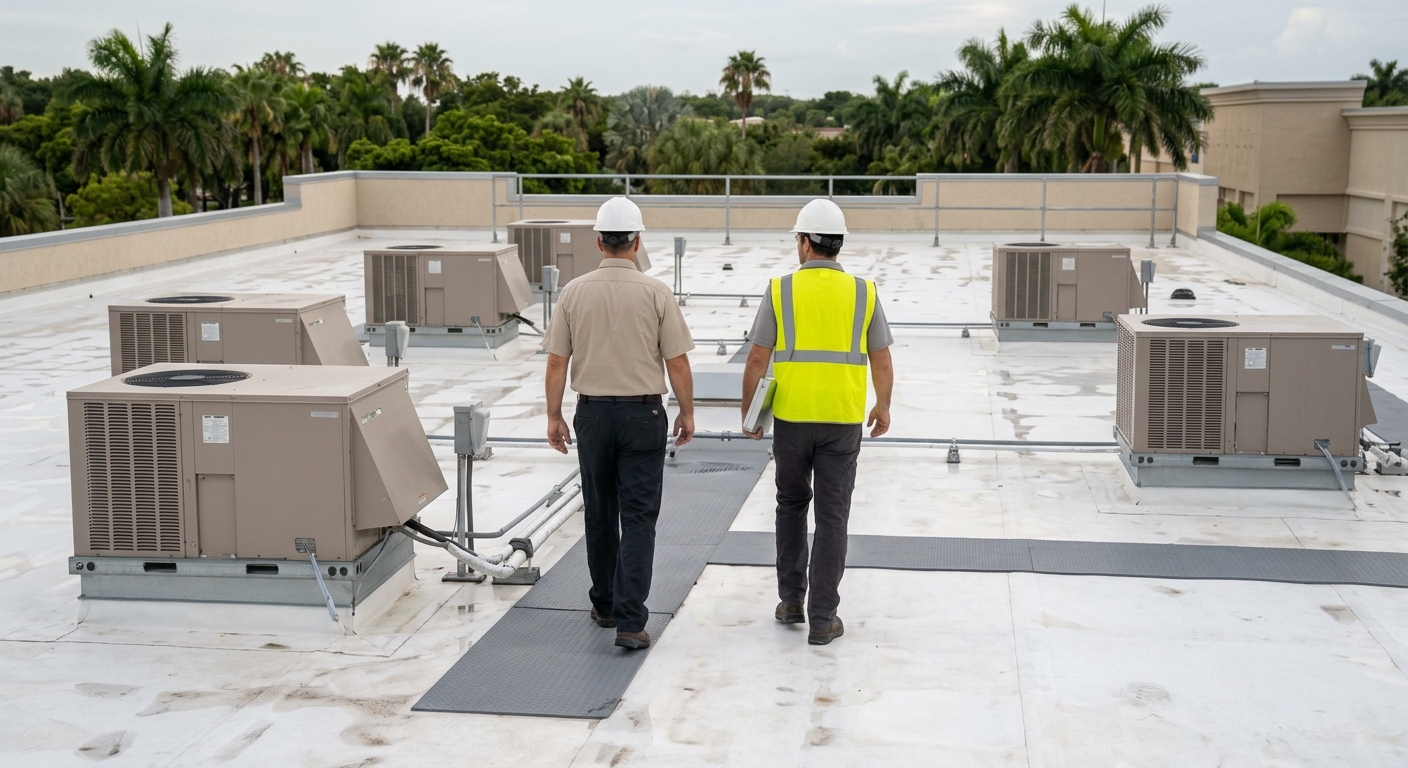
Rooftop work adds lift planning. Replacing a packaged unit on an occupied building means a crane pick, a curb that fits or an adapter that is fabricated, and a watertight roof around the opening at the end of each day. Advanced Air Systems lists an in-house crane division whose fleet includes boom trucks, hydraulic cranes, and two mobile hydraulic tower cranes, and as a division of Advanced Roofing Inc., the same organization handles the roofing around the curb. Lifts over occupied space are scheduled around tenants, so the plan should name the hours when picks are allowed.
Which rules govern emergency commercial AC repair in South Florida?
Florida’s building code lets emergency equipment work start before the permit, and South Florida jurisdictions publish their own procedures. Section 105.2.1 of the Florida Building Code, as amended in Broward County, requires the permit application within the next working business day when equipment must be replaced or repaired in an emergency. Broward County’s Board of Rules and Appeals adopted Formal Interpretation #36, effective September 12, 2025, stating that any interruption in the work of a heating, ventilation, and air conditioning system is considered an emergency under that section.
The emergency path still carries paperwork. Miami Shores Village’s air-conditioning emergency replacement form, for example, requires notifying the building department before the work, then filing the permit the next business day with replacement data sheets, an engineered anchoring detail, and a product approval or wind load calculation for the unit’s attachment. Each jurisdiction sets its own procedure, so the plan should hold the current form for each building, and the building official decides what a replacement requires.
As of October 2026, these provisions sit in the 8th Edition (2023) code and should be re-confirmed under the 9th Edition. Buildings served by variable refrigerant flow equipment face a second date: after January 1, 2027, an emergency replacement may need different equipment from the system it replaces, which our comparison of VRF, chillers, and rooftop units covers in more detail.
HVAC contingency plan checklist: who owns each step?
Most items below can be completed between November and April.
- Facility manager: List every cooling zone, rank it critical, important, or deferrable, and record the acceptable temperature and humidity range for each critical zone.
- HVAC contractor: Record the age, refrigerant, and repair history of each unit serving a critical zone, and flag equipment a failure would send to air conditioning unit change-outs instead of repair.
- Mechanical engineer: Confirm the cooling load of each critical zone so temporary equipment is sized from a calculated number.
- Electrician: Identify the temporary power connection point or generator location and confirm its capacity under NFPA 70 Article 590.
- Owner or asset manager: Approve tie-ins or duct entry points during a planned shutdown, and set the manager’s after-hours spending limit.
- Property manager: Pre-negotiate a temporary cooling rental agreement with delivery commitments and after-hours contacts.
- Owner and HVAC contractor: Write emergency response terms into the commercial HVAC service contract, including response times by priority and refrigerant leak-rate duties.
- Property manager: Keep the local emergency replacement form and each rooftop unit’s anchoring documents on file.
- Facility manager: Draft tenant notices and run a tabletop exercise before May.
Frequently Asked Questions
What should an HVAC contingency plan include?
An HVAC contingency plan should list critical zones with temperature limits, the equipment serving each zone, repair and rental contacts with response commitments, temporary power and connection points, staging areas, the local emergency permit procedure, refrigerant recordkeeping duties, a spending limit for after-hours decisions, and drafted tenant notices. Review it each year before the cooling season and after any equipment change.
How quickly can temporary cooling be set up in a commercial building?
Setup time depends on equipment availability, power, and connection points more than on the unit itself. A building with valved chilled water tie-ins, a marked staging area, and an identified power source avoids the slowest steps, while a building without them may need piping, electrical work, or a plant shutdown first. Ask the rental provider to state delivery commitments in writing before summer.
Is a temporary cooling rental cheaper than an emergency AC replacement?
The two solve different problems, so the comparison depends on the failure. Rental costs accrue for each day or week the equipment stays, while a replacement is a capital cost that ends the outage. A rental fits when the existing equipment has years of service left and the repair needs time; a replacement fits when the failed unit was already due.
Do I need a permit for an emergency AC replacement in South Florida?
Florida Building Code Section 105.2.1 allows emergency equipment replacement to begin before the permit, with the application due the next working business day, and South Florida jurisdictions publish their own forms and anchoring requirements. Procedures vary by city and county, and the 9th Edition code takes effect December 31, 2026, so confirm the current procedure with the local building official.
Does a maintenance agreement replace an HVAC contingency plan?
No. A maintenance agreement lowers the odds of a failure and sets response times, while a contingency plan covers what happens when equipment fails anyway: which zones to protect, where temporary cooling connects, who approves costs, and how tenants are told. The two documents should reference each other, and a preventive maintenance program built on ASHRAE/ACCA Standard 180 supports both.
A plan written in November is the one used in July
An HVAC contingency plan earns its place because the conditions that make a summer cooling failure expensive are known well ahead of time: the critical zones, the equipment most likely to fail, the missing tie-ins and power points, the permit paperwork, and the code and refrigerant dates arriving before next season. Settling them in the cooler months turns an emergency into a set of approved steps. The building can still lose cooling when equipment fails. The plan shortens the outage, settles who decides what, and fixes how much of the cost was chosen in advance. Service details for buildings in our area are on the emergency commercial HVAC repair in Miami and commercial HVAC contractor in Fort Lauderdale pages.
Written by The Technical Team at Advanced Air Systems. Established in 1994, Advanced Air Systems is 100% employee-owned and a division of Advanced Roofing Inc.
To review your building’s equipment before the next cooling season, request a free quote or call (954) 332-1418.