At a glance: VRF, chilled water, and packaged rooftop units each fit a different kind of South Florida building. This guide compares how each system moves heat and removes moisture, where each falls short in a hot, humid, cooling-dominated climate, what drives cost and schedule, and how replacement works in an occupied building. It covers the EPA refrigerant dates that put a January 1, 2027 installation deadline on higher-GWP VRF systems, the December 31, 2026 Florida Building Code change, and a decision checklist assigned by role.
The VRF vs chiller vs packaged rooftop unit decision for a South Florida building turns on four conditions specific to the site: how much moisture the system must remove, how the floor plan is divided, what the roof and water supply can carry, and which refrigerant rules apply on the permit date. Each system wins on some of those conditions and loses on others. Choosing from an efficiency figure measured in a different climate can leave an owner with a quiet, efficient system that keeps the building clammy, or a chiller plant whose cooling tower costs more to run than the budget assumed. This article compares the three systems for Florida commercial, institutional, and multifamily buildings. It does not size equipment or pick a manufacturer; those decisions belong to the building’s mechanical engineer of record.
Why is the VRF vs chiller decision time-sensitive in South Florida in late 2026?
Two regulatory calendars converge on South Florida HVAC projects between now and January 2027. EPA’s Technology Transitions table of HFC restrictions by sector, last updated August 28, 2026, sets a 700 global warming potential (GWP) limit for new variable refrigerant flow systems with an installation compliance date of January 1, 2027. Under the table’s footnote, higher-GWP VRF systems can be installed until that date only if every component was manufactured or imported before January 1, 2026, and until January 1, 2028 in buildings that received an approved building permit before October 5, 2023 that allowed an HFC in that system.
The same table treats the other two systems differently. Comfort-cooling chillers have carried a 700 GWP limit since January 1, 2025. Residential and light commercial air conditioning systems, a category EPA illustrates with mini-splits and unitary systems, have no installation compliance date where every component was manufactured or imported before January 1, 2025; the manufacturer confirms which category a specific rooftop unit falls in. As of October 28, 2026, a VRF project bid on higher-GWP equipment has roughly two months of installation runway, while chiller and rooftop projects follow different dates.
The building code moves at the same time. The Florida Building Code, 9th Edition (2026) takes effect December 31, 2026, and Miami-Dade County’s notice on the 9th Edition code change states that permit applications and plans submitted on or after that date must comply with the new edition. The permit submittal date therefore sets the code edition and, for a VRF project, part of the refrigerant path.
How do VRF, chilled water, and packaged rooftop units move heat out of a building?
A packaged rooftop unit (RTU) holds the compressor, both coils, and the supply fan in one cabinet on the roof, and ductwork carries conditioned air down to the spaces it serves. A chilled water system makes cold water in a central chiller, pumps it to air handlers or fan coils throughout the building, and, in a water-cooled plant, rejects heat through a cooling tower that evaporates water. A VRF system runs refrigerant itself from outdoor condensing units through piping to many small indoor fan coils, and inverter-driven compressors vary refrigerant flow to match each zone’s demand.
| System | Heat transfer medium | Where the main equipment sits | What runs through occupied space | How moisture is removed |
|---|---|---|---|---|
| Packaged rooftop unit | Air (refrigerant stays in the roof cabinet) | Roof, one curb per unit | Supply and return ductwork | Cooling coil in each unit; outside air through the unit |
| Chilled water (air- or water-cooled) | Water to air handlers or fan coils | Plant room or plant yard; cooling tower if water-cooled | Chilled water piping, air handler ductwork | Chilled water coils at air handlers, sized for latent load |
| VRF | Refrigerant to indoor fan coils | Condensing units on roof or grade; branch boxes in ceilings | Refrigerant piping, branch boxes, fan coils | Each fan coil; ventilation air usually handled by separate equipment |
The medium matters because it decides what runs over occupants’ heads and how moisture leaves the air. ASHRAE Standard 15 sets added requirements for high-probability systems, those in which leaked refrigerant can reach an occupied space, and a VRF system with fan coils in occupied rooms is designed under those provisions. Chilled water keeps refrigerant in the plant and puts water piping above the ceilings. Rooftop units keep both refrigerant and compressors on the roof.
Part-load performance is where VRF’s reputation comes from. In an Oak Ridge National Laboratory study published in April 2018, a VRF system in an occupancy-emulated research building in the southeastern U.S. measured cooling COPs of 4.2, 3.9, and 3.7 at 100, 75, and 50 percent load, against 3.1, 3.0, and 2.5 for a rooftop unit variable-air-volume system with electric resistance heat, for estimated cooling savings of 30, 37, and 47 percent. The baseline was an RTU feeding VAV boxes with electric reheat; the study did not test a current high-efficiency RTU or a chiller plant. In October 2016, Advanced Air Systems announced it had been named a Daikin VRV Pro Contractor.
Where does each system fall short in a South Florida building?
Each system has a weakness that matters more in South Florida than in the national literature. VRF’s headline advantage is heat recovery, which moves heat from zones that need cooling to zones that need heating. PNNL’s 2012 VRF assessment for GSA’s Green Proving Ground program projected HVAC energy savings of 34 percent and higher, and listed climates with significant heating loads, buildings with limited room for ductwork changes, and buildings of 5,000 to 100,000 square feet among the characteristics to target. A Miami-Dade or Broward building has little heating load, so the comparison rests on cooling and dehumidification rather than heat recovery.
Moisture is the second test. EPA’s mold guidance recommends keeping indoor relative humidity below 60 percent, ideally between 30 and 50 percent, and South Florida ventilation air arrives warm and wet for most of the year. Ask the engineer of record how ventilation air will be dehumidified on each option. If a VRF design depends on a separate dedicated outdoor air unit, that unit, its ductwork, and its roof penetration belong in the VRF price.
Chilled water plants carry their own operating burden. The Department of Energy’s Federal Energy Management Program guidance on cooling tower management notes that cooling towers reject heat through evaporation and therefore use significant amounts of water, and that controlling blowdown is the largest water-saving opportunity. CDC’s Legionella control toolkit treats cooling towers as one of the water systems commonly implicated in Legionnaires’ disease outbreaks and publishes a dedicated module on their operation and maintenance. Tower condition is a recurring cost covered in cooling tower protective coatings.
Packaged rooftop units are the simplest of the three to replace one at a time, and their limits are physical. Every unit is a curb and a penetration in the roof, each unit serves its area as one zone, and oversized units cycle off before they remove enough moisture. Our guide to commercial rooftop unit replacement in South Florida covers when an RTU is due.
| System | Best fit in South Florida | Where it falls short |
|---|---|---|
| VRF | Many small zones; retrofits with little ceiling space for new ductwork; mid-size buildings | Heat recovery adds little in a cooling-dominated climate; ventilation air needs its own dehumidification; refrigerant piping in occupied space is designed under ASHRAE 15; controls and parts are manufacturer-specific |
| Chilled water | Large buildings and campuses with a central plant, mechanical staff, and a long ownership horizon | Cooling tower water use and chemical treatment; Legionella water management program; plant room, pumps, and a major project when the plant is replaced |
| Packaged rooftop unit | Low-rise retail, office, and warehouse buildings with open floor plans; phased one-unit-at-a-time work | Many roof penetrations; zone control limited to each unit’s area; oversized units leave spaces humid; salt-air coil corrosion on coastal roofs |
A contractor organized around occupied, multi-unit buildings is not always the lowest bid for one small rooftop unit. An owner with a working R-410A system does not need to replace it because of the refrigerant transition, and lower-GWP equipment can cost more to buy and install.
What drives cost, schedule, and energy results for each system?
Advanced Air Systems does not publish pricing, and published VRF-versus-chiller cost comparisons rarely state building size, climate, or scope. The installed price turns on the work around the equipment; list each driver below as a line item.
| Cost or schedule driver | VRF | Chilled water | Packaged rooftop unit |
|---|---|---|---|
| Distribution | Refrigerant piping and branch boxes through occupied ceilings | Chilled water piping, pumps, air handlers | Ductwork from each roof unit |
| Ventilation air | Separate outdoor air unit if the design relies on one | Conditioned at the air handlers | Outside air through each unit |
| Roof and structure | Condensing units on rails; smaller lifts | Chiller pad or roof structure; large crane pick | Curb, adapter, flashing, and crane pick per unit |
| Water and treatment | None | Make-up water, blowdown, chemical program (water-cooled) | None |
| Controls | Manufacturer-specific network | Building automation across the plant | Unit controls or building automation |
| Refrigerant timing (EPA table, Aug. 28, 2026) | Jan. 1, 2027 installation date for higher-GWP systems | 700 GWP limit since Jan. 1, 2025 | Pre-2025 components may still be installed |
Energy results depend on run hours, the utility rate, controls, and installation quality. Utility incentives can offset part of a premium. Florida Power & Light’s Business HVAC Program Standards describe incentives for high-efficiency chillers and split or packaged direct-expansion systems and for variable frequency drives on HVAC pumps. FPL sets the amounts and eligibility, so confirm whether a specific VRF or chiller selection qualifies before the bid assumes an incentive.
What changes when the system is replaced in an occupied South Florida building?
Each system disrupts an occupied building differently, and that pattern often outweighs the efficiency rating. Rooftop unit replacement happens on the roof one unit at a time, so each zone loses cooling for one shift and the crane pick is the main event. For a Publix in Homestead, Advanced Air Systems changed out the old mechanical equipment with two 50-ton Daikin rooftop packaged units, lifted by the company’s Crane Division with a 300-ton hydro crane. Our commercial AC unit change-outs follow that sequence.
Chiller replacement concentrates the risk in one plant. When the chillers and pumps on the Weston YMCA Family Center’s 180-ton system reached the end of their service life, Advanced Air Systems kept the facility cooled with a temporary chiller while two 90-ton air-cooled scroll chillers, new pumps, insulated chilled water piping, and new controls were installed, according to the company’s project record. Chiller and cooling tower services for occupied buildings start with that temporary cooling plan.
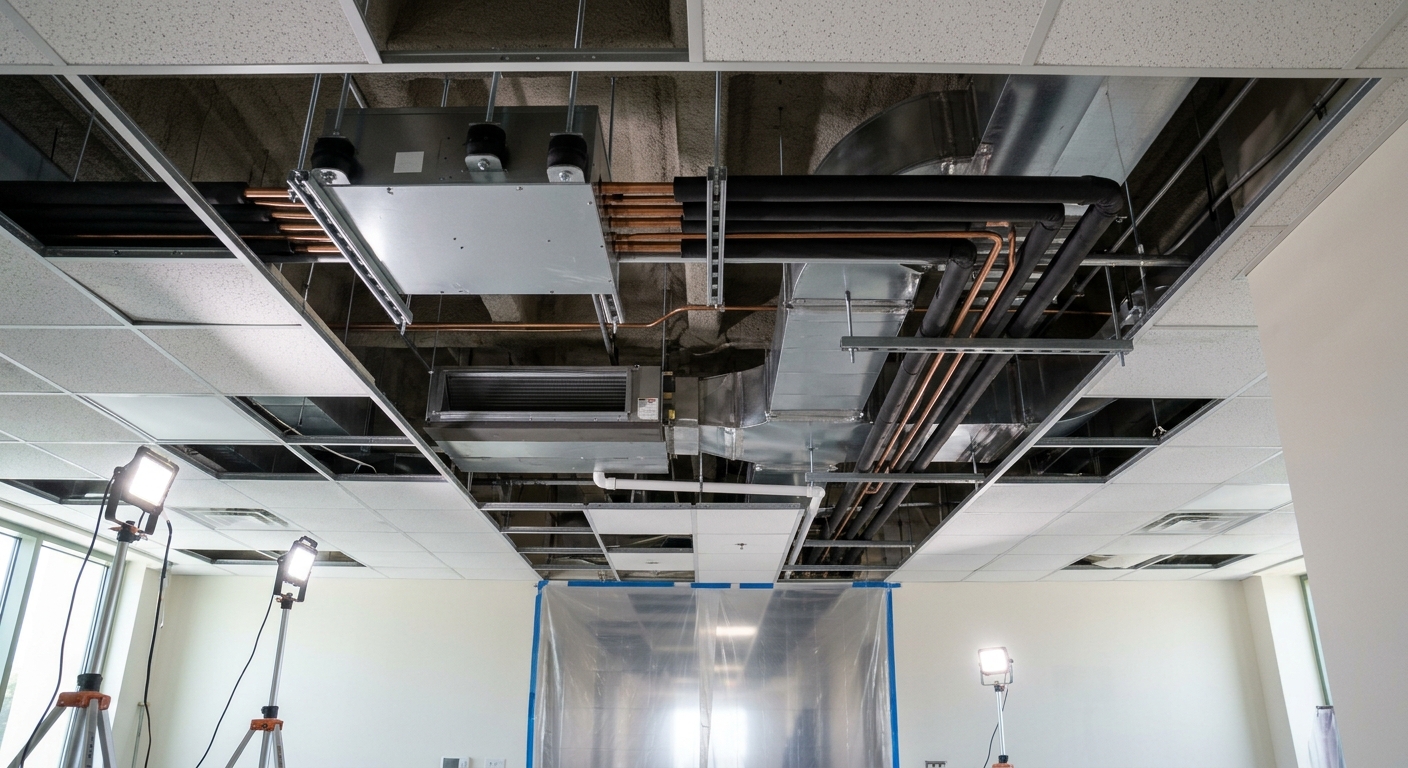
A conversion to VRF moves the work indoors. Refrigerant piping, branch selector boxes, and fan coils go into occupied ceilings, so the work is phased floor by floor or tenant by tenant, with dust control and after-hours work planned before the contract. That work falls under commercial HVAC retrofits, where existing equipment keeps serving the zones not yet converted.
Every option on a Miami-Dade or Broward roof also needs attachment designed for the High-Velocity Hurricane Zone. SPRI’s white paper on rooftop equipment attachment notes that rooftop equipment forms part of the building envelope and that equipment is frequently displaced in wind events. If the roof is near the end of its life, coordinate the HVAC work with re-roofing by our sister company Advanced Roofing so equipment is not lifted twice.
Which refrigerant and code dates apply to a VRF vs chiller decision?
The dates below are current as of October 28, 2026. Confirm each against its source on the day a contract is signed.
| Rule | Date | What it means for the system choice |
|---|---|---|
| EPA Technology Transitions: VRF systems, 700 GWP limit | Installation by Jan. 1, 2027 (Jan. 1, 2028 for qualifying permits issued before Oct. 5, 2023) | Higher-GWP VRF must be installed by the date and built from components made or imported before Jan. 1, 2026 |
| EPA Technology Transitions: comfort-cooling chillers, 700 GWP limit | Jan. 1, 2025 | New chiller selections use lower-GWP refrigerants |
| EPA Technology Transitions: residential and light commercial systems | No installation date where all components predate Jan. 1, 2025 | Remaining inventory can be installed; the manufacturer confirms the category |
| Florida Building Code, 9th Edition (2026) | Applications submitted on or after Dec. 31, 2026 | The submittal date sets the code edition for the permit |
| ASHRAE Standard 15-2022, A2L addenda | Addendum e approved Sept. 29, 2023 | Charge limits and safety measures for A2L systems that can leak into occupied space |
Lower-GWP equipment generally uses Group A2L refrigerants such as R-32 or R-454B, the lower-flammability class defined in ASHRAE Standard 34. The Standard 15 addenda tie the refrigerant charge that can be released into a space to the volume of that space, and add measures such as refrigerant detection, circulation airflow, and safety shutoff valves where charge exceeds the limit. Whether a specific building and layout comply is a determination for the engineer of record and the building official.
VRF vs chiller vs rooftop units: decision checklist by role
- Owner or asset manager: State the ownership horizon and whether the building will be re-tenanted or re-divided.
- Facility manager: Document humidity complaints, run hours, and equipment service history by zone before design starts.
- Mechanical engineer of record: Provide a load calculation that includes latent load, state how ventilation air will be dehumidified, and confirm ASHRAE 15 compliance for any refrigerant piped through occupied space.
- HVAC contractor: Price distribution, ventilation equipment, roof work, crane picks, controls, and temporary cooling as separate line items, and state the refrigerant and manufacture date for each piece of equipment.
- Facility manager and water treatment provider: For any cooling tower, budget make-up water, chemical treatment, and a Legionella water management program.
- Roofing contractor or roof consultant: Report the roof’s remaining service life and approve curb, rail, and pipe support flashing details.
- Owner and HVAC contractor: Confirm utility incentive eligibility, set the permit submittal date against the December 31, 2026 code change and the January 1, 2027 VRF date, and set up a preventive maintenance program from day one.
Frequently Asked Questions
Is a VRF system a good choice for humid South Florida buildings?
It can be, when the design treats moisture as its own problem. VRF fan coils modulate efficiently at part load, but outdoor ventilation air in South Florida carries a heavy moisture load, and EPA recommends keeping indoor relative humidity below 60 percent. Ask the engineer how ventilation air will be dehumidified. If the answer is a separate outdoor air unit, include that unit in the VRF price before comparing bids.
What is the 2027 installation deadline for VRF systems?
EPA’s Technology Transitions table sets January 1, 2027 as the installation compliance date for new VRF systems using refrigerants above 700 GWP, provided every component was manufactured or imported before January 1, 2026. Buildings with an approved building permit issued before October 5, 2023 that allowed an HFC in the system have until January 1, 2028. Confirm both dates against EPA’s table on the day the contract is signed.
When does chilled water make more sense than VRF?
Chilled water tends to fit large buildings and campuses with a central plant, mechanical staff on site, and a long ownership horizon, where one plant serves many air handlers. The trade-off is the cooling tower’s water use, chemical treatment, and Legionella water management program, plus a major project when the plant itself is replaced. The engineer’s load and life-cycle analysis decides it for a specific building.
Are packaged rooftop units still a good option for Florida commercial buildings?
Yes, for many low-rise retail, office, and warehouse buildings with open floor plans. Rooftop units can be replaced one at a time with a crane pick, which limits disruption in an occupied building. Their limits are roof penetrations, zone control limited to each unit’s area, and humidity problems when units are oversized, so the load calculation matters as much as the efficiency rating.
Can a building convert from rooftop units to VRF while it stays open?
Yes, with phasing. A VRF conversion puts refrigerant piping, branch boxes, and fan coils into occupied ceilings, so the work is sequenced floor by floor or tenant by tenant, with after-hours work where occupants require it. The existing rooftop units keep serving zones not yet converted, and retired curbs are removed and the roof closed to the roof warranty holder’s requirements.
Choosing among VRF, chilled water, and rooftop units for a Florida building
A South Florida building is cooling-dominated, humid, exposed to salt air and hurricane winds, and usually occupied while its HVAC system is replaced. Those conditions narrow VRF’s heat-recovery advantage, put ventilation dehumidification at the center of every design, make cooling tower water a standing cost of chilled water, and keep rooftop units competitive where floor plans are open. Settle the moisture strategy, the floor plan, and the permit date first, and the system choice follows. Planning steps are covered in planning a commercial HVAC project in South Florida, and local details are on our Miami commercial HVAC page.
Written by The Technical Team at Advanced Air Systems. Established in 1994, Advanced Air Systems is 100% employee-owned and a division of Advanced Roofing Inc., serving commercial buildings across South Florida. Learn more about employee ownership at Advanced.
Compare systems for your building. Call (954) 332-1418 or request a free quote from Advanced Air Systems for an assessment of your chiller plant, rooftop units, or VRF options.