At a glance: A rooftop HVAC replacement opens the roof at every curb it touches. This guide explains why the roofing contractor belongs in the scope from the first site visit, what fails at the curb when the trades work separately, how to choose between reusing a curb, adding a curb adapter, or a full HVAC roof curb replacement, what drives roofing cost and schedule, how to sequence rooftop unit waterproofing on an occupied Florida building, and which code, licensing, and warranty rules apply.
A rooftop HVAC replacement on a commercial building is also roofing work, and it should be scoped, permitted, and sequenced that way from the first site visit, because lifting a packaged unit off its curb opens the roof at a penetration, disturbs the flashing that keeps water out, and often changes the curb itself. When the roofing contractor arrives only after the new unit is set, the owner tends to pay twice, first for the change-out and then for leak repairs, reflashing, or a warranty claim the roof manufacturer declines because the alteration was never authorized. This article explains where the two trades overlap, how to choose between reusing, adapting, and replacing a curb, and how to sequence the work on an occupied Florida building. It does not size equipment or make code, licensing, or warranty determinations, which belong to the engineer of record, the building official, and the roof manufacturer.
Why does a rooftop HVAC replacement involve the roofing contractor?
A rooftop HVAC replacement involves the roofing contractor because the curb under the unit is part of the roof system. Florida’s licensing statute, the Florida Building Code, and the roof warranty each draw a line at the curb, and a change-out scope that ignores any one of them leaves a gap the owner pays to close.
Section 489.105 of the Florida Statutes includes a definition of a roofing contractor covers installing, repairing, and altering all kinds of roofing and waterproofing, along with required roof-deck attachments. The Class A air-conditioning contractor definition in the same section covers equipment, ductwork, piping, controls wiring, and condensate drains to an approved disposal point, and it does not list roofing or waterproofing. Which licensed trade must perform a particular curb-flashing detail is a question for the building department, and the simplest way to keep that question off a project is to put the flashing in the roofing contractor’s scope.
The code ties the equipment to the roof as well. Section 1510.10 of the Florida Building Code, Building, 8th Edition (2023) requires roof-mounted mechanical units outside the High-Velocity Hurricane Zone to sit on curbs raised at least 8 inches above the roof surface, or on raised supports whose clearance grows with unit width. Section 1522.3 sets a parallel clearance table for Miami-Dade and Broward counties so the roof beneath equipment can be repaired and replaced.
The roof warranty is the third line. A Total Roofing System Warranty form published by the State of Tennessee for its own public buildings shows language typical of manufacturer no-dollar-limit warranties. Placing equipment on or through the roof after acceptance voids coverage for the affected area unless the manufacturer authorizes it in writing, and alterations not completed by an authorized contractor are not warranted. Florida owners should read their own warranty, because terms vary by manufacturer and by contract.
What fails at the curb when commercial HVAC roof coordination is skipped?
Curb leaks after an HVAC change-out usually start at the transition between the membrane and the curb wall, where the roof’s waterproofing turns vertical and has to stay attached through heat, wind, and movement. NRCA’s construction details, as summarized in NRCA’s Professional Roofing magazine, recommend a minimum flashing height of 8 inches and a sealing material between the curb and the equipment frame. Water on a low-slope roof moves sideways, and a low or loose flashing edge lets wind-driven rain and ponded water run behind it.
Replacement work creates these failures in predictable ways. Old units are often removed with flashing still bonded to the curb, so the membrane tears at the base when the curb is pried or cut. A curb that stood 12 inches tall when installed can end up closer to 8 after a reroof adds insulation, leaving little room to terminate new flashing. A new unit with a different footprint sits on an adapter, and the gaskets and fasteners between adapter, curb, and unit become a second seam where water can enter. Crews dragging equipment, staging materials, or walking off the walkway pads puncture the membrane away from the curb.
Wind adds a structural failure to the waterproofing one. SPRI’s 2022 white paper on rooftop equipment attachment explains that displaced rooftop equipment can tear roof membranes and let water directly into the building, and its checklist calls for investigating the roof warranty terms and developing a loading, travel, and protection plan for the membrane before work starts. Condensate is the slow version of the same problem, covered in Advanced Air Systems’ guide to commercial HVAC condensate drain problems.
| Failure point | What happens physically | Who should own it |
|---|---|---|
| Base flashing torn at removal | Membrane bonded to the old curb rips when the unit or curb is pulled | Roofing contractor, on site the day of the lift |
| Flashing height lost after a reroof | Added insulation lowers the curb’s height above the finished roof | Roofing contractor and engineer, during scoping |
| Adapter-to-curb seam | Gaskets and fasteners between adapter and existing curb open over time | HVAC contractor (fit and seal); roofer reviews counterflashing |
| Membrane punctures from traffic | Equipment, tools, and debris cut the field membrane | Both trades, under a written protection plan |
| Anchorage penetrations | Tie-down fasteners through the membrane or curb flange left unsealed | Engineer (design); roofer (flashing) |
| Condensate onto the roof | A drain line discharges onto the membrane and keeps one area wet | HVAC contractor; roofer confirms routing |
HVAC roof curb replacement, curb adapter, or reuse: which option fits?
Every rooftop unit change-out ends in one of three curb decisions, and the choice should come from a roof-side inspection rather than the new unit’s catalog dimensions. The deciding facts are the existing curb’s condition and height, whether the new unit’s footprint and duct openings match, the roof’s remaining service life, and what the roof warranty allows. Advanced Air Systems lists curb adaptors among its commercial retrofit solutions and performs commercial AC unit change-outs on all three paths.
| Option | When it fits | What it asks of the roof | Where it falls short |
|---|---|---|---|
| Reuse the existing curb | Same-footprint unit; curb sound, level, and tall enough; flashing intact | Flashing inspection; reseal or counterflashing by the roofer | Keeps the old curb height and any hidden corrosion; old flashing may be near the end of its life |
| Curb adapter on the existing curb | Different footprint or duct layout; existing curb sound | Little or no new membrane work if the base flashing is sound | Adds height, weight, and a seam; does not fix a low or deteriorated base curb or its flashing |
| HVAC roof curb replacement | Curb corroded, too low, or wrong for the new unit’s weight or anchorage | New curb, deck opening work, new base flashing, possible structural review | Opens the roof longest, needs the most coordination, and carries the highest roofing cost |
| Coordinate with a planned reroof | Roof replacement expected within a short horizon | Temporary seal now; full flashing with the new roof | Equipment may be lifted twice; a temporary seal is not permanent waterproofing |
Reuse is the least expensive path only when the base flashing has years left. An adapter avoids opening the deck, but it rests on the old curb and inherits that curb’s condition, height, and attachment. A full HVAC roof curb replacement costs the most and puts the roofer, the HVAC crew, and often the engineer on the roof the same day, and it is the only option that resets the curb, the flashing, and the anchorage together. Where the roof itself is within a few years of replacement, scheduling both projects so each unit is lifted once is usually cheaper; planning guidance for commercial HVAC projects in South Florida covers that roof-timing decision, and Advanced Roofing’s commercial re-roofing team can assess the roof’s remaining life.
No curb option repairs a roof that is already failing. A new curb flashed into a wet or deteriorated membrane leaks at the seam between new and old work, and a roofing contractor should say so before the HVAC contract is signed.
What drives cost and schedule on the roofing side of an RTU change-out?
The roofing share of a rooftop unit replacement is driven by what is found under and around the old unit, which is why it is the part of the budget most often missing from HVAC proposals. Advanced Air Systems does not publish pricing, and a cost range quoted without the roof system, curb count, and access conditions is not useful for budgeting. Ask each bidder to price the drivers below as separate line items, with the roofing scope stated by whoever will perform it.
| Driver | Why it moves cost or schedule | How to pin it down before award |
|---|---|---|
| Roof system type and age | Matching membrane, manufacturer authorization, and compatible flashing materials | Roof file: system, manufacturer, warranty holder, install date |
| Wet insulation at the curb | Saturated insulation must be cut out and replaced before reflashing | Cores or a moisture scan around each curb |
| Curb height and condition | Low or corroded curbs need extensions or replacement | Measured curb height above the finished roof, with photos |
| Deck opening changes | New duct openings may need deck framing and structural review | Engineer’s review of the opening and the new unit’s weight |
| Warranty authorization | Manufacturer approval and inspection add lead time | Written request to the manufacturer at the design stage |
| Crane and staging | Pick weight, reach, lane closures, and after-hours windows | Pick plan with crane size, location, and date window |
| Weather days | Open curbs must be dried in before rain | Daily dry-in requirement written into both contracts |
The schedule item that catches owners is lead time on the roofing side. A manufacturer inspection, a custom curb, or a structural review can take longer than equipment delivery, so the roofing questions belong in the first roof walk, before the unit is ordered.
How should rooftop unit waterproofing be sequenced on an occupied Florida building?
Rooftop unit waterproofing on an occupied building runs on a same-day rule, under which every curb opened in the morning is watertight before the crew leaves, whether or not the new unit is set. A missed dry-in becomes a ceiling leak in an occupied space that night.
On a multi-unit change-out the work runs in the order the owner sees it. The roofing contractor walks the roof with the HVAC project manager, photographs every curb, and records existing damage so it is not blamed on the new work. Protection boards and a marked travel path go down before equipment moves. Each zone’s cooling is shut down only for its own window, with the property manager notified in advance. The crane picks the old unit, the roofer inspects and repairs or replaces the curb flashing, the adapter or new curb is set and sealed, the new unit is lifted on and anchored, and the roofer completes counterflashing and seals any anchorage penetrations. A joint walk closes the day.
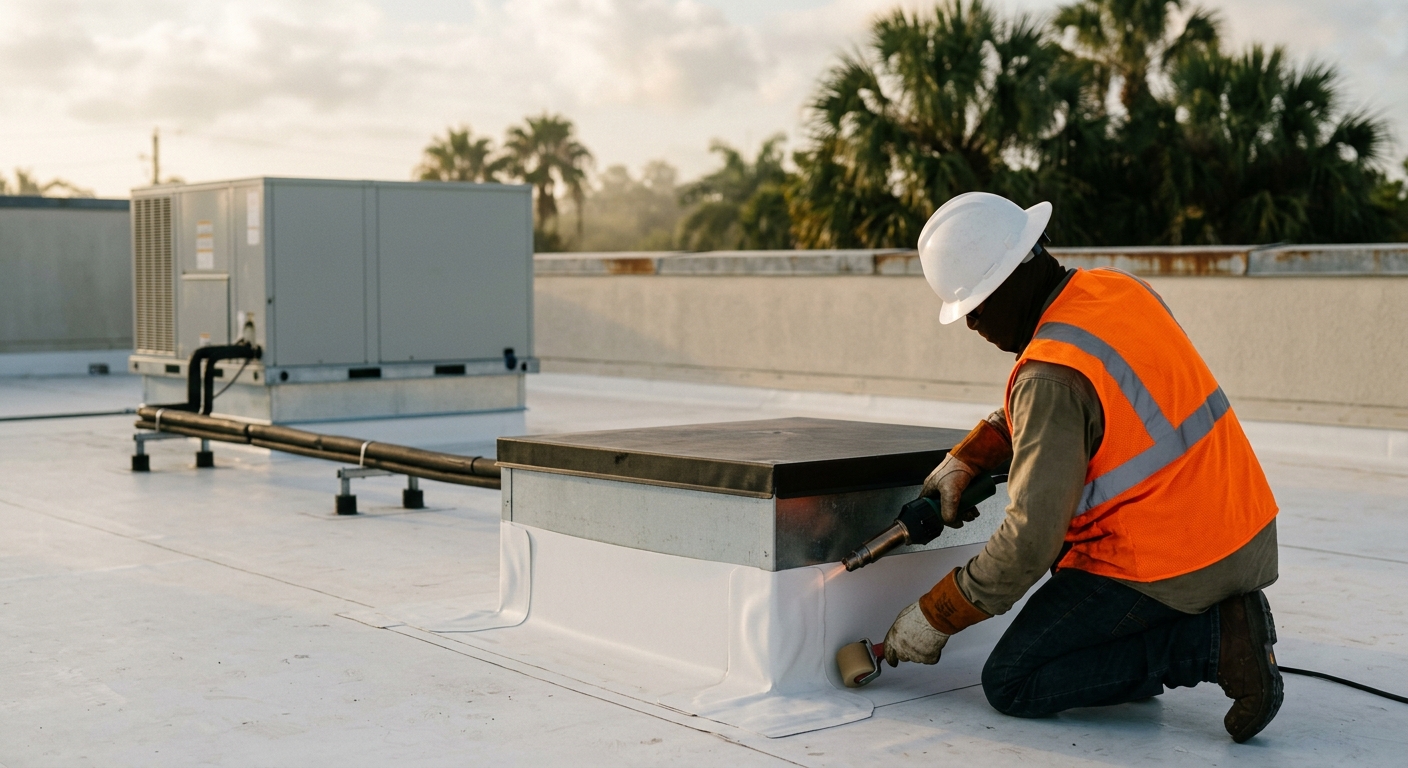
Advanced Air Systems’ crane division has 10 full-time NCCCO-certified operators, according to the company, so picks can be scheduled early in the morning or on weekends where the site allows. As a division of Advanced Roofing Inc. with in-house roofing, sheet metal, crane, and waterproofing divisions, Advanced Air Systems can put the curb, the flashing, and the lift under one project schedule.
Single-source coordination does not override the warranty. If a different roofing contractor installed the membrane and holds the workmanship warranty, or the manufacturer requires its own authorized applicator, that contractor may need to perform the flashing, and the owner should confirm this before awarding the HVAC work. Because the Atlantic hurricane season runs through November 30, a project with open curbs in the fall needs a written plan for securing staged equipment and covering openings to a standard the roofer accepts.
Which Florida code and licensing rules apply to a rooftop unit change-out?
As of October 2026, these are the provisions an owner is most likely to meet on a rooftop unit change-out in Florida.
- Florida Statutes 489.105(3)(e) and (f): roofing and waterproofing appear only in the roofing contractor definition.
- Florida Building Code, Building, Section 1510.10 (outside the HVHZ): 8-inch minimum curbs or raised supports per its clearance table; the building official may accept existing equipment with enough room to maintain the roof.
- Section 1522 (HVHZ, Miami-Dade and Broward): equipment and supports secured to the structure under HVHZ loads, no wood sleepers, clearance per Table 1522.3, and no condensate draining onto the roofing system.
- Inspection practice: Miami-Dade County’s mechanical inspection guidelines direct inspectors to verify raised roof equipment clearance under Section 1522.3 and that roof equipment and supports are secured to the structure under Florida Building Code, Mechanical Section 301.15.
- 9th Edition (2026): takes effect December 31, 2026; confirm with the designer which edition the permit will follow and whether any section numbers change.
Whether a replacement unit on an existing curb must meet the current clearance table, and what attachment design is required, are determinations for the engineer of record and the building official.
Commercial HVAC roof coordination checklist: who owns each decision?
- Owner or asset manager: Pull the roof file (system, manufacturer, warranty number, warranty holder, install date) before requesting HVAC bids, and require the roofing scope as a named line item in every proposal.
- Property manager: Request the manufacturer’s written authorization for the alteration and confirm who must perform the curb flashing to keep the warranty in force.
- Roofing contractor: Inspect and photograph every curb, measure flashing height above the finished roof, and moisture-test around older curbs.
- HVAC contractor: Confirm each new unit’s footprint, duct openings, and weight against the existing curb, and state reuse, adapter, or replacement for every unit. Advanced Air Systems’ current conditions reports for rooftop units document unit condition before a replacement plan.
- Engineer of record: Review structural capacity for heavier units or new openings, and design anchorage for the governing code edition and wind zone.
- HVAC and roofing contractors together: Write a daily dry-in requirement, a membrane protection and travel plan, and a joint final walk into both contracts.
- Owner: Collect close-out photos of each finished curb and any manufacturer acceptance, and keep the new equipment on a preventive maintenance program from the first season.
Frequently Asked Questions
Does replacing a rooftop AC unit void my roof warranty?
It can. Many manufacturer warranties void coverage for the affected area when equipment is placed on or through the roof without the manufacturer’s prior written authorization, or when the alteration is not done by an authorized contractor. Read your warranty, notify the warranty holder before the work, and have the flashing done by a contractor the manufacturer accepts. Only the manufacturer can confirm that coverage continues.
Who should flash the curb on a rooftop unit replacement?
On most commercial projects the roofing contractor should flash the curb. Florida’s licensing statute places roofing and waterproofing in the roofing contractor’s scope, and roof warranties usually require an authorized applicator. The HVAC contractor sets, seals, and anchors the unit. Confirm the split in writing before work starts, and ask the building department if a permitting question comes up.
Can a new rooftop unit go on the old curb?
A new rooftop unit can go on the old curb when the footprint and duct openings match, or on a curb adapter when they do not, provided the existing curb is sound, level, and tall enough for proper flashing. A corroded, low, or poorly flashed curb should be replaced after a joint inspection by the roofer and the HVAC contractor.
How tall does an HVAC roof curb need to be in Florida?
Outside the High-Velocity Hurricane Zone, Section 1510.10 of the Florida Building Code, Building requires roof-mounted mechanical units on curbs at least 8 inches above the roof surface, or on raised supports that meet a clearance table. Miami-Dade and Broward follow Section 1522.3. The building official decides how these provisions apply to existing equipment.
Should the roof be replaced at the same time as the rooftop units?
When the roof is near the end of its service life, coordinating both projects usually avoids lifting the units twice and flashing new curbs into an old membrane. When the roof has years left, the HVAC work can go ahead with curb flashing approved by the warranty holder. A roofing contractor or roof consultant should assess remaining service life before the HVAC scope is final.
Treating the curb as shared scope on every rooftop HVAC replacement
The curb is where the HVAC system and the roof system meet, and it is where most change-out leaks, warranty disputes, and inspection corrections begin. Licensing, code, and warranty rules all meet there. A rooftop HVAC replacement that names the roofing scope, the warranty holder, and the curb decision for every unit before bids are compared avoids the second bill. Broward owners can find local details on the commercial HVAC contractor in Fort Lauderdale page.
Written by The Technical Team at Advanced Air Systems. Established in 1994, Advanced Air Systems is a 100% employee-owned commercial HVAC contractor, a division of Advanced Roofing Inc., and part of the employee-owned Advanced family of businesses.
To plan a rooftop unit replacement with the curb and roofing scope included, call (954) 332-1418 or request a free quote from Advanced Air Systems.