At a glance: HVAC replacement in South Florida hotels and condominium towers is planned around occupied rooms first. This guide explains the five system families these buildings use and how each is replaced, compares like-for-like, stack-by-stack, plant-first, and conversion paths with their limits, lists the drivers that set cost and schedule, covers phasing, lifts, and cutovers in occupied buildings, dates the 2026 refrigerant and code rules, and ends with a checklist assigned by role.
A high-rise HVAC replacement South Florida hotels and condominium towers can carry out while occupied is planned around the people in the building before it is planned around the equipment. The scope has to settle which rooms or units lose cooling and for how long, how equipment moves vertically, and what the chilled water and ventilation systems must keep doing during the work. Settled late, those questions cost rooms held out of inventory, rescheduled crane picks, and condominium owners who were never told when their units would be entered. It is not a design guide or a price list, and it makes no code, engineering, or legal determination for any specific building.
Why is high-rise HVAC replacement South Florida work different in 2026?
Two regulatory calendars moved in 2026, and both reach the equipment a hotel or tower can buy and the permit it will be built under. On refrigerants, EPA’s Technology Transitions table of HFC restrictions by sector, last updated August 28, 2026, sets a 700 global warming potential (GWP) limit for new residential and light commercial split and unitary systems, with no installation deadline where every specified component was manufactured or imported before January 1, 2025. Variable refrigerant flow (VRF) systems above 700 GWP can be installed until January 1, 2027 if all components were made or imported before January 1, 2026, and until January 1, 2028 in buildings whose approved building permit predates October 5, 2023 and allowed an HFC system. New comfort-cooling chillers carry a 700 GWP limit with a January 1, 2025 installation date.
For through-wall equipment, the same EPA table lists self-contained room air-conditioning products under a 700 GWP limit for units manufactured or imported from January 1, 2025, and its first footnote ends sale and distribution of restricted products three years after that date. In a final determination published February 13, 2023, the U.S. Department of Energy concluded that efficiency standards for packaged terminal air conditioners (PTACs) and heat pumps (PTHPs) did not need to be amended.
On codes, the Florida Building Code, 9th Edition (2026) takes effect December 31, 2026. Miami-Dade County’s permitting notice on the 9th Edition states that permit applications and plans submitted on or after that date must comply, and that portal applications received after 4 p.m. on December 30, 2026 fall under the new edition.
What HVAC equipment do hotels and high-rise buildings actually replace?
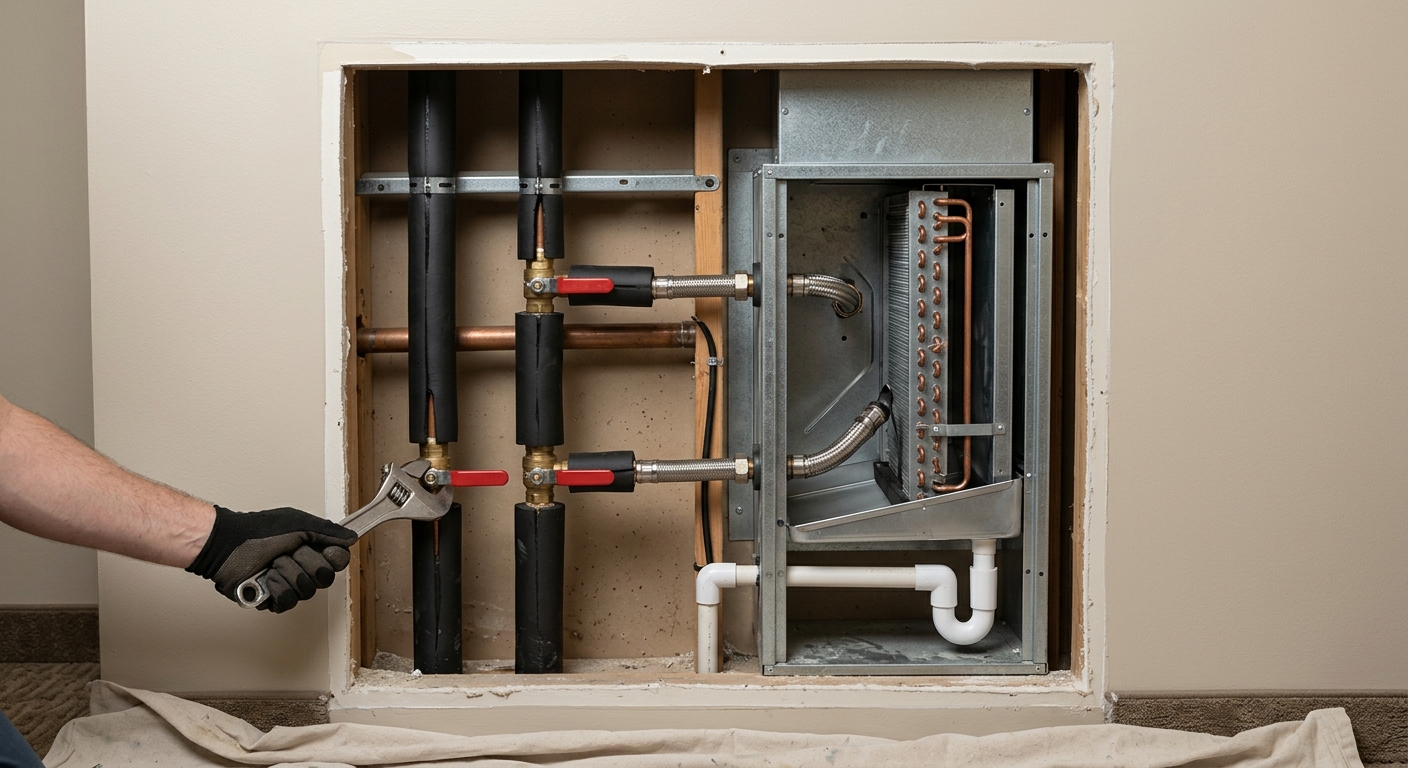
Hotels and high-rise residential towers in South Florida are usually served by one of five system families, and each is replaced in a different part of the building. Through-wall PTACs and PTHPs sit in a sleeve under each guestroom window. Vertical stacked fan coils sit in a closet or chase in each room and draw chilled water from risers fed by a central plant of chillers and cooling towers. Water-source heat pumps share a condenser water loop. Split systems pair an air handler in each unit with a condensing unit on the roof or a balcony, and many towers add a dedicated outdoor air system (DOAS) that conditions corridor and lobby makeup air.
| System | Where the equipment sits | What replacement disturbs | Signs it is near the end |
|---|---|---|---|
| PTAC or PTHP | Wall sleeve in each guestroom | One room at a time; sleeve and exterior louver | Noise, poor dehumidification, corroded chassis or sleeve |
| Vertical stacked fan coil | Closet or chase in each room, on chilled water risers | Every room on the same riser stack; finishes around the cabinet | Leaking valves and drain pans, stained ceilings below |
| Water-source heat pump | Ceiling or closet; shared condenser water loop | Individual rooms plus loop shutdowns | Loop leaks, compressor failures, scaling |
| Split system with rooftop condensers | Air handler in the unit; condenser on the roof or balcony | Unit entry plus crane picks for condensers | Coastal coil corrosion, refrigerant leaks, rusted stands |
| Central plant (chillers, cooling towers, DOAS) | Roof, mechanical floor, or plant room | Every room on the loop during cutover | Lost capacity, rising repair frequency, refrigerant availability |
The physical problem behind most replacement projects is moisture. A guestroom unit sized to the peak sensible load satisfies its thermostat and cycles off before its coil has removed much water, while outdoor air entering through corridors, sleeves, and balcony doors keeps adding humidity. EPA’s guidance on why and where mold grows recommends keeping indoor relative humidity below 60 percent, ideally between 30 and 50 percent, and names poorly draining condensate pans inside air handlers among common hidden moisture sources.
Like-for-like, stack-by-stack, plant-first, or conversion: which hotel HVAC replacement path fits?
Every hotel or high-rise replacement follows one of four paths, chosen by the condition of the distribution system, tolerance for rooms out of service, and the ownership horizon. Advanced Air Systems performs commercial AC unit change-outs, retrofits, and chiller and cooling tower replacement, and the comparison below includes where each path falls short.
| Path | When it fits | Where it falls short |
|---|---|---|
| Like-for-like terminal unit replacement | Sleeves, cabinets, and risers sound; humidity acceptable; tight capital budget | Carries forward sizing and humidity problems; sleeve and louver condition sets the limit |
| Stack-by-stack riser and fan coil replacement | Leaking risers or valves; renovation already taking rooms offline | Takes a vertical column of rooms out at once; hidden pipe and finish conditions add change orders |
| Plant-first replacement (chiller, tower, DOAS) | Central plant at end of life; terminal units still serviceable | Needs a cutover window or temporary cooling; a new plant cannot fix failing room units |
| System conversion (for example PTAC to VRF, or DOAS plus terminals) | Major renovation, long ownership horizon, persistent humidity | Highest first cost and longest schedule; refrigerant dates, A2L safety design, and structural review apply |
Like-for-like replacement is the right answer more often than conversion proposals suggest. When sleeves, cabinets, and risers still have service life, replacing only what has failed keeps rooms in inventory. It also reproduces whatever the original design got wrong, so a building with chronic humidity complaints should have its engineer check the latent load and ventilation path before ordering the same units again.
Conversions carry their own constraints. VRF systems face the EPA installation dates above, and most new equipment using A2L refrigerants such as R-454B and R-32 needs an integral refrigerant detection system. UL’s guidance on inspecting refrigerant detection systems explains that under UL 60335-2-40 a detection system is generally required on equipment with more than a 4-pound charge, and that mitigation can include closing shut-off valves on multi-coil systems such as VRF.
A contractor organized around occupied multi-story buildings is also not the right fit for every job. A property replacing a handful of PTACs from stock rarely needs a phased plan, and a smaller service contractor often fits better.
What drives cost and schedule in an occupied hotel or tower?
Cost on a high-rise replacement is driven less by the equipment than by vertical logistics, occupied-room constraints, and conditions found when walls open. Advanced Air Systems does not publish pricing, and published per-room ranges rarely state their assumptions. List each driver below in every proposal so bids compare on one scope.
| Driver | Why it moves cost or schedule | How to pin it down before award |
|---|---|---|
| Vertical transport | Crane size and reach, street or sidewalk closure, after-hours picks, or freight elevator time | Lift plan naming the method, crane location, permits, and dates |
| Rooms or units out of service | Lost room nights or resident access; sets crew size and sequence | Phasing plan by floor or stack with return-to-service dates |
| Riser and valve condition | Corroded valves and piping found at demolition | Sample inspection and unit prices for riser repairs |
| Finishes and access | Closets, cabinets, and ceilings opened and restored | Protection and patch-and-paint scope stated in writing |
| Plant cutover | Chilled water shutdowns affect every connected room | Cutover window, temporary cooling, and restart plan |
| Electrical capacity | New equipment may need different circuits or disconnects | Load check against the selected equipment |
| Refrigerant path | Legacy inventory availability versus A2L lead time | Refrigerant and lead time stated for each equipment type |
Schedule risk sits mostly in the first two rows. Taking one floor or riser stack at a time keeps most of the building in service but multiplies mobilizations, while larger blocks finish sooner and cost more in rooms out of service. That trade belongs to the owner.
How do you replace HVAC equipment while guests and residents stay?
Occupied replacement is sequenced so that each room or unit loses cooling once, for a defined window, with notice. In a hotel, the director of engineering and the rooms or revenue manager agree on which floors or riser stacks come out of inventory each week. In a condominium, unit entry follows the notice provisions in the association’s documents, and the community association manager publishes the schedule first. Noisy work is held to agreed hours.
Lifting is where occupied high-rises differ most from low-rise work. OSHA’s crane standard on keeping clear of the load, 29 CFR 1926.1425, requires hoisting routes that minimize workers’ exposure to hoisted loads where available, consistent with public safety, and limits who may stand in the fall zone. On a hotel or tower that means picks early in the morning or on weekends, with entrances, pool decks, and drives under the swing path closed before the load leaves the ground. On the Villa Magna Condominium project in Highland Beach, the HVAC crew set a 3,000-pound rooftop unit with a larger crane staged, with permission, in the neighboring hotel’s parking lot, and crane moves along A1A ran under local police traffic control.
Tall picks can also need federal notice. Under 14 CFR 77.9, the FAA must be notified of construction or alteration more than 200 feet above ground level, or that penetrates the imaginary surfaces around nearby public-use airports, and the instructions to FAA Form 7460-1 list cranes as temporary structures with a filing deadline of at least 45 days before work starts. Check this while the lift plan is drafted.
Cutovers are planned to the hour. At Treasures on the Bay Condominium, a high-rise in North Bay Village with humidity problems in its shared areas, the old system was shut down on a Friday evening and a new 100-ton dedicated outdoor air system was running by Saturday morning. At the Towers of Oceanview East condominium in Hallandale, Advanced Air Systems raised more than 200 air conditioning units onto new hurricane stands while its parent company, Advanced Roofing, replaced the roof. At the historic Riverside Hotel on Las Olas Boulevard, the company reports completing air conditioning replacement work with no safety incidents or disruptions for hotel guests.
Central plant work adds a water management step. CDC’s guidance on controlling Legionella in cooling towers directs owners to clean and disinfect towers according to manufacturer recommendations before startup and after shutdown, and to perform offline cleaning and disinfection at least annually, so a tower restart belongs in the water management plan. Advanced Air Systems’ in-house sheet metal, electrical, crane, and roofing resources, including two mobile hydraulic tower cranes with 330-foot tip heights, let one team schedule the pick, the curb, and the roof work together.
Which 2026 rules apply to hotel and high-rise condominium HVAC replacement?
As of October 2026, four sets of rules bear on a hotel or high-rise replacement, and each should be re-checked on the day a contract or permit relies on it.
- Florida Building Code, 9th Edition (2026): effective December 31, 2026, per Miami-Dade’s permitting notice; the engineer of record confirms which edition governs the submittals.
- High-Velocity Hurricane Zone: in Miami-Dade and Broward counties, rooftop equipment and its supports fall under the high-velocity provisions in Section 1522 of the Florida Building Code, Building, 8th Edition (2023), and anchorage design is the engineer’s determination.
- EPA Technology Transitions: manufacture and installation dates for split, VRF, chiller, and self-contained equipment as summarized above, current to EPA’s August 28, 2026 table update.
- Florida condominium law: under section 718.113(1), Florida Statutes, maintenance of the common elements is the association’s responsibility, except limited common elements the declaration assigns to unit owners.
None of these settles a specific building. The engineer of record and building official decide code paths and anchorage, and the association attorney advises on condominium cost allocation.
High-rise HVAC replacement checklist: who owns each decision?
To replace HVAC in an occupied hotel or high-rise, choose the replacement path, phase rooms or units by floor or riser stack, plan crane or elevator lifts and plant cutovers before bidding, confirm the 2026 refrigerant and code dates with the engineer of record, and assign every decision below to a named role.
- Owner or asset manager: Choose the replacement path against the hold period and renovation calendar, and decide how many rooms or units can be out of service at once.
- Director of engineering or chief engineer: Map every system by floor, stack, and plant, with failure history and humidity complaints by room.
- Rooms or revenue manager (hotel): Block inventory by floor or stack in the phasing plan and confirm return-to-service dates.
- Board and community association manager (condominium): Publish entry notices and the schedule, and confirm with the association attorney who pays for each component.
- Engineer of record: Confirm latent load, ventilation, refrigerant path, A2L safety requirements, anchorage, and the governing code edition.
- HVAC contractor: Submit the lift plan (with any FAA notice), phasing plan, cutover plan, and unit prices for riser and valve repairs.
- Water treatment provider: Write cooling tower cleaning, disinfection, and restart steps into the water management plan.
- Commissioning lead: Verify each phase before the next begins, following the steps in commissioning a commercial HVAC retrofit.
Frequently Asked Questions
Can a hotel replace its HVAC system without closing?
Most hotels stay open by phasing the work. Rooms come out of inventory one floor or riser stack at a time, plant cutovers run overnight or with temporary cooling, and crane picks happen when entrances can be closed. How many rooms are out of service at once is the owner’s decision, weighed against schedule length and the cost of each added mobilization.
Who pays to replace air conditioning in a Florida high-rise condominium?
It depends on the declaration. Section 718.113(1), Florida Statutes, makes the association responsible for maintaining the common elements, except limited common elements the declaration assigns to unit owners. Whether a unit’s air handler, rooftop condenser, or riser falls into which category is set by the condominium documents, so boards should confirm cost allocation with the association attorney before scoping a building-wide replacement.
Can hotels still install R-410A PTACs in 2026?
EPA’s Technology Transitions table lists self-contained room air-conditioning products under a 700 GWP limit for units manufactured or imported from January 1, 2025, and ends sale and distribution of restricted products three years after that date. Confirm with the manufacturer how a specific PTAC model is classified and when it was built, and re-check EPA’s table on the day you order.
How is HVAC equipment lifted onto a high-rise roof?
Most rooftop equipment goes up by mobile crane, scheduled early in the morning or on weekends with the area under the load closed. Where reach or street access rules out a crane, equipment can be ordered in knocked-down sections and moved by freight elevator, or lifted by helicopter. The lift method sets permits, closures, and dates, so it belongs in the proposal.
How long does a high-rise HVAC replacement take?
Phasing, equipment lead time, permits, and lift dates set the schedule more than installation labor in each room. A plant cutover may fit a single overnight window, while a building-wide terminal unit replacement runs floor by floor over months. Ask each bidder for a schedule showing every phase, the rooms it takes out of service, and its return-to-service date.
Do VRF systems make sense for hotel retrofits?
VRF can serve hotels well where a renovation already opens rooms and the owner wants individual room control with heat recovery. EPA sets installation dates for VRF systems above 700 GWP, and A2L-refrigerant VRF requires refrigerant detection and shut-off design under UL 60335-2-40. The engineer should confirm charge limits and room-by-room safety measures before VRF is selected.
Planning the replacement around the people in the building
Hotels and high-rise towers in South Florida can replace HVAC equipment without closing, provided the project is scoped from the occupied rooms outward. Choose the replacement path against the distribution system and ownership horizon, plan phasing and lifts before bidding, and confirm the 2026 refrigerant and code dates with the engineer of record. Owners in Miami-Dade can review local service details on the commercial HVAC Miami page, and Broward owners on the commercial HVAC contractor in Fort Lauderdale page.
Written by The Technical Team at Advanced Air Systems. Established in 1994, Advanced Air Systems is 100% employee-owned and a division of Advanced Roofing Inc., serving commercial buildings from offices in Fort Lauderdale, Miami, and West Palm Beach.
Planning a replacement in an occupied hotel or tower? Request a free quote or call (954) 332-1418 to start with a phasing and lift plan.