At a glance: South Florida buildings can hold their temperature setpoint and still run too humid, because moisture is a separate load from heat. This guide explains why humidity persists with the air conditioning running, compares fan and control corrections, reheat, dedicated outdoor air systems, and standalone dehumidifiers with the limits of each, lists what drives cost and energy, covers occupied buildings and storm season, dates the code change that takes effect December 31, 2026, and ends with a checklist by role.
Commercial dehumidification South Florida buildings can rely on starts with treating moisture as its own load, separate from temperature, because a building can hold its thermostat setpoint all day and still sit above 60 percent relative humidity. Getting this wrong shows up as musty corridors, sweating diffusers, stained ceiling tile, and a mold cleanup bill that a few humidity sensors and a controls change might have prevented. This guide explains why Florida buildings stay damp with the air conditioning running, compares the humidity control options with their limits, and assigns each decision to a role. It does not diagnose a specific building or make a health claim for any product; those calls belong to the mechanical engineer and an industrial hygienist.
Why is commercial dehumidification South Florida’s hardest cooling job?
South Florida’s outdoor air carries more water than an occupied building can tolerate for much of the year, so every building that brings in outdoor air, or leaks it in through the envelope, has to remove that water mechanically. A National Weather Service study of Miami International Airport records from 1956 through 1997 found that summer dew points stay in the lower to middle 70s °F. The same study placed the median start of that humid season on May 21 and the median end on October 17, an average of 152 days.
Indoor targets sit far below those outdoor conditions. EPA’s mold course on why and where mold grows recommends keeping indoor relative humidity below 60 percent, ideally between 30 and 50 percent. ASHRAE Standard 62.1-2019, as revised by Addendum f requires buildings with mechanical cooling to have dehumidification components and controls designed to hold indoor air at or below a 60°F dew point during both occupied and unoccupied hours whenever the outdoor dew point is above 60°F. It allows an exception for overnight unoccupied periods of up to 12 hours when indoor relative humidity stays at or below 65 percent.
The health case behind those limits is documented without being precise. ASHRAE’s Position Document on Limiting Indoor Mold and Dampness in Buildings, approved in November 2021, cites public health findings that damp buildings are associated with exacerbated asthma, new asthma, respiratory infections, and allergic rhinitis. It names two early warning signs an owner can track with low-cost instruments: gypsum board moisture content consistently above 15 percent wood moisture equivalent, and indoor dew points consistently above 60°F. NIOSH guidance on mold in the workplace adds that finding and correcting the source of dampness does more to prevent health problems than sampling the air for mold.
Why does a commercial building stay humid while the air conditioning runs?
An air conditioner removes moisture only while its coil is colder than the dew point of the air crossing it, and only while it runs long enough for condensate to drain away. The thermostat responds to temperature alone, so a unit that satisfies it quickly shuts off before removing enough water, and the space ends up cool and clammy.
Oversized equipment makes that worse, and so does fan control. Florida Solar Energy Center research published in 2006 by Shirey, Henderson, and Raustad found that a cooling coil’s moisture removal degrades at part load, especially when the supply fan runs continuously while the coil cycles on and off. Water that condensed on the coil evaporates back into the airstream during the off cycle. Many commercial units run their fans continuously during occupied hours to deliver ventilation air, so each off cycle can return moisture the coil just removed.
Outdoor air and building pressure add the rest. Ventilation air arrives at summer dew points in the 70s, and a building that exhausts more air than it brings in pulls humid air through wall cavities, ceiling plenums, and doorways. Our commercial indoor air quality guide for South Florida explains why adding outdoor air without matching dehumidification can trade a stuffy office for a damp one. Nighttime setbacks let humidity build while the space is empty, and surfaces colder than the surrounding air’s dew point collect condensation. EPA’s course shows condensation on an uninsulated air conditioning duct and names poorly draining condensate pans inside air handlers as a common hidden moisture source.
| Symptom | Likely physical cause | What to measure first |
|---|---|---|
| Space is cool but clammy | Equipment satisfies the thermostat before removing enough moisture | Trended space humidity and dew point through occupied hours |
| Humidity rose after a fan schedule change | Continuous fan re-evaporates coil moisture during off cycles (FSEC, 2006) | Fan mode schedule and coil cycling in trend data |
| Musty odor first thing in the morning | Humidity builds during unoccupied setback | Overnight dew point and relative humidity trends |
| Sweating diffusers or ductwork | Surface temperature below the dew point of surrounding air | Surface temperature against space dew point |
| Stained ceiling tile near air handlers | Drain pan or condensate line not draining (EPA) | Drain pan slope, trap, and line condition |
| Doors pull shut or whistle | Building under negative pressure, drawing in humid air | Building pressure relative to outdoors |
Which building humidity control options fit, and where does each fall short?
Building humidity control options range from controls changes on existing equipment to dedicated dehumidification equipment, and the least expensive options come first when the equipment has capacity to spare. A 2008 FSEC report on equipment specification and operation from FSEC summarizes measures for conventional air conditioning that can be applied before an owner pays the added first cost and operating cost of separate dehumidifiers. The comparison below lists each option with its limits.
| Option | What it does well | Where it falls short |
|---|---|---|
| Fan and control corrections (fan cycling outside ventilation hours, setpoints, unoccupied humidity control) | Low cost; uses existing equipment | Cannot add moisture-removal capacity the equipment lacks; ventilation needs may require the fan to run |
| Right-sized or variable-capacity equipment at replacement | Longer run times at part load improve moisture removal | Available only at replacement; needs a load calculation that includes latent load |
| Reheat (hot gas or other source) on packaged units | Keeps the coil removing water after the space reaches setpoint | Reheat energy unless recovered heat is used; sequences must be commissioned |
| Dedicated outdoor air system (DOAS) | Dries ventilation air before it reaches occupied spaces; separates humidity from temperature control | Highest first cost; curb, structural, duct, and electrical work; needs humid-season commissioning |
| Standalone commercial dehumidifiers (ducted or portable) | Targets one problem zone, archive, or storage room | Adds heat to the space; condensate and filter upkeep; leaves a system-wide cause in place |
| Desiccant dehumidification | Reaches low dew points for specialty spaces | Regeneration energy and specialized maintenance; rarely needed for offices |
Where the cause is the equipment itself, the answer arrives at replacement or retrofit. Commercial AC unit change-outs give an owner the chance to size for latent load instead of matching old nameplate tonnage, and reheat or controls upgrades are scoped as HVAC retrofits. At Treasures on the Bay Condominium in North Bay Village, the shared areas had ongoing humidity problems and mildew. Advanced Air Systems replaced the outdated system with a 100-ton dedicated outdoor air system with hot gas reheat; the old system was shut down on a Friday evening and the new unit was running by Saturday morning.
None of these options removes mold that has already grown or stops a roof or plumbing leak, and EPA’s guidance treats both as moisture problems to fix at the source. A contractor organized around rooftop systems and occupied multi-zone buildings is also not the right fit for every humidity complaint. A single damp storage room may need a leak repair and a portable unit, and a smaller service contractor often fits that job better.
What drives the cost and energy use of commercial dehumidification?
The cost of commercial dehumidification is set by how much water the building has to remove and where that water comes from, more than by the equipment type. Advanced Air Systems does not publish pricing, and we found no public source with a per-square-foot figure that fits Florida commercial buildings, so the table lists the variables a proposal should address in writing.
| Driver | Why it moves cost or energy | How to pin it down before award |
|---|---|---|
| Outdoor air quantity | More ventilation air means more water to remove at summer dew points in the 70s °F (NWS) | Measured outdoor airflow from a test and balance report |
| Internal moisture sources | Occupants, kitchens, pools, and wet cleaning add latent load | Space-by-space latent load in the engineer’s calculation |
| Reheat energy source | New reheat energy versus recovered heat changes operating cost | Reheat method stated in the proposal |
| Sensors and controls | Humidity control depends on calibrated sensors in occupied zones | Sensor locations, calibration, and sequences in scope |
| Unoccupied-hours operation | The ASHRAE 62.1-2019 dew-point limit covers unoccupied hours | Overnight sequence and setpoints written down |
| Building pressure and envelope | Infiltration adds moisture the equipment must remove | Pressure readings; envelope repairs scoped separately |
| Roof, curb, and electrical work | New equipment can need curbs, structure, crane picks, and circuits | Line items for each in the proposal |
Energy follows the same variables. Running equipment longer or adding reheat to remove water costs energy, while correcting fan control and building pressure can cut the moisture load before any new equipment is bought. Any savings estimate should be stated against trended data from the building, because the result depends on run hours, the utility rate, and how the system is operated.
What changes when you add dehumidification to an occupied Florida building?
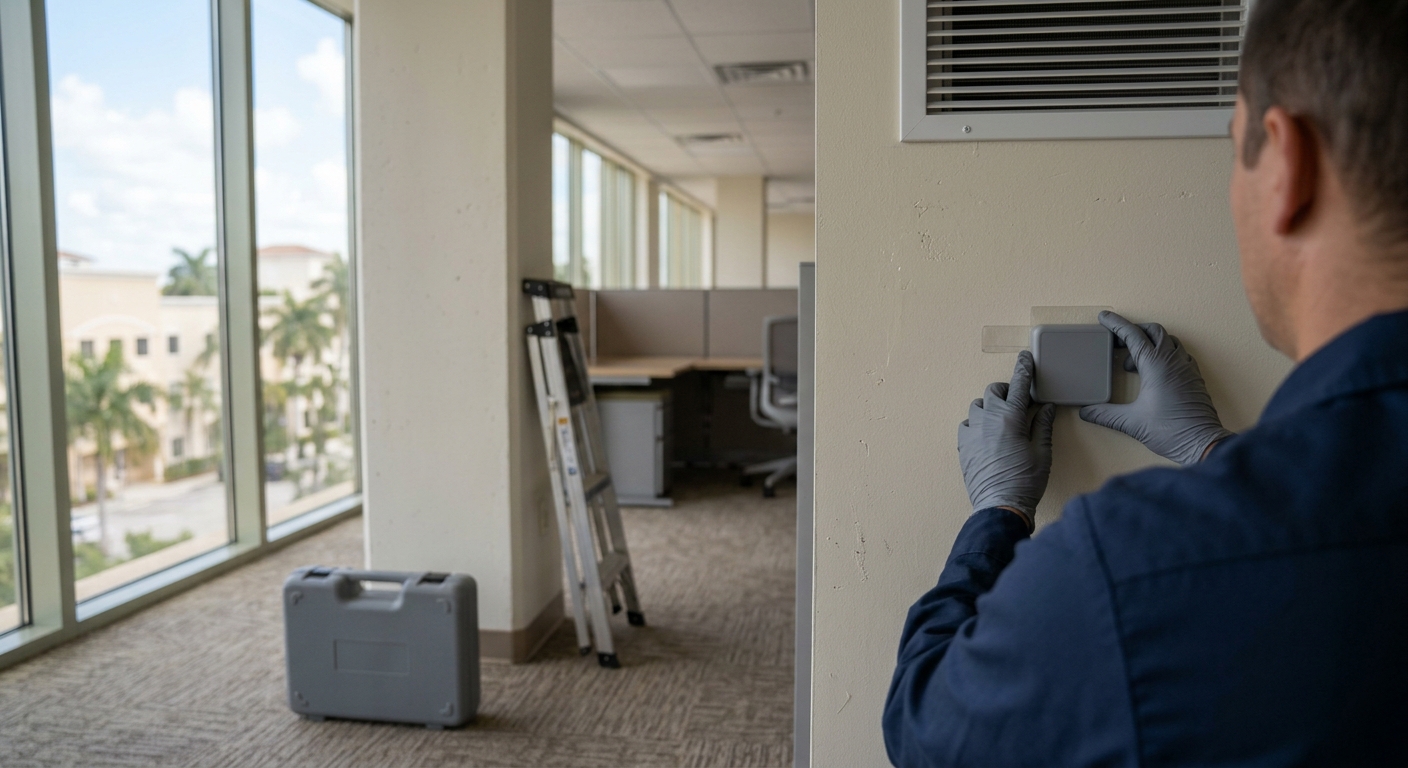
Humidity work in an occupied building starts with measurement, because the evidence is collected while the system runs. Two to four weeks of trended temperature, humidity, and dew point in occupied spaces, plus coil cycling and fan status, usually shows whether the problem is capacity, controls, or air leakage before anyone schedules a shutdown. Controls changes are made after hours and checked the next morning against the trend.
Equipment work follows the zone-by-zone pattern used for any change-out. Each zone loses conditioning for one defined window, tenants receive notice before it starts, and spaces that cannot go warm, such as server rooms and medical suites, get temporary cooling. New rooftop equipment brings crane picks, curbs, and flashing. Advanced Air Systems is a division of Advanced Roofing Inc. and uses the group’s in-house crane, sheet metal, and roofing resources to schedule them together. Dehumidification modes are best verified in the humid months, so a project finished in winter should carry deferred humidity tests into the next summer, as described in our guide to commissioning after a retrofit.
Storm season adds a second moisture risk. When power or cooling is lost after a storm, EPA’s mold course says wet buildings and furnishings must be dried within 24 to 48 hours to avoid mold growth, so a building’s restart plan should bring dehumidification back with cooling. The Atlantic hurricane season runs through November 30, as noted on our hurricane season resource page.
Which codes and standards apply to building humidity control as of October 2026?
The Florida Building Code sets the minimum for equipment and ventilation. Miami-Dade County’s permitting notice states that the Florida Building Code, 9th Edition (2026) takes effect December 31, 2026, that permit applications submitted on or after that date must comply, and that online applications received after 4 p.m. on December 30, 2026 fall under the new edition. As of October 2026, a dehumidification project permitted near year end should confirm with its engineer which edition governs the submittals.
ASHRAE Standard 62.1’s dew-point limit and EPA’s humidity guidance are a consensus standard and a recommendation. Whether a specific building must meet them, and how, is a determination for the engineer of record and the building official. ASHRAE recommends Standard 62.1-2019 as the minimum for humidity control in new buildings and systems, so an owner writing a design brief can name it as a target even where no code requires it.
Mold prevention HVAC checklist: who owns each step?
- Property or facility manager: Log humidity complaints, musty odors, and stained ceiling tile by floor and time of day, and note recent leaks or wet cleaning.
- Controls contractor: Place calibrated humidity sensors in occupied zones, trend dew point through occupied and unoccupied hours, and confirm fan mode schedules.
- HVAC service contractor: Confirm drain pans slope to the drain, traps and lines flow, coils are clean, and ducts and diffusers are insulated where they can sweat. Our guide to commercial HVAC condensate drain problems covers the drain side, and a preventive maintenance program keeps these checks on a schedule.
- Test and balance agency: Measure outdoor air and exhaust and report building pressure relative to outdoors, as described in our guide to commercial HVAC air balancing.
- Mechanical engineer: Calculate latent load, confirm whether existing equipment can hold a 60°F indoor dew point, and select the dehumidification method.
- Industrial hygienist: Investigate visible mold, odors, or occupant complaints before cleanup or equipment decisions.
- Owner or asset manager: Approve the method on trended data and require humidity trends in commissioning and close-out documents.
Frequently Asked Questions
What humidity level should a commercial building maintain?
EPA recommends keeping indoor relative humidity below 60 percent, ideally between 30 and 50 percent. ASHRAE Standard 62.1-2019, as revised by Addendum f, sets a 60°F maximum indoor dew point for mechanically cooled buildings during occupied and unoccupied hours, with an overnight exception up to 65 percent relative humidity. Archives, laboratories, and medical spaces can need tighter targets, which the mechanical engineer sets for each space.
Why does my office feel humid when the air conditioning is running?
The equipment is likely cooling the air without removing enough water. Oversized units satisfy the thermostat and shut off early, and Florida Solar Energy Center research found that a continuously running supply fan evaporates moisture off the coil back into the space during off cycles. Humid ventilation air and negative building pressure add more. Trended dew point data shows which cause applies.
Does a dehumidifier get rid of mold?
No. Dehumidification removes the moisture mold needs, but it does not remove growth that already exists. EPA advises drying wet materials within 24 to 48 hours, and NIOSH says correcting the source of dampness matters more than air sampling. Existing growth should be assessed by an industrial hygienist and cleaned up by qualified remediation workers, then the moisture source corrected.
Do I need a dedicated outdoor air system to control humidity?
Not always. A 2008 Florida Solar Energy Center report summarizes fan, control, and equipment measures to try before buying separate dehumidification. A dedicated outdoor air system fits buildings with large ventilation loads, persistent humidity after control corrections, or equipment due for replacement. The mechanical engineer confirms the method against a latent load calculation.
Should the supply fan run continuously in a Florida commercial building?
It depends on how ventilation air is delivered. Where the supply fan carries outdoor air, it may need to run during occupied hours. Research from the Florida Solar Energy Center shows continuous fan operation reduces a cycling coil’s moisture removal, so buildings that must run fans continuously often need reheat, variable-capacity equipment, or a dedicated outdoor air system. Your engineer sets the sequence.
How do I know if my building has a humidity problem?
Measure it. ASHRAE lists two early warning signs that low-cost instruments can track: indoor dew points consistently above 60°F and gypsum board moisture consistently above 15 percent wood moisture equivalent. Musty odors, visible mold, water stains, and sweating diffusers are further indicators. Two to four weeks of trended humidity in occupied zones shows when and where the problem occurs.
Treating humidity as its own load in Florida buildings
Florida buildings stay damp when moisture is treated as a side effect of cooling. Outdoor dew points in the 70s for about five months a year, part-load cycling, continuously running fans, and negative building pressure all add water a thermostat never sees. The order of work that holds up is to measure dew point through occupied and unoccupied hours, correct controls, drains, and pressure, and then size dedicated dehumidification to whatever load remains. Owners in Broward County can find local service details on our commercial HVAC contractor in Fort Lauderdale page, and owners in Miami-Dade and Palm Beach counties on the commercial HVAC Miami and West Palm Beach and Jupiter commercial HVAC pages.
Written by The Technical Team at Advanced Air Systems. Established in 1994, Advanced Air Systems is 100% employee-owned and a division of Advanced Roofing Inc., serving commercial buildings from offices in Fort Lauderdale, Miami, and West Palm Beach.
To trend and diagnose humidity in your building, request a free quote or call (954) 332-1418.