At a glance: The A2L refrigerant transition does not require replacing working R-410A equipment, but it changes what can be installed when a unit fails. This article covers EPA’s Technology Transitions rule as amended in May 2026, the HFC phasedown step in 2029, how R-454B and R-32 equipment differs from R-410A equipment, the Florida Building Code path from the 8th Edition to the 9th Edition taking effect December 31, 2026, what changes on an occupied building, and a role-by-role replacement checklist.
The A2L refrigerant commercial HVAC transition does not require a Florida building owner to replace a working R-410A rooftop unit, split system, or chiller. It changes what can go back on the roof when that equipment fails. The replacement that follows is a different project: equipment designed for a mildly flammable refrigerant, listing and code requirements that did not apply to the old unit, and an R-410A service supply that federal law keeps shrinking. An owner who meets that project during an August compressor failure in an occupied building pays for it in downtime. This article sets out the federal and Florida rules as of November 3, 2026; it does not argue for retiring equipment with service life left, and it makes no compliance determination for any building.
Which federal rules govern A2L refrigerant commercial HVAC replacement as of November 2026?
The short answer: As of November 3, 2026, a commercial building can keep servicing R-410A equipment, can install remaining R-410A unitary and split equipment built before January 1, 2025, and can install R-410A VRF only until January 1, 2027. Most new commercial replacements use A2L refrigerants such as R-454B or R-32, which require equipment listed for them and code-compliant installation.
Two programs under the American Innovation and Manufacturing (AIM) Act of 2020 shape commercial replacement. The Technology Transitions rule caps the global warming potential (GWP) of refrigerants in new comfort-cooling equipment at 700, with a compliance date for each equipment category. EPA’s Technology Transitions restrictions-by-sector page (last updated August 28, 2026) is the current reference.
EPA amended that rule this year. The final reconsideration rule published at 91 FR 31284 on May 26, 2026, effective July 27, 2026, removed the installation deadline for residential and light commercial systems whose components were all manufactured or imported before January 1, 2025, and left the VRF dates in place. R-410A components made after that date can only be used for repairs, and EPA’s frequently asked questions on the HFC phasedown explain that they must be labeled for servicing existing equipment only. The Natural Resources Defense Council filed a petition for review of the rule in the D.C. Circuit on July 20, 2026 (Case No. 26-1188), so a plan that depends on the amendment should be re-checked before purchase.
The second program is the HFC allowance phasedown. EPA’s HFC allocation rule fact sheet caps HFC consumption at 60 percent of the historic baseline for 2024 through 2028, 30 percent for 2029 through 2033, 20 percent for 2034 and 2035, and 15 percent from 2036. R-410A stays legal for servicing; the supply it draws from shrinks on that schedule.
| Equipment category (EPA subsector) | GWP limit | Installation compliance date (EPA table, as of Nov. 3, 2026) | What it means at replacement |
|---|---|---|---|
| Residential and light commercial AC and heat pump systems (unitary, split) | 700 | Jan. 1, 2025; no installation date for systems built entirely from components manufactured or imported before Jan. 1, 2025 | Remaining pre-2025 R-410A inventory may be installed; other new systems use a refrigerant at or below 700 GWP |
| Variable refrigerant flow (VRF) systems | 700 | Jan. 1, 2027, if all components were manufactured or imported before Jan. 1, 2026; Jan. 1, 2028 for qualifying buildings permitted before Oct. 5, 2023 | R-410A VRF projects must be installed by the deadline that applies |
| Chillers, comfort cooling | 700 | Jan. 1, 2025 | New comfort-cooling chillers use a refrigerant at or below the limit |
| Data centers, computer room AC, IT equipment cooling | 700 | Jan. 1, 2027 | IT and telecom room cooling follows the 2027 date |
| Self-contained products (for example PTACs) | 700 | Manufacture and import Jan. 1, 2025; sale and distribution three years later | Pre-2025 R-410A PTACs may be sold until Jan. 1, 2028 per EPA’s FAQ |
Source: EPA, Technology Transitions HFC Restrictions by Sector (page last updated Aug. 28, 2026) and EPA frequently asked questions. EPA states these tables are informational; the binding requirements are in 40 CFR Part 84, Subpart B.
What does an A2L refrigerant change inside R-454B commercial equipment?
An A2L refrigerant is one that ASHRAE Standard 34 classifies as lower toxicity and lower flammability, between nonflammable A1 refrigerants such as R-410A and the A2 and A3 classes. R-454B and R-32 dominate new unitary and split equipment. EPA’s Technology Transitions GWP reference table lists R-454B at 465 and HFC-32 at 675, against 2,088 for R-410A, and EPA’s SNAP listing for residential and light commercial air conditioning lists both A2Ls as acceptable for new equipment subject to use conditions.
Mild flammability is why the equipment changes. An A2L can ignite only if a leak builds to its lower flammability limit near an ignition source, so the product safety standard UL 60335-2-40 sets charge limits tied to the space served and, depending on charge and configuration, requires refrigerant detection that triggers mitigation such as circulating air to dilute a leak. A new A2L unit can arrive with sensors and control logic the R-410A unit never had.
An A2L is not a drop-in replacement for R-410A. EPA’s FAQ draws the working line for split systems: replacing a failed R-410A condensing unit alone is a repair, while replacing the condensing unit and indoor coil together is a new system under the 700 GWP limit. A compressor or condensing unit swap can keep an R-410A system running; a full change-out moves the building to new refrigerant, controls, and installation requirements.
| Refrigerant | Where it appears in commercial cooling | 100-year GWP (EPA Technology Transitions table) | Against the 700 limit |
|---|---|---|---|
| R-410A | Most unitary, split, and VRF equipment installed before 2025 | 2,088 | Above |
| R-454B | New unitary, split, and packaged equipment (manufacturer-specific) | 465 | Below |
| HFC-32 (R-32) | New split, ductless, and VRF equipment (manufacturer-specific) | 675 | Below |
| HFC-134a | Many existing centrifugal and screw chillers | 1,430 | Above |
| R-513A | Modeled by EPA as a replacement for HFC-134a in centrifugal chillers | 630 | Below |
| HFO-1234ze(E) | Low-GWP chiller refrigerant; confirm safety class on the manufacturer’s data | 1 | Below |
Source: EPA Technology Transitions GWP Reference Table (last updated Apr. 2, 2026). EPA’s SNAP listing rounds R-454B to 470 and R-410A to 2,090; the Technology Transitions values are the ones used to apply the 700 limit.
R-410A vs. R-454B or a repair: how do the replacement paths compare?
A Florida owner facing a failing unit has four realistic paths in late 2026. The right one depends on the equipment category, its remaining service life, and how long the owner will hold the building.
| Replacement path | Where it fits | Where it falls short |
|---|---|---|
| Repair the existing R-410A equipment | Equipment with service life left and failures limited to replaceable components | R-410A service depends on an HFC supply cap that drops to 30% of baseline in 2029; repeated compressor failures on end-of-life equipment point toward replacement |
| Install remaining pre-2025 R-410A unitary or split inventory | Like-for-like change-outs where curb, electrical, and controls already match and documented pre-2025 stock exists | Inventory is finite; the new unit depends on R-410A service for its whole life; not available for VRF after the 2027 deadline; state or local rules can be stricter |
| Replace with A2L equipment (R-454B or R-32) | Most new rooftop, split, and unitary replacements | Can cost more to buy and install; may need a curb adapter, detection and mitigation wiring, A2L-rated tools, and added code review |
| Replace a comfort-cooling chiller with a compliant refrigerant | Chillers at the end of their service life | Different refrigerant, controls, and sometimes footprint; machinery room provisions change under the 9th Edition Mechanical code |
The transition is not, by itself, a reason to replace a working R-410A system. Planned replacement makes sense where a unit already shows end-of-life failures and a cool-season change-out avoids an emergency one in July; it rarely makes sense for equipment with years of reliable service left. Our guide to commercial rooftop unit replacement in South Florida covers the repair-versus-replace test in more depth, and the VRF, chiller, and packaged rooftop unit comparison explains how system type affects the choice.
What drives the cost, schedule, and performance of an A2L replacement?
In an A2L change-out, the conditions around the new unit usually move the budget and schedule more than the refrigerant does. Advanced Air Systems does not publish pricing and quotes each project individually, because these variables differ from roof to roof:
- Curb and structural fit. A new packaged unit may not match the existing curb footprint, and a curb adapter, new curb, or structural review can set the schedule more than the equipment does.
- Detection and controls wiring. Where the equipment listing requires refrigerant detection and mitigation, sensors, wiring, and building automation integration are part of the scope.
- Electrical. Disconnect, breaker, and conductors are checked against the new unit’s data before ordering.
- Code edition. The permit application date generally decides whether the 8th or 9th Edition Florida Building Code applies, which affects machinery room and detector requirements on chiller work.
- Efficiency step in 2029. DOE’s amended efficiency standards for air-cooled commercial package air conditioners rated at 65,000 Btu/h and above take effect for equipment manufactured on or after January 1, 2029, and are expressed in a new metric (IVEC).
A new A2L unit does not fix undersized ductwork, poor controls, or a bad load calculation, and an oversized unit short-cycles and leaves a Florida building humid whatever refrigerant it uses.
What changes when the replacement happens on an occupied Florida building?
On an occupied building, an A2L change-out is scheduled around the people inside. Each rooftop unit change-out is sequenced so a zone loses cooling for the shortest window the scope allows, crane picks are planned for hours the site permits, and the property manager receives notice of every shutdown before it starts. Where the new unit sits on a different footprint, the curb adapter is fabricated and set before pick day, which keeps a one-day zone outage from becoming a multi-day one.
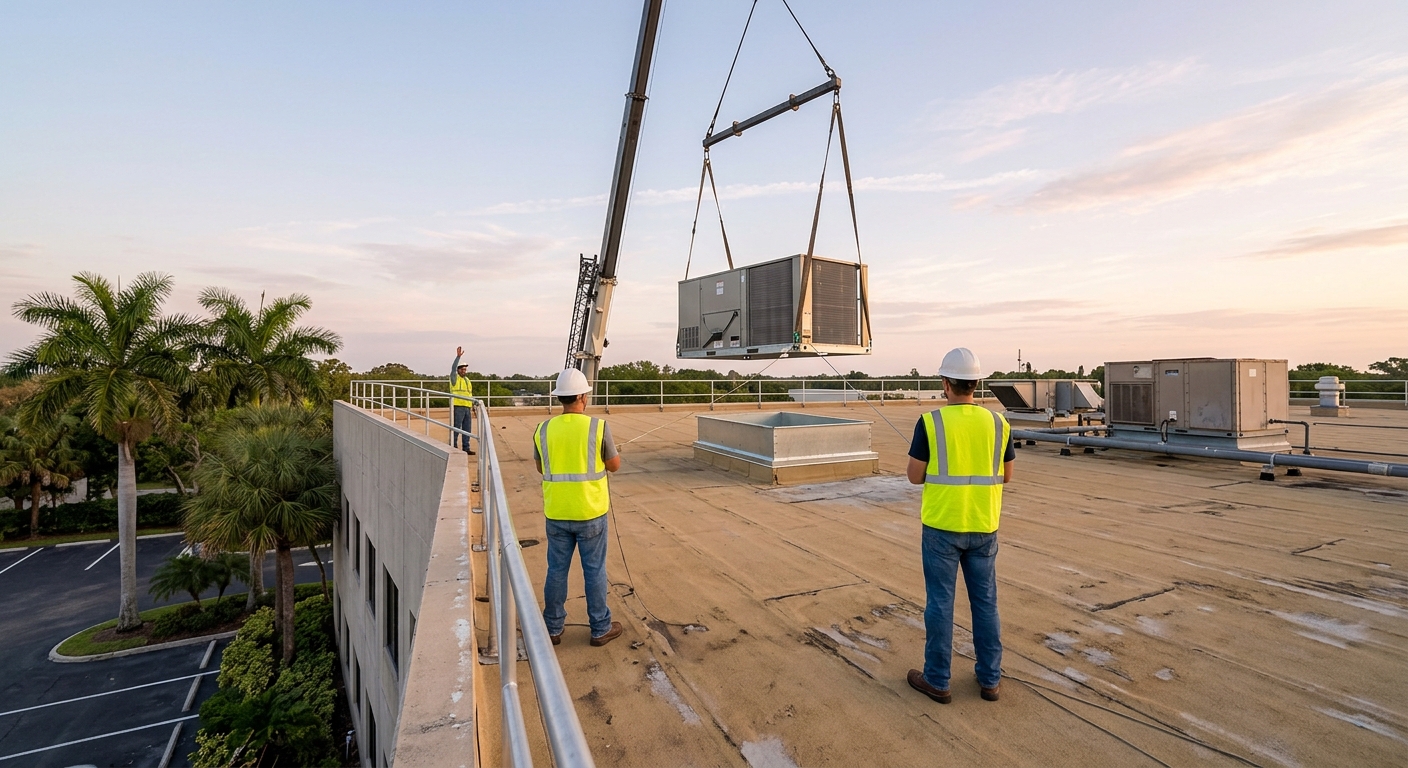
Rooftop replacements are also roofing projects: removing a unit, setting an adapter, and flashing the curb all open the membrane, which can involve the roof warranty holder. Advanced Air Systems is a division of Advanced Roofing Inc.; the sequence is covered in our article on rooftop HVAC replacement and roofing coordination. In Miami-Dade and Broward counties, rooftop equipment attachment falls under the High-Velocity Hurricane Zone provisions of the Florida Building Code; the engineer of record and the building official determine the tie-down design.
Split and VRF systems put the A2L inside the building. Indoor sections, line sets, and detectors sit above occupied ceilings, and the mechanical engineer confirms that the rooms served fit the equipment’s charge limits. On coastal sites, salt-air corrosion on commercial HVAC equipment shortens coil life regardless of refrigerant. For server rooms or medical suites, an HVAC contingency plan for temporary cooling belongs in the schedule before demolition starts.
How does the Florida Building Code treat A2L refrigerants in 2026 and 2027?
Florida’s mechanical code has caught up in steps. The Florida Building Code, Mechanical, 8th Edition (2023) applied quantity limits in Table 1104.3.2 that raised the question of whether A2Ls were held to A2 limits. In August 2024, answering declaratory statement DS 2024-024 from the Broward County Board of Rules and Appeals, the Florida Building Commission stated that A2L systems designed and installed under ASHRAE 15-2019 meet the code and that the table’s limits do not apply to A2Ls. The Commission then approved Supplement 5 to the 8th Edition Mechanical code on December 10, 2024, directing that A2L systems be designed and installed in accordance with ASHRAE 15 and updating the referenced edition to ASHRAE 15-2022.
The 9th Edition (2026) Florida Building Code takes effect December 31, 2026. The Commission’s analysis of changes for the 9th Edition (2026) Mechanical code lists a new Section 1101.2.1 requiring high-probability equipment that uses A2L refrigerants to be listed to UL 484, UL/CSA 60335-2-40, or UL/CSA 60335-2-89, and new Section 1106.5 machinery room requirements for A2L and B2L refrigerants, including detectors that alarm and start ventilation within set response times. A chiller permitted in December 2026 and one permitted in January 2027 can face different requirements; the building official determines which edition governs. Dates are as of November 3, 2026.
What belongs on a refrigerant-transition replacement checklist?
A replacement plan written before the next failure is the document a board or asset manager will ask for. Each item has an owner:
- Facility manager: inventory every unit by type, refrigerant, tonnage, manufacture year, and service history, and flag R-410A units already showing major component failures.
- Mechanical engineer of record: confirm the load calculation before tonnage is matched, and confirm whether the selected A2L equipment’s listing requires detection, mitigation, or room-size checks for the spaces served.
- HVAC contractor: field-verify curb dimensions, structural support, electrical service, and crane access for each unit, and price curb adapters and roof work in the same scope.
- Procurement officer: for any R-410A unit offered, get written confirmation of the manufacture or import date, since only systems built entirely from pre-2025 components can be installed under EPA’s rule.
- Asset manager with VRF: decide before January 1, 2027 whether a planned R-410A VRF project can be installed in time, or design it for a compliant refrigerant now.
- Permit expediter: confirm with the building department which code edition will govern, based on the permit application date.
- CFO or owner: budget both paths, continued R-410A service with refrigerant price risk and planned A2L replacement, so a failure does not make the decision.
Owners with central plants can start with our guidance on chiller replacement versus overhaul and our chiller and cooling tower services. A preventive maintenance program produces the service records that make the inventory above possible.
Frequently Asked Questions
Do we have to replace working R-410A rooftop units because of the A2L transition?
No. EPA’s Technology Transitions rule restricts new equipment, not existing installations, and EPA’s FAQ states that existing systems can continue to be repaired, including replacement of a condensing unit or compressor. The pressure comes from supply: R-410A draws on an HFC cap that falls from 60 to 30 percent of baseline in 2029, so its service cost belongs in the replacement budget.
Can a commercial building still install new R-410A equipment in 2026?
In limited cases. Since July 27, 2026, residential and light commercial systems built entirely from components manufactured or imported before January 1, 2025 can be installed with no deadline. R-410A VRF systems must be installed by January 1, 2027. New comfort-cooling chillers have been limited to refrigerants at or below 700 GWP since January 1, 2025.
Is R-454B safe to use in an occupied commercial building?
R-454B is classified A2L: lower toxicity and lower flammability. EPA lists it as acceptable for new air conditioning equipment subject to use conditions, and Florida’s mechanical code directs A2L systems to ASHRAE 15. Safety in a given building depends on the equipment listing, charge size, rooms served, and A2L-trained installation; the mechanical engineer and building official confirm the design.
Can an existing R-410A unit be converted to R-454B?
No. EPA lists A2L refrigerants for new equipment designed for them, and R-454B is not charged into a system built for R-410A. When a split system needs both a new condensing unit and a new indoor coil, EPA treats the work as a new system, so the replacement is matched equipment for a compliant refrigerant.
What is the deadline for R-410A VRF systems?
EPA’s table sets January 1, 2027 for VRF systems using refrigerants above 700 GWP, provided all components were manufactured or imported before January 1, 2026. Buildings with an approved permit issued before October 5, 2023 for an HFC system have until January 1, 2028 under conditions EPA lists. The May 2026 rule did not change either date.
Will R-410A refrigerant keep getting harder to buy?
The supply cap tightens on a fixed schedule: 60 percent of the historic HFC baseline through 2028 and 30 percent from 2029 through 2033, measured by exchange value. Reclaimed refrigerant and service-labeled components remain available for existing equipment, but owners should treat R-410A availability and price as a budget risk rather than a fixed cost.
Plan the replacement before a failure picks the refrigerant
The A2L transition leaves working R-410A equipment in service and leaves owners free to repair it. What it takes away is the option of an unplanned like-for-like swap: pre-2025 R-410A stock is finite, R-410A VRF has a January 1, 2027 deadline, comfort-cooling chillers have been on the 700 GWP limit since 2025, and the HFC supply that services retained equipment steps down in 2029. Florida’s 9th Edition code adds A2L listing and machinery room requirements on December 31, 2026. An owner who inventories equipment and budgets both paths makes the replacement decision on a schedule; an owner who waits makes it during the failure.
Written by The Technical Team at Advanced Air Systems. Established in 1994, Advanced Air Systems is 100% employee-owned and a division of Advanced Roofing Inc., serving occupied commercial buildings across South Florida.
To plan an A2L or R-410A replacement for a rooftop unit, split system, VRF system, or chiller, request a quote or call (954) 332-1418.