At a glance: Rooftop unit replacement cost in South Florida is driven by the scope around the unit as much as by the unit itself. This guide breaks a commercial RTU replacement bid into its line items, cites the few published figures that exist (federal equipment price data, a national laboratory cost estimate, Miami-Dade permit fees, and FPL rebates) along with their limits, explains what changes on an occupied building and under the December 31, 2026 code change, and closes with a bid-leveling checklist that assigns each item to the person who owns it.
Commercial rooftop unit replacement cost in South Florida is set less by the price of the packaged unit than by the work around it, because the crane pick, the curb, wind-load tie-downs, electrical and roofing tie-ins, the permit, and the hours the crew may work can outweigh the difference between two equipment quotes. Owners who compare bids on one per-ton number tend to buy the omissions later, as change orders, a failed inspection, or a unit never properly anchored to its curb. This article explains what each line of a packaged RTU replacement bid pays for, cites the published figures and their limits, and gives property managers a bid-leveling checklist. It does not quote a price; Advanced Air Systems does not publish pricing, and no honest installed number exists for a building nobody has walked.
What is driving rooftop unit replacement cost in South Florida in late 2026?
Equipment prices have moved faster than the cost guides that rank for this search. The U.S. Bureau of Labor Statistics producer price index for unitary air conditioners stood at 303.9 in August 2026 against 192.8 in January 2020 (1982 = 100), a rise of roughly 58 percent in what manufacturers receive, before freight, markup, or labor. The index is not an installed price and its recent months are preliminary, but it explains why a per-ton figure from a 2021 guide understates a 2026 bid.
Two federal rules shape what a bid contains. The EPA Technology Transitions rule, as amended by a final rule signed May 21, 2026 and effective July 27, 2026, removed the January 1, 2026 installation deadline for residential and light commercial air conditioning and heat pump systems that use refrigerants above 700 global warming potential, provided every specified component was manufactured or imported before January 1, 2025. Whether a given packaged rooftop unit falls in that subsector depends on its type and capacity, so each bidder should name the refrigerant and rule in writing. Further out, the Department of Energy’s standards for air-cooled commercial package air conditioners and heat pumps raise minimum efficiencies for equipment of 65,000 Btu/h and larger manufactured on or after January 1, 2029.
The Florida Building Code 9th Edition (2026) takes effect December 31, 2026. Miami-Dade’s Permitting and Inspection Center states that applications submitted on or after that date, or through its online portal after 4 p.m. on December 30, 2026, must comply with the new edition. A bid priced against the 8th Edition (2023) can be re-scoped if the application slips past that date.
What does each line of a packaged RTU replacement bid pay for?
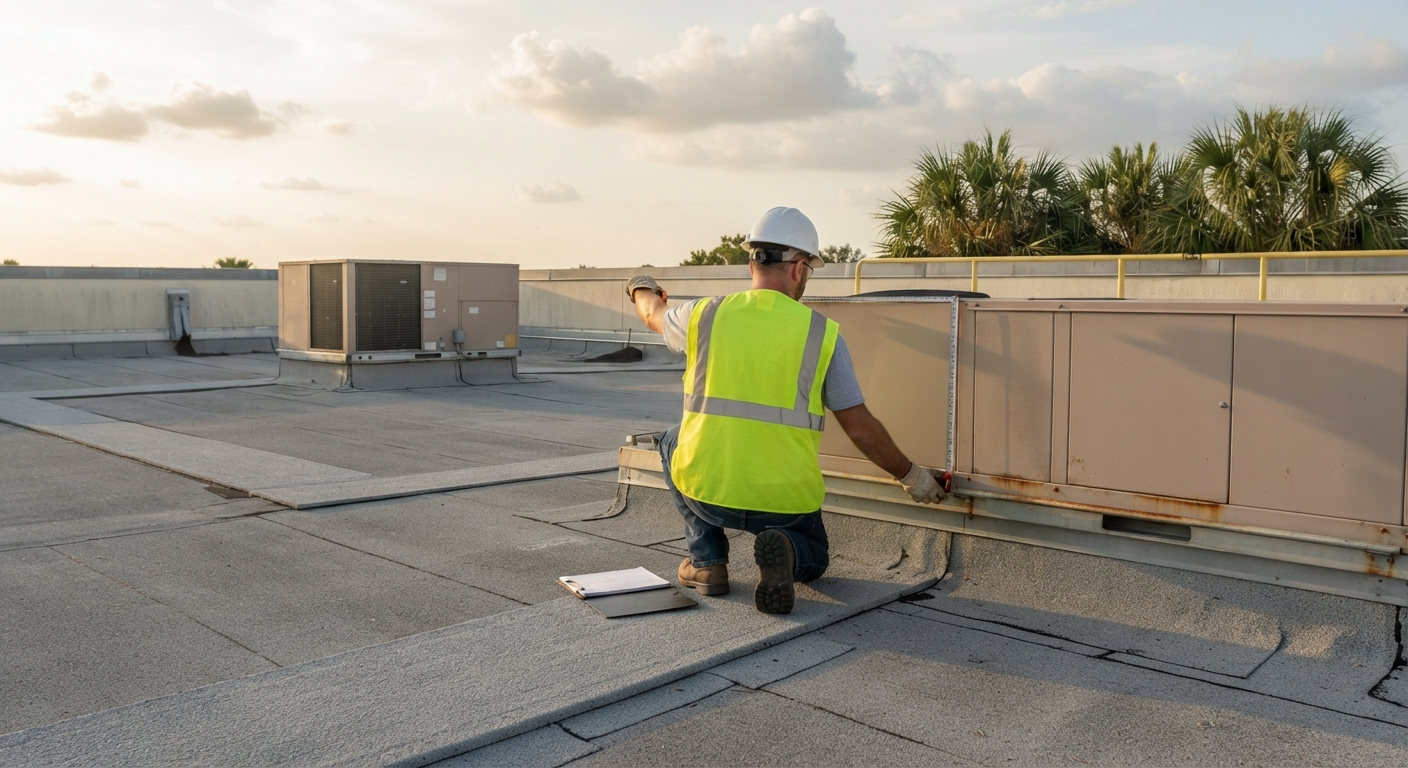
A packaged rooftop unit replacement is a sequence of trades on one roof, and each step carries its own cost. Refrigerant is recovered by EPA-certified technicians, connections are broken, and a crane lifts the old unit off. The new unit is set on the existing curb, an adapter, or a new curb, anchored against uplift and sliding, reconnected, started, and tested. Any difference in footprint, weight, duct openings, or electrical characteristics adds work, and that work is where bids diverge.
The curb is the most common source of surprise. Units of the same tonnage from different manufacturers or generations rarely share a curb footprint. An adapter bridges the difference without opening the roof, but it raises the unit, adds weight, and must itself be anchored. Replacing the curb outright means cutting the membrane, which brings in the roofer and the roof warranty holder; our article on coordinating rooftop HVAC replacement with the roofing contractor covers that sequence, and on a roof near the end of its service life the change-out can be paired with commercial re-roofing by Advanced Roofing.
Wind anchorage is the second variable. FEMA’s guidance on low-slope roof systems notes that poorly anchored roof-mounted equipment can be knocked out of place by high winds or wind-borne debris, and it recommends hold-down connectors, straps, and anchors designed to local code and ASCE 7. In Miami-Dade and Broward, building departments typically ask for an engineered tie-down detail or a product approval with the change-out application; our guide to commercial HVAC permit requirements in Miami-Dade and Broward walks through what each department reviews.
| Bid line | What it pays for | What makes it larger |
|---|---|---|
| Equipment | Packaged unit and factory options such as economizer, coil coating, and controls | Higher efficiency tier, coastal coil coatings, refrigerant availability, lead time |
| Crane and rigging | Crane, certified operator, riggers, signal person, lot or street closure | Building height, reach to the unit, night or weekend picks, right-of-way permits |
| Curb or curb adapter | Adapter fabrication, or a new curb with roof cut-in | Footprint mismatch, relocated duct openings, rotted nailers, corroded rails |
| Wind anchorage | Tie-down brackets, straps, fasteners, engineering detail | HVHZ documentation, sealed calculations, curb that will not hold new anchors |
| Electrical and controls | Disconnect, conductors, thermostat or building automation tie-in | Change in voltage or minimum circuit ampacity, new disconnect, BAS integration |
| Refrigerant and removal | Recovery, unit removal, recycling or disposal | Larger charge, damaged or leaking unit |
| Roofing tie-in | Curb flashing, membrane repair, warranty notice | Aged membrane, warranty holder inspection, wet insulation at the curb |
| Permit and inspection | Mechanical permit fee, plan review, inspections, notice of commencement | Tonnage over review thresholds, municipality, private provider fees |
| Labor window | Crew hours on the roof and in the building | After-hours cutovers, phased shutdowns, occupied spaces below |
| Start-up and commissioning | Start-up, testing, documentation, owner training | Economizer and controls verification, air balancing |
Like-for-like or upgraded: which commercial AC replacement cost path fits the building?
Each replacement path moves cost into a different line of the bid, and each has a point where it stops being the economical choice. A direct replacement on the existing curb usually gives the shortest roof schedule because the roof stays closed. It depends on a current unit with a matching footprint and on a curb that is sound, level, and able to take new anchors. A curb with rusted rails becomes a curb replacement once the old unit is lifted, so inspect it before bids are due. Coastal salt air makes this more likely; see how salt air drives commercial HVAC corrosion in South Florida.
Upgrading efficiency or controls at replacement adds equipment cost in exchange for operating savings that depend on runtime, utility rates, and installation quality. A 2022 cost appendix in the Department of Energy and Lawrence Berkeley National Laboratory RTU replacement package put the median U.S.-average cost of a 5-ton constant-volume rooftop unit with curb, economizer, and filters at $13,038, and the median premium for a high-efficiency unit at $4,694, based on RSMeans data for typical site conditions. Those figures exclude site constraints, describe a gas-heat unit uncommon in South Florida, and predate recent price increases, so they are useful as a ratio and not as a budget. Our article on commercial HVAC retrofit ROI in Florida covers how to test the savings side.
Repair remains the right answer for a unit with service life left and one failed component. Repeated compressor failures and a corroded coil on end-of-life equipment point the other way; our guide to commercial rooftop unit replacement in South Florida sets out those signals.
| Path | When it fits | Where the cost sits | Where it falls short |
|---|---|---|---|
| Direct replacement on existing curb | Matching footprint is available; curb is sound and anchorable | Equipment, crane, anchorage | Limits equipment choice; fails if the curb is corroded or out of level |
| Replacement with curb adapter | Footprint differs; roof is in good condition | Adapter fabrication, added anchorage, duct transition | Raises unit height and weight; adds airside pressure drop; needs its own tie-down detail |
| New curb with roof work | Curb is deteriorated or the roof is being replaced | Roofing tie-in, structural review, longer shutdown | Longest schedule; requires roof warranty holder coordination |
| Upgraded unit with controls package | Long runtime hours; rebates available; owner holds the building long term | Equipment premium, controls, commissioning | Savings depend on runtime and tariff; old ductwork and poor controls limit results |
| Repair and defer | Unit has service life left; single component failed | Parts and service labor | Repeated repairs on end-of-life equipment cost more over time and risk a summer failure |
Which costs move a rooftop unit replacement budget the most?
A commercial rooftop unit replacement in South Florida is priced as the unit plus the crane pick, the curb or curb adapter, engineered wind anchorage, electrical and controls changes, roof flashing, refrigerant recovery, the permit, and the labor window. Two bids for the same tonnage can differ widely when those lines carry different assumptions.
The figures that trace to a primary source are few and narrow; the table lists them with their limits. None is an installed price for a specific building, and none is Advanced Air Systems pricing. In practice, three variables move a South Florida bid more than tonnage does: crane access, the curb, and the work window. Ask every bidder to price those three as separate lines with stated assumptions.
| Figure | Source and date | What it does and does not tell you |
|---|---|---|
| Producer price index for unitary air conditioners: 192.8 (Jan 2020) to 303.9 (Aug 2026), 1982 = 100 | U.S. Bureau of Labor Statistics, series WPU114802, via FRED, accessed Nov 24, 2026 | Manufacturer price trend only; excludes distribution, freight, and installation; recent months preliminary |
| 5-ton constant-volume RTU with curb, economizer, filters: $13,038 median; high-efficiency premium: $4,694 median | DOE / Lawrence Berkeley National Laboratory RTU replacement package, Aug 17, 2022 (RSMeans basis) | U.S. average, typical site; excludes site constraints; gas-heat configuration; predates 2023 to 2026 price increases |
| A single crane lift can cost $30,000 | Pacific Northwest National Laboratory release, July 23, 2026 | Describes rooftop installations in a research program; actual crane cost depends on crane size, reach, height, and duration |
| Commercial A/C exact change-out permit: $24.80 per ton; $233.82 minimum mechanical permit; change-outs over 15 tons require processing | Miami-Dade County mechanical fee sheet, accessed Nov 24, 2026 | Unincorporated Miami-Dade only; municipalities and Broward set their own fees |
| Rebates of $200 to $800 per unit under 20 tons; $820 per kW of summer demand reduction at 20 tons and above | FPL Business HVAC Program Standards, effective Sept 1, 2025 | FPL business customers only; equipment must exceed Florida Building Code efficiency; FPL sets eligibility and can change amounts |
What changes when the building stays open during an RTU replacement?
On an occupied retail center, office, or medical building, the schedule is built around the tenants, and the schedule is a cost line. A crane pick over a parking lot or storefront needs a closure plan and often a weekend window, and a unit serving a server room or restaurant may need temporary cooling or an after-hours cutover. Each adds labor hours or rental equipment and should appear in the bid as a stated assumption.
Crane work falls under OSHA’s cranes and derricks in construction standard, which requires certified operators and qualified riggers and signal persons. Advanced Air Systems runs an in-house crane division whose page lists ten full-time NCCCO-certified operators, so the crane day is scheduled with the mechanical crew. A contractor that subcontracts the crane can still deliver a sound job, and on a small single-unit change-out may be the lower bid; the owner should confirm who controls the crane date and what a weather cancellation costs.
Afternoon thunderstorms and lightning stop crane picks and can leave an open curb exposed, so the plan should set the new unit the same day the old one is lifted or make the opening watertight before the crew leaves. The proposal should commit to a pre-construction meeting, written notice before every shutdown, a staging and crane plan, daily cleanup, photo reports, and close-out documents with warranty registration. On commercial rooftop unit change-outs across several units, sequencing so each zone loses cooling for no more than one shift keeps tenants operating.
Which code, rebate, and tax rules apply to a replacement priced now?
As of November 24, 2026, the Florida Building Code 8th Edition (2023) governs permit applications, and the 9th Edition (2026) applies to applications submitted on or after December 31, 2026. The engineer of record and the building official decide whether a specific unit and anchorage comply.
FPL’s Business HVAC Program Standards, effective September 1, 2025, list rebates for packaged and split direct-expansion equipment that exceeds the Florida Building Code efficiency requirement, documented with an AHRI certificate and invoices. FPL sets eligibility and amounts, so confirm both before ordering.
Under Section 713.135, Florida Statutes, the notice-of-commencement provisions do not apply to a direct contract to repair or replace an existing heating or air-conditioning system for less than $15,000. Most commercial RTU replacements exceed that amount, so owners should expect to record and post a notice of commencement before the first inspection.
On the tax side, 26 U.S.C. Section 179(e) lists heating, ventilation, and air-conditioning property placed in service on nonresidential real property among qualified real property, and IRS Publication 946 states a $2,500,000 expensing limit for tax years beginning in 2025, reduced once qualifying purchases exceed $4,000,000. Whether a replacement qualifies is for the owner’s tax advisor to determine.
Rooftop unit replacement bid checklist: who owns each item?
- Property manager: assemble model, serial, age, tonnage, and service history for each unit.
- Each bidder: inspect the curb and state whether the price assumes reuse, an adapter, or a new curb.
- Each bidder: price crane and rigging as a separate line, with crane size, pick-day assumptions, and the cost of a weather cancellation.
- Mechanical engineer: confirm the load calculation before equipment is selected; an oversized unit short-cycles and leaves a Florida building humid.
- Each bidder: name the anchorage method and the documentation the building department will require.
- Roof warranty holder: confirm curb flashing scope and warranty notice requirements.
- Each bidder: state the refrigerant, the AHRI-certified efficiency, and expected FPL program eligibility.
- Each bidder: state work hours, shutdown windows, and temporary cooling assumptions.
- Each bidder: state the permit application date the price assumes relative to December 31, 2026.
- Tax advisor: review expensing or depreciation treatment before the purchase order.
- Each bidder: include start-up, testing, and close-out documents; our checklist for commercial HVAC commissioning after a retrofit lists what to verify.
Frequently Asked Questions
How much does it cost to replace a rooftop AC unit on a commercial building?
No single figure is reliable, because the installed price depends on tonnage, efficiency, crane access, curb condition, wind anchorage, electrical changes, and the work window. A 2022 DOE and Lawrence Berkeley National Laboratory estimate put a 5-ton unit with curb and economizer at a $13,038 U.S.-average median, excluding site constraints and recent price increases. A site walk and line-item bid are the only dependable basis for a South Florida budget.
Why do two RTU replacement bids for the same unit differ so much?
Bids usually differ because they assume different scope. One bid may reuse the curb while another includes an adapter, or one may omit tie-down engineering, electrical changes, or roof flashing. Ask each bidder to price the crane, the curb, anchorage, electrical, permit, and the labor window as separate lines with stated assumptions.
Does a replacement rooftop unit need new hurricane tie-downs in Miami-Dade or Broward?
Replacement units in Miami-Dade and Broward generally must be anchored to resist code wind loads, and building departments typically ask for an engineered tie-down detail or a product approval with the change-out application. The engineer of record and the building official decide what a specific installation requires, so the bid should state the anchorage method and documentation included.
Can an R-410A rooftop unit still be installed in South Florida in 2026?
EPA’s May 2026 amendment to its Technology Transitions rule allows residential and light commercial air conditioning and heat pump systems using refrigerants above 700 GWP, such as R-410A, to be installed without a deadline if all specified components were manufactured or imported before January 1, 2025. Whether a packaged rooftop unit falls in that subsector depends on its type and capacity, so the bidder should document it.
Does Section 179 apply to a commercial rooftop unit replacement?
The tax code lists heating, ventilation, and air-conditioning property placed in service on nonresidential real property among the qualified real property eligible for Section 179 expensing, and IRS Publication 946 states a $2,500,000 limit for tax years beginning in 2025. Whether a specific replacement qualifies, and which treatment fits, is for the owner’s tax advisor to determine.
Budgeting a rooftop unit replacement from the scope instead of the tonnage
The installed price of a commercial rooftop unit in South Florida is assembled from the crane pick, the curb, the anchorage, the electrical and roofing tie-ins, the permit, and the labor window, with the equipment as one line among them. The published figures confirm rising equipment prices and site costs that national averages omit, without supplying a budget number. A bid that names its assumptions line by line can be compared and defended to an owner. Owners with buildings in Miami and Fort Lauderdale can ask any bidder, including Advanced Air Systems, for that before the next failure forces the decision.
Written by The Technical Team at Advanced Air Systems. Established in 1994, Advanced Air Systems is 100% employee-owned and a division of Advanced Roofing Inc., with commercial HVAC offices in Fort Lauderdale, Miami, and West Palm Beach.
To scope a rooftop unit replacement with line-item pricing for your building, request a free commercial HVAC quote or call (954) 332-1418.