At a glance: Server rooms and data closets that rely on office comfort air conditioning run warm on nights and weekends, lose cooling during repairs, and pick up condensation risk from South Florida humidity. This guide explains ASHRAE’s inlet temperature and dew point targets, why comfort cooling falls short, how dedicated splits, precision cooling, in-rack units, and relocation compare, what drives cost and schedule, how to cut over in an occupied building, which 2026 and 2027 code and EPA dates apply, and who owns each decision.
Server room cooling South Florida businesses depend on fails most often where the IT closet still relies on the comfort air conditioning that serves the offices around it. A server room makes heat every hour of the year, while comfort systems are scheduled, set back, and sized to pull moisture out of people and outdoor air, so the closet runs warm on nights and weekends and loses cooling whenever the rooftop unit is down. Getting this wrong costs a failed switch or storage array, an office or clinic that cannot open, and an emergency purchase made under code and refrigerant rules that change on December 31, 2026 and January 1, 2027. The answer is cooling matched to heat load, humidity, and downtime cost; one network rack rarely needs a computer room air conditioner, and some servers belong off site.
Why does server room cooling in South Florida need a decision before 2027?
Small IT rooms get far less engineering attention than large data centers. A 2014 field study of small server rooms by Lawrence Berkeley National Laboratory found that 57 percent of U.S. servers sat in server closets, server rooms, and localized data centers, with inefficiencies traced mainly to organizational causes. A 2017 LBNL report on small data centers estimated a lower share, roughly 40 percent of installed servers; the studies used different definitions and data years, and both describe rooms with no clear owner between IT and facilities.
The temperature target is often misquoted. ASHRAE TC 9.9’s 2021 Thermal Guidelines for Data Processing Environments set a recommended envelope of 64.4°F to 80.6°F (18°C to 27°C) measured at the air inlet of the IT equipment, with a dew point from 15.8°F to 59°F (−9°C to 15°C). Many pages quote the wider allowable range as the target, or read the wall thermostat instead of the rack inlet.
As of November 3, 2026, EPA’s Technology Transitions restrictions table lists data center, computer room, and IT equipment cooling systems at a 700 global warming potential (GWP) limit with an installation compliance date of January 1, 2027, and EPA’s May 26, 2026 reconsideration rule in the Federal Register revised dates in several other subsectors. The Florida Building Code, 9th Edition (2026) takes effect December 31, 2026, and Miami-Dade County’s permitting notice states that permit applications and plans submitted on or after that date must comply with it.
Why does a data closet overheat on the building’s comfort air conditioning?
A data closet overheats on comfort air conditioning because the two loads behave differently. IT equipment turns nearly all of the electricity it draws into dry, sensible heat, around the clock. Office comfort cooling is built to remove heat and moisture from people and ventilation air, and in South Florida much of a comfort coil’s work is dehumidification. When one rooftop unit serves both, the closet gets whatever its supply register delivers, when the office thermostat calls.
Three failure patterns follow. Setbacks warm the closet on nights and weekends, when the servers keep running. A closed door with no dedicated return path traps hot exhaust air at the ceiling, so rack inlets draw recirculated air, a distribution problem covered in our guide to commercial HVAC air balancing. When the rooftop unit trips, freezes a coil, or waits on a compressor for commercial air conditioning repairs, the closet has no cooling at all.
Humidity adds a fourth problem. A dedicated unit oversized for a small closet short-cycles, shutting off before its coil removes much moisture, which leaves the room cold and damp. A leaky door or open ceiling pulls humid plenum air across cold supply ducts, where condensation can drip onto equipment. EPA’s guidance for commercial buildings recommends indoor relative humidity below 60 percent, and ASHRAE’s 59°F dew point ceiling is easy to exceed where humidity control was designed for comfort alone. See our guide to commercial dehumidification in South Florida.
| Envelope | Inlet dry-bulb temperature | Moisture limits | What it means for the owner | Source and date |
|---|---|---|---|---|
| Recommended, Classes A1 to A4 | 64.4°F to 80.6°F (18°C to 27°C) | Dew point 15.8°F to 59°F (−9°C to 15°C); 70% RH maximum, 50% RH where gaseous contamination is high | The design and operating target for long-term reliability | ASHRAE TC 9.9 Thermal Guidelines, 5th ed. (2021), accessed Nov. 3, 2026 |
| Allowable, Class A1 | 59°F to 89.6°F (15°C to 32°C) | 8% RH to 80% RH; dew point 62.6°F (17°C) maximum | Excursions the equipment class is tested to tolerate; not a design target | ASHRAE TC 9.9 Thermal Guidelines, 5th ed. (2021), accessed Nov. 3, 2026 |
| Recommended, high-density Class H1 | 64.4°F to 71.6°F (18°C to 22°C) | Same dew point and RH limits as the recommended envelope | Applies only to equipment its manufacturer classifies as H1 | ASHRAE TC 9.9 Thermal Guidelines, 5th ed. (2021), accessed Nov. 3, 2026 |
Comfort AC, dedicated split, or precision cooling: which fits a commercial server room?
Server room cooling in South Florida works best when the IT space has its own cooling sized to its continuous heat load, controlled to ASHRAE’s inlet temperature and dew point range, drained and alarmed so a clog or failure is caught early, and backed up in proportion to what an hour of downtime costs the business.
Precision cooling, the commercial category that includes computer room air conditioners and in-row units, is engineered for continuous duty, a high share of sensible capacity, tighter control, and built-in alarms, at the highest cost to buy and maintain. A dedicated ductless split system is the usual answer for a single closet, provided the model is rated for continuous cooling with its own controls and an alarm contact. In-rack units suit a room that cannot take new ductwork or a wall unit. Moving servers to a colocation facility or cloud service, which LBNL’s fact sheet on server rooms and closets lists among its energy measures, takes the cooling problem out of the building.
| Option | When it fits | Where it falls short |
|---|---|---|
| Building comfort AC with a supply register | Patch panels and a switch with low heat output, in a room the comfort system serves around the clock | Fails during setbacks, schedules, and rooftop unit outages; no alarm; humidity follows the office system |
| Dedicated ductless split system | One closet or small room with a steady load and wall or ceiling space away from the racks | Comfort-rated models may not be built for continuous duty; a single unit offers no redundancy; condensate must be routed and alarmed |
| Precision cooling (computer room air conditioner or in-row unit) | Larger rooms, rising density, tight inlet and dew point control, or a need for redundancy | Highest first cost; needs floor space, piping, and service access; an oversized unit short-cycles in a small room |
| In-rack or close-coupled cooling | One or two racks in a room that cannot accept new ductwork or a wall unit | Cools only the rack; adds equipment to service; still needs a heat rejection path |
| Relocation to colocation or cloud | Servers that do not need to be on site | Recurring service and network costs; on-site switches and telecom equipment still need cooling |
Oversizing is the most common mistake in small rooms. A unit chosen by matching the old comfort unit’s tonnage short-cycles, holds temperature poorly, and leaves the room humid. Have the mechanical engineer or the contractor’s designer calculate the load from the equipment’s measured power draw and planned growth, and confirm capacity before bidding. A single network rack is a small job, and a contractor organized for occupied, multi-system buildings may not be the lowest-cost choice for it; the load calculation and alarms still apply.
What drives the cost and schedule of data closet AC?
Advanced Air Systems does not publish pricing, and the cost of data closet AC depends on conditions visible only on site. These drivers move the budget and timeline.
- Heat load in kW: measured IT power draw sets capacity, and planned growth sets the margin; nameplate ratings overstate it.
- Redundancy: a second unit adds equipment, an outdoor location, and failover controls.
- Heat rejection path: distance and height to the outdoor unit, roof access, and any crane pick.
- Condensate: whether a gravity drain exists, or a pump, secondary pan, and overflow switch are required.
- Electrical: dedicated circuits, disconnects, and whether cooling is on generator or emergency power when the servers are on a UPS.
- Building constraints: fire-rated assemblies, fire suppression, after-hours access, and rooftop wind attachment.
- Refrigerant and code timing: the equipment’s refrigerant, its EPA subsector, and the code edition in force on the permit application date.
- Monitoring: rack-inlet temperature and humidity sensors, leak detection, and alarms.
Equipment lead time and the permit usually set the schedule, and installation labor is the shorter part. A precision unit with piping, electrical, and controls work is planned as a small project with its own cutover plan, and it can fit inside a broader commercial HVAC retrofit of the floor or building.
What changes when the server room sits in an occupied South Florida building?
On an occupied building the cutover is planned around IT equipment that cannot be shut off. Existing cooling stays in service until the new unit is holding temperature, and where there is no backup, temporary spot cooling is staged before anything is disconnected. The IT manager is notified of every window of reduced capacity and its duration.
Inside the room, tiles above racks are opened only with dust protection, brazing happens away from equipment intakes, and line sets and condensate piping are routed so no joint, trap, or drain pan sits over a rack. Brazing can require a hot work permit and coordination with the room’s suppression system, which NFPA 75 addresses; the fire official decides which requirements apply.
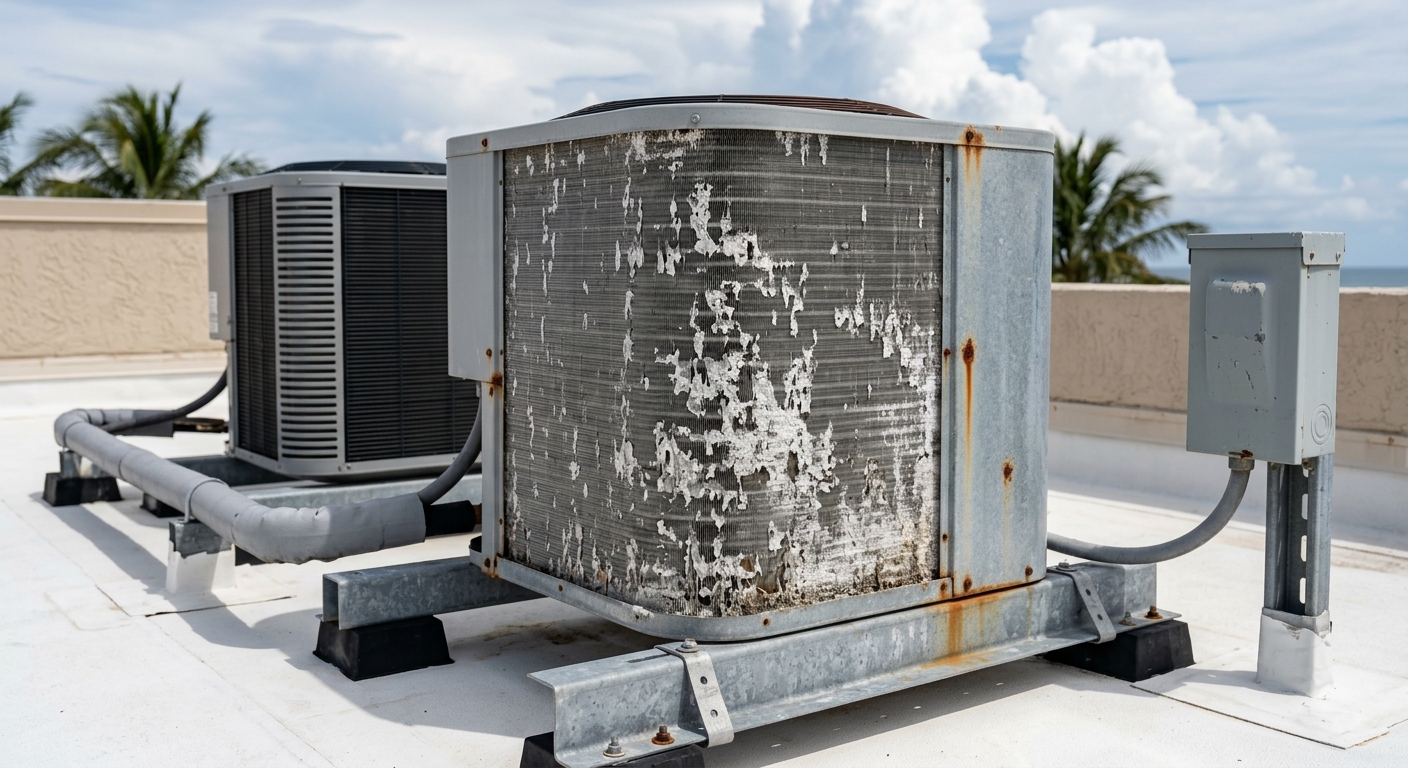
Outdoors, salt air attacks coil fins and fasteners on coastal roofs, so coil coatings, corrosion-resistant hardware, and scheduled coil cleaning belong in the specification. In Miami-Dade and Broward counties, rooftop equipment attachment falls under the Florida Building Code’s High-Velocity Hurricane Zone provisions, and the building official decides whether engineered anchorage is required. Attachment is designed to rated pressures, and a storm can exceed them. If the nearby comfort unit is near end of life, plan the new condensing unit with commercial rooftop unit replacement so the roof is opened once.
Close-out should document rack inlet temperatures at top, middle, and bottom under load, test the temperature, humidity, and condensate overflow alarms, run a failover test where there are two units, and hand over the maintenance schedule that keeps the warranty in force. Where the room is tied to a building automation system, alarms should reach a person at night, and the building’s HVAC contingency plan should list the server room as a critical zone.
Which code and refrigerant dates apply to server room cooling in 2026 and 2027?
As of November 3, 2026, three items apply. The Florida Building Code, 9th Edition (2026), published through the Florida Building Commission, takes effect December 31, 2026, and the permit application date generally sets the governing edition. EPA’s restrictions table lists January 1, 2027 as the installation compliance date for data center, computer room air conditioning, and IT equipment cooling systems using refrigerants above 700 GWP, with exceptions described in the rule. Whether a closet’s ductless unit falls in that subsector or the residential and light commercial one is for the engineer of record and manufacturer to confirm.
ASHRAE’s fact sheet on Standard 90.4-2022, the Energy Standard for Data Centers, gives its scope as spaces above 20 watts per square foot with IT loads above 10 kW; whether a project’s energy code path uses it is for the engineer and building official to determine. A2L refrigerants such as R-454B and R-32 are mildly flammable, and ASHRAE Standard 15 and UL 60335-2-40 set detection and charge limits that matter in a small closed room. Servicing an existing R-410A system remains allowed, and a working unit does not have to be replaced because of the transition.
Server room cooling South Florida checklist: who owns each decision?
Each item is assigned to the role that can close it, in the order the project needs the answers.
- IT manager: record each rack’s measured power draw and growth, and state how long the room can be down.
- Facility manager: confirm what serves the room today, and log temperature and humidity at rack inlets for at least two weeks, including a weekend.
- Mechanical engineer or HVAC designer: calculate the load, select capacity and redundancy, and confirm the refrigerant’s EPA subsector.
- HVAC contractor: survey the outdoor location, line set route, condensate path, and power, and price the cutover and temporary cooling.
- Electrical engineer or electrician: confirm the cooling is on generator or emergency power wherever the servers are on a UPS, and size the circuits.
- Fire protection contractor and fire official: confirm hot work requirements and how new penetrations affect the room’s detection and suppression.
- Building official: determines the code edition, permit scope, and wind attachment requirements.
- Owner or CFO: weigh the cost of redundancy against the cost of an outage, and decide whether some servers should move off site.
Frequently Asked Questions
What temperature should a server room be kept at?
ASHRAE TC 9.9’s 2021 Thermal Guidelines recommend 64.4°F to 80.6°F measured at the IT equipment’s air inlet, with a dew point from 15.8°F to 59°F. The wall thermostat is not the measurement that matters. LBNL’s fact sheet notes inlet temperatures can be raised toward 80°F once hot and cold air are kept apart; check each manufacturer’s limits first.
What is the difference between precision cooling and comfort cooling?
Precision cooling is built for IT spaces, with continuous duty, a high share of sensible capacity, tighter temperature and humidity control, and built-in alarms. Comfort cooling is built for people, spends more capacity removing moisture, and runs on occupancy schedules. Precision equipment costs more to buy and maintain, so it fits rooms where load, density, or downtime cost justify it.
Does a server room need redundant cooling?
A server room needs redundant cooling when an outage lasting as long as a typical repair would cost more than a second unit. A clinic or dispatch office often meets that test; a small office running cloud applications often does not. Redundancy also needs controls that rotate units, alarm on failure, and keep both on emergency power.
How much cooling does a data closet need?
A data closet needs cooling matched to the heat its equipment releases, which is close to the electrical power it draws, plus lighting and wall gains. Measure actual draw at the power distribution units instead of adding nameplate ratings. The mechanical engineer converts that load to capacity with growth margin, without oversizing the unit.
Does the EPA 2027 refrigerant rule affect server room AC units?
As of November 3, 2026, EPA’s Technology Transitions table lists January 1, 2027 as the installation compliance date for data center, computer room, and IT equipment cooling systems using refrigerants above 700 GWP. Existing systems can keep operating and be serviced. The engineer and manufacturer confirm which subsector a closet unit falls under.
Protecting the server room before the next cooling season
A South Florida server room needs cooling that runs on the room’s schedule, holds ASHRAE’s inlet range and dew point, and alarms before equipment is affected. Comfort air conditioning was never designed for that duty, and South Florida humidity exposes the difference. For most commercial closets the answer is a dedicated unit sized from a load calculation, with drained and alarmed condensate and a cutover planned around the IT equipment. Larger or denser rooms call for precision cooling with redundancy sized to downtime cost. Scoping the work in the cooler months, ahead of the December 31, 2026 code change and the January 1, 2027 EPA date, lets the owner choose equipment and a permit path before an emergency chooses them.
Written by The Technical Team at Advanced Air Systems. Established in 1994, Advanced Air Systems is 100% employee-owned and a division of Advanced Roofing Inc., serving commercial buildings from offices in Fort Lauderdale, Miami, and West Palm Beach.
To scope dedicated cooling for a server room or data closet, request a free quote or call (954) 332-1418.