At a glance: Enterprise data centers in South Florida face EPA’s January 1, 2027 refrigerant limit for new data center cooling equipment and the Florida Building Code 9th Edition on December 31, 2026. This guide explains what fails in multi-rack rooms (air mixing, humidity control, heat rejection, and single points of failure), compares CRAC, CRAH, in-row, and liquid cooling with their shortfalls, lists what drives cost and schedule, describes how cutovers run in occupied buildings, and assigns a decision checklist by role.
Data center cooling South Florida businesses run in-house, in the multi-rack IT rooms inside hospitals, banks, county buildings, universities, and office towers, has to be planned against two fixed dates and a humid coastal climate. EPA’s January 1, 2027 compliance date for new data center and IT cooling equipment and the Florida Building Code 9th Edition taking effect December 31, 2026 mean a precision cooling replacement scoped this winter is designed under different rules than one scoped next spring. Getting the sequence wrong costs more than energy, because an emergency change-out after a failure makes the architecture decision with no engineering behind it. This article covers enterprise and edge data centers of roughly four to forty racks; single-rack data closets are covered in our server room cooling guide for South Florida data closets, and hyperscale campuses are outside its scope.
Why does data center cooling in South Florida need a decision before January 1, 2027?
Enterprise data center cooling is a capital decision with a regulatory calendar attached. The U.S. Department of Energy, announcing Lawrence Berkeley National Laboratory’s 2024 United States Data Center Energy Usage Report, reported that U.S. data centers used about 176 TWh of electricity in 2023, roughly 4.4% of national consumption. The refrigerant calendar is the firmer constraint. EPA’s Technology Transitions restrictions table lists a 700 GWP limit for data centers, computer room air conditioning, and IT equipment cooling, with January 1, 2027 compliance dates for new systems and products. EPA’s reconsideration rule, published in the Federal Register on May 26, 2026 and effective July 27, 2026, extended deadlines for several other subsectors; as of November 12, 2026, EPA’s table still shows January 1, 2027 for the data center rows. Existing equipment can keep running and be serviced.
EPA’s January 2026 leak repair fact sheet states that owners of appliances holding 15 pounds or more of an HFC refrigerant, or certain substitutes, became subject to leak repair requirements on January 1, 2026, with refrigerants at a GWP of 53 or below excluded. A multi-ton computer room unit or chiller can exceed that charge, so a leaking legacy unit now carries repair deadlines and records.
The building code changes the same winter. Miami-Dade County’s permitting notice on the 9th Edition code change states that the Florida Building Code, 9th Edition (2026) takes effect December 31, 2026, and that permit applications submitted on or after that date must comply with it.
What actually fails in an enterprise data center cooling system?
Most enterprise data center cooling problems are air and moisture problems before they are capacity problems. When rack exhaust wraps around a row end or over a rack top and re-enters the server inlets, inlet temperature climbs even though the cooling units have spare capacity. Supply air escaping through open tiles and cable cutouts returns unused and lowers every unit’s useful output. Berkeley Lab’s Center of Expertise for Energy Efficiency in Data Centers lists hot and cold aisles, sealed cable penetrations, covered rack openings, and shutting off surplus cooling units among its air management practices, and identifies cooling as one of the largest energy loads in a data center.
Moisture behaves differently in South Florida. Air infiltrating through doors, walls, and ceiling plenums brings a heavy latent load, while the IT equipment adds almost none. ASHRAE TC 9.9’s Thermal Guidelines for Data Processing Environments, 5th Edition, set the recommended envelope at 18 to 27°C (64.4 to 80.6°F) at the server inlet, with a dew point from -9°C to 15°C (15.8 to 59°F) and relative humidity no higher than 70%. The federal Best Practices Guide for Energy-Efficient Data Center Design (FEMP, revised July 2024) warns that data centers often over-control humidity and recommends running cooling coils above the dew point. Our guide to commercial dehumidification in South Florida buildings covers the building side.
The third failure point is outdoors. On coastal roofs, salt air corrodes condenser coil fins until capacity drops on the hottest afternoons, when the margin is smallest. Controls complete the list: sensors that read return air instead of rack inlet, and alarms that reach no one after hours, which is why a building automation system with rack-inlet monitoring belongs in the scope of any data center cooling project.
| Failure mode | Physical mechanism | What staff notice | First test |
|---|---|---|---|
| Hot-air recirculation | Rack exhaust re-enters inlets at row ends and rack tops | Hot spots at the top of racks while the room thermostat reads normal | Inlet temperature at the top, middle, and bottom of each rack |
| Cold-air bypass | Supply air escapes through open tiles and cable cutouts | Units running at low return temperature with high fan energy | Tile and cutout survey; return-air trend |
| Humidity fighting | Units with independent controls humidify and dehumidify at the same time | Humidifiers and reheat running while compressors run | Controls trend review across all units |
| Heat-rejection loss | Corroded or fouled condenser coils raise head pressure | High-pressure trips on hot afternoons | Coil inspection and head-pressure log |
| Single point of failure | One unit, circuit, or pump carries the room | Room temperature climbs within minutes of one trip | Witnessed failover test |
CRAC, CRAH, in-row, or liquid cooling: which architecture fits the room?
Data center cooling for a South Florida enterprise room is usually one of four architectures: packaged DX computer room air conditioners, chilled-water computer room air handlers on a building plant, close-coupled in-row or rear-door units, or direct liquid cooling for high-density racks. Rack density, chilled-water access, the redundancy target, and the 2027 refrigerant rule decide among them.
A computer room air conditioner (CRAC) carries its own compressor and refrigerant circuit; a computer room air handler (CRAH) has a chilled-water coil and fans and depends on a chiller plant. The FEMP guide describes packaged DX units as likely the most common cooling equipment in smaller data centers and a CRAH served by chilled water at 55°F or higher as a way to minimize cooling energy. CRAH units move compressor work to the building plant, provided the plant runs year-round, including cool nights. Advanced Air Systems’ chiller and cooling tower services cover that plant side.
Close-coupled units sit in the row or on rack rear doors and shorten the air path. Direct-to-chip liquid cooling moves heat from processors into a coolant loop through a coolant distribution unit; the FEMP guide notes high-performance computing racks reached 60 kW in 2013 and have since passed 125 kW. A room adding GPU servers should reserve space and piping routes for liquid cooling.
| Architecture | How it rejects heat | Best fit | Where it falls short |
|---|---|---|---|
| Packaged DX CRAC (air-cooled) | Refrigerant circuit to an outdoor condenser | Rooms without chilled-water access | New units must meet the 2027 refrigerant limit; condensers exposed to salt air and high ambient temperature |
| Chilled-water CRAH | Building chiller plant | Buildings with a plant that runs 24/7 | Depends on plant and pump reliability and year-round operation; adds water piping in the room |
| In-row or rear-door unit (DX or chilled water) | Unit at the rack row | Dense rows; low ceilings or no raised floor | More units to maintain; needs containment discipline; uses floor space in the row |
| Direct-to-chip liquid cooling | Coolant distribution unit to facility water | GPU and other high-density racks | Requires IT equipment built for it; leak management; new piping and controls |
| Building comfort AC | Office air handlers or rooftop units | Not suited beyond a small closet | Built for occupants rather than continuous sensible load; often set back after hours |
No architecture compensates for poor air management. Replacing an aging CRAC with a high-efficiency unit while the room still recirculates hot air buys a new nameplate and the same hot spots. Oversizing is the other common error, because a DX unit far larger than the load short-cycles and controls humidity poorly. Sizing belongs to the mechanical engineer working from measured IT load, never from the tonnage of the unit being replaced.
What drives the cost, schedule, and efficiency of a data center cooling project?
Advanced Air Systems does not publish pricing, and a cost figure quoted without the room’s load, redundancy target, and building conditions would mislead. For efficiency, the FEMP guide’s benchmark table places an average data center at a PUE of 1.6, with 1.4 rated good and 1.1 better. PUE compares total facility energy to IT energy, so cooling improvements show up directly in it.
| Driver | Why it moves budget, schedule, or efficiency | Who sets it |
|---|---|---|
| Measured IT load and growth plan (kW) | Sets unit size and count; oversized units waste energy and control humidity poorly | IT lead with the mechanical engineer |
| Redundancy target (N, N+1, 2N) | Each added unit or path adds equipment, piping, and electrical capacity | Owner and engineer |
| Chilled-water access | Decides whether CRAH units are an option and whether plant work is in scope | Engineer and facility manager |
| Refrigerant and equipment availability | New DX units must meet the January 1, 2027 limit; lead times set the schedule | Manufacturer and contractor |
| Rigging and access | Crane picks, elevator limits, and roof structure set the install sequence | Contractor and structural engineer |
| Controls and commissioning | Rack-inlet sensing, alarm routing, and failover tests decide whether the design performs | Engineer and controls contractor |
| Economizer hours | FEMP: water-side economizers suit climates with wet-bulb below 55°F for 3,000+ hours a year | Engineer, from local weather data |
What changes when the data center sits inside an occupied South Florida building?
An enterprise data center cannot be shut down for a cooling replacement, so the project is sequenced around the IT change calendar as well as the tenants. The usual method is a hot cutover. New units are set, piped, and started beside the old ones, load moves one unit at a time inside an approved change window, and each old unit stays in place until its replacement has carried the room through a full cycle. Where there is no spare capacity, temporary cooling is staged first. Our HVAC contingency plan guide for South Florida buildings covers temporary cooling, and our commercial air conditioning unit change-outs follow the same one-unit-at-a-time discipline.
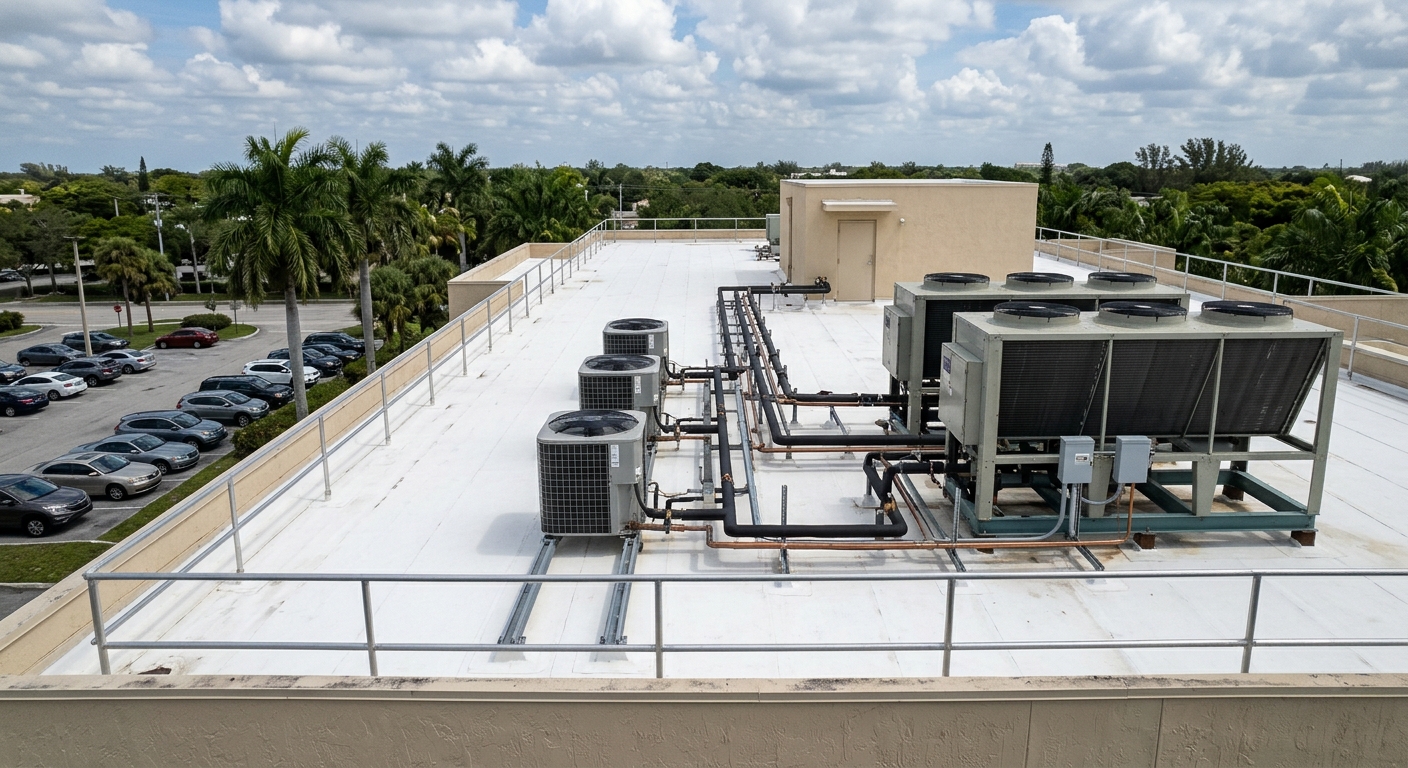
Crane picks for rooftop condensers or chillers are scheduled outside business hours where the site allows, and the property manager receives notice of every utility shutdown before it starts. Brazing and core drilling near a live data hall are coordinated with the fire protection and IT teams, because early-warning smoke detection can respond to dust and fumes.
Rooftop equipment brings code and weather exposure. In Miami-Dade and Broward, rooftop mechanical equipment attachment falls under High-Velocity Hurricane Zone provisions, and the engineer and building official confirm the attachment design. Condensers are anchored to rated wind pressures that a storm can exceed, so the redundancy plan should not assume every rooftop unit survives every event. Salt air shortens coil life, so coated coils and a preventive maintenance program set for the exposure are part of the scope. Advanced Air Systems coordinates crane, sheet metal, roofing penetrations, and HVAC through its in-house divisions, which removes a contractor handoff at the curb and the roof penetration.
Which refrigerant, code, and energy rules apply to data center cooling in 2026 and 2027?
Each item below should be re-checked against its source at scoping and again at permitting. Advanced Air Systems does not determine code paths or compliance for a specific building; the mechanical engineer of record and the building official do.
- EPA Technology Transitions, as of November 12, 2026: a 700 GWP limit for new data center, computer room, and IT equipment cooling from January 1, 2027. Our guide to the A2L refrigerant transition for commercial HVAC covers installation and service impacts.
- EPA leak repair, in effect since January 1, 2026: appliances with 15 pounds or more of HFC refrigerant carry leak repair and recordkeeping obligations.
- Florida Building Code, 9th Edition: effective December 31, 2026, for permit applications submitted on or after that date. Our guide to commercial HVAC permit requirements in Miami-Dade and Broward covers the steps.
- ASHRAE Standard 90.4: ASHRAE’s Standard 90.4-2022 fact sheet states that it applies to data centers with power density above 20 W/ft² and IT loads above 10 kW, including alterations that require new mechanical or electrical systems. Which path applies under the Florida energy code is the engineer’s determination.
Data center cooling South Florida checklist: who owns each step?
Each item names the role that owns it, so the plan can be forwarded with its open questions assigned.
- IT infrastructure lead: Document measured load per rack, last season’s rack-inlet temperature and dew point trends, and the three-year growth plan, including any GPU equipment.
- Facility manager: Inventory every unit serving the room with its age, refrigerant type, charge, service history, and leak repair records.
- Mechanical engineer of record: Set the redundancy target with the owner, size equipment from measured load, and confirm the EPA subsector and code edition for the permit.
- Mechanical engineer of record: Specify rack-inlet control, alarm routing, and a witnessed failover test as commissioning requirements.
- HVAC contractor: Provide a phased cutover plan with change windows, temporary cooling triggers, crane dates, and shutdown notices.
- CFO or owner: Compare repair, partial replacement, and full replacement over the equipment’s remaining life, using bids priced on the same scope.
- Fire protection engineer: Review hot work, dust control, and detection impacts before work starts in or near the IT room.
Frequently Asked Questions
What inlet temperature and humidity does ASHRAE recommend for a data center?
ASHRAE TC 9.9’s Thermal Guidelines, 5th Edition (2021), recommend 18 to 27°C (64.4 to 80.6°F) at the server inlet, with a dew point from -9°C to 15°C (15.8 to 59°F) and relative humidity no higher than 70%. High-density Class H1 equipment has a narrower recommended range of 18 to 22°C. Take the readings at the rack inlet.
Does the EPA January 1, 2027 deadline mean existing CRAC units must be replaced?
No. EPA’s Technology Transitions restrictions apply to new installations and newly manufactured products in the data center and IT cooling subsector, which carries a 700 GWP limit from January 1, 2027. Existing units can keep operating and be serviced, though units holding 15 pounds or more of HFC refrigerant are subject to EPA’s leak repair requirements.
What is the difference between a CRAC and a CRAH unit?
A computer room air conditioner (CRAC) contains its own compressor and refrigerant circuit and rejects heat to an outdoor condenser or fluid cooler. A computer room air handler (CRAH) contains a chilled-water coil and fans and relies on a chiller plant.
What does N+1 cooling redundancy mean for a data center?
N is the number of cooling units needed to carry the full IT load. N+1 adds one unit so the room stays within its limits when any single unit fails or is down for maintenance, and 2N provides a complete second set of units and paths. The owner and engineer set the target, and a witnessed failover test confirms it.
Can a South Florida data center use free cooling?
Possibly, for a limited number of hours, and the engineer should confirm them from local weather data before counting savings. The federal Best Practices Guide for Energy-Efficient Data Center Design says water-side economizers suit climates with wet-bulb temperatures below 55°F for 3,000 or more hours a year, and air-side economizing needs a dew point lockout to keep moist air out.
When does an enterprise data center need liquid cooling?
Liquid cooling becomes necessary when rack power exceeds what the room’s air path can remove at the inlet temperature the IT equipment requires, a limit the IT vendor’s thermal specification and the engineer determine. Rooms adding GPU servers should reserve space, piping routes, and power for a coolant distribution unit even if they start on air.
Planning data center cooling on measured load and published dates
The case for acting this winter rests on published dates. EPA’s January 1, 2027 compliance date for new data center cooling equipment and the Florida Building Code edition change on December 31, 2026 both fall within the next two months, and the leak repair rule already applies to units in service. None of that requires replacing a working system, but it does require knowing what each unit holds and how the room behaves at the rack inlet before a failure makes the choice. A room with good air management, units with service life left, and a tested failover can keep running and be planned for a later budget cycle. A room with recirculation, humidity fighting, and one unit carrying the load needs an engineer’s scope now. A statewide contractor built for occupied buildings may not be the lowest bid on a single-unit swap in a simple room.
Written by The Technical Team at Advanced Air Systems. Established in 1994, Advanced Air Systems is 100% employee-owned and a division of Advanced Roofing Inc., serving commercial buildings across South Florida.
To scope a data center cooling assessment, request a free commercial HVAC quote or call Advanced Air Systems at (954) 332-1418. Local teams provide commercial HVAC services in Miami and commercial HVAC services in Fort Lauderdale.