At a glance: PTAC replacement in Florida hotels and condominiums depends on room-by-room sizing, the condition of each wall sleeve and louver, and a schedule built around occupied rooms. This article explains what fails on coastal buildings, compares four replacement paths, and sets out the EPA refrigerant and DOE efficiency rules in force as of November 2026, the Florida Building Code change on December 31, 2026, and condominium responsibility under F.S. 718.113. It closes with a checklist that assigns each decision to the person who owns it.
PTAC replacement in a South Florida hotel or condominium succeeds or fails on three decisions made before any chassis is ordered: the capacity each room actually needs, the code and refrigerant path for the unit, sleeve, and louver, and the order in which rooms come out of service. Get those wrong across a few hundred rooms and the property pays twice, in guestrooms that hold temperature but stay damp, in water at the sill after the first heavy rain, in inspections that stop work, and in rooms pulled from inventory a second time to correct the first job. This article covers through-wall PTACs and PTHPs in occupied Florida buildings; it does not argue for or against leaving PTACs behind, and it does not replace your mechanical engineer’s room-by-room load calculation.
Why is PTAC replacement in South Florida different in 2026?
PTAC replacement in 2026 sits where three rule sets meet, each on its own schedule. The U.S. Environmental Protection Agency treats PTACs as factory-charged products, and EPA’s HFC phasedown FAQ states that R-410A PTACs manufactured before January 1, 2025 may be sold, distributed, or exported until January 1, 2028, while PTACs manufactured after January 1, 2025 must use a lower-GWP refrigerant. EPA’s Technology Transitions table by sector (last updated August 28, 2026) sets a 700 GWP limit for residential and light commercial products, so new orders draw on a shrinking R-410A inventory or on A2L units such as R-32 models.
Federal efficiency rules have been steadier. The U.S. Department of Energy reviewed its PTAC and PTHP standards and, in a final determination published February 13, 2023, found no clear and convincing evidence that stricter standards were justified, so the standard-size levels in force since January 1, 2017 remain the federal floor. Between 7,000 and 15,000 Btu/h the required minimum EER falls as rated capacity rises.
The state side changes on December 31, 2026. A Miami-Dade County building department notice on the 9th Edition Florida Building Code states that the 2026 edition becomes effective on that date and that portal applications submitted after 4:00 p.m. on December 30, 2026 must follow it, so a program spanning the new year should confirm which edition governs each permit.
What actually fails in a hotel or condo PTAC installation?
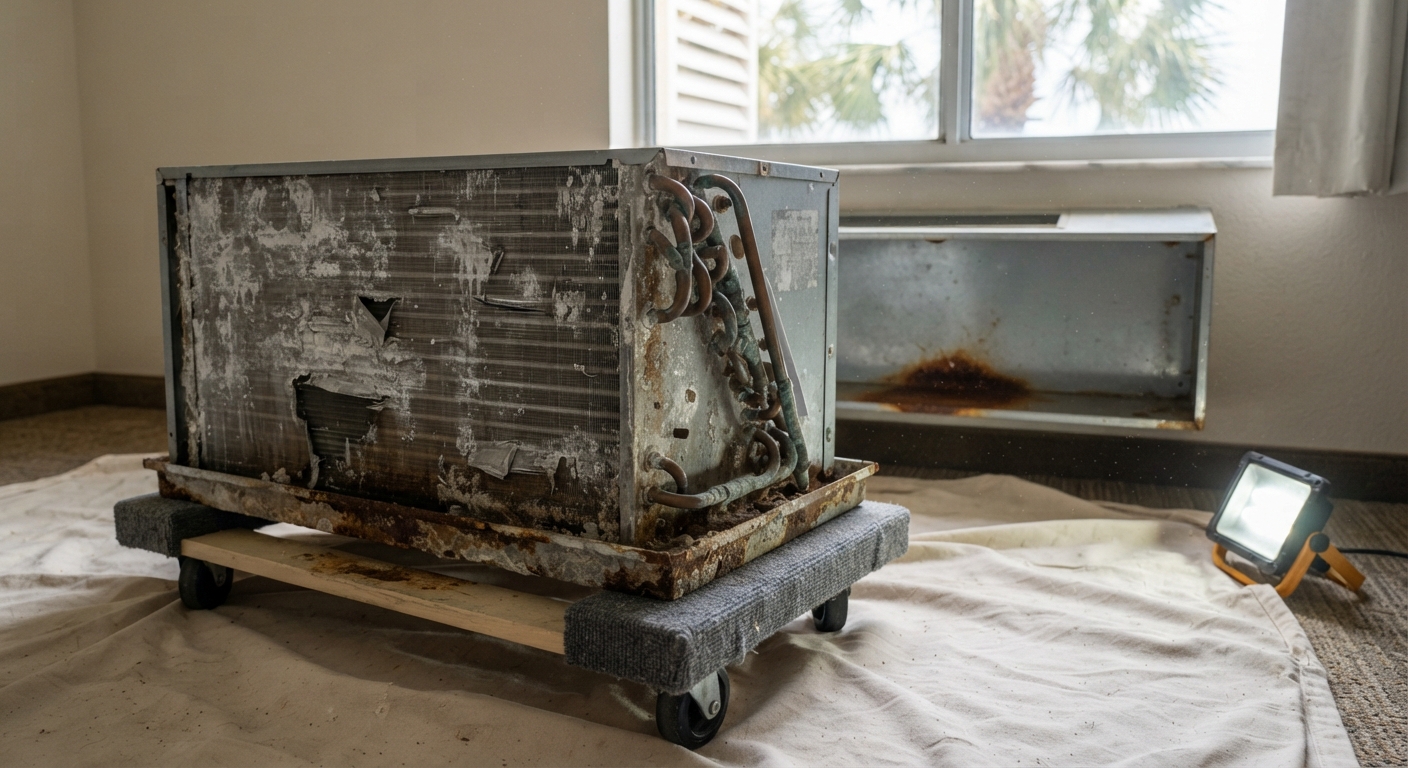
A PTAC replacement is usually triggered by the chassis, but the costliest failures sit around it. The chassis slides into a wall sleeve and rejects heat through a louver in the exterior wall, so on a coastal building the outdoor coil breathes salt-laden air directly and corrodes first on elevations facing the water. The mechanism is covered in how salt air drives commercial HVAC corrosion in South Florida.
Water problems start at the sleeve. A sleeve with lost outward pitch, dried seals, or failed perimeter sealant lets condensate from the base pan and wind-driven rain travel inward. Trane’s published installation, operation, and maintenance manual for its R-32 PTAC (September 2024) calls for the unit to be pitched 1/4 inch downward from the inside to the outside of the wall. A new chassis set into a sleeve that has settled level inherits the leak, and the water usually ends up in the drywall below the sill, the pattern described in commercial HVAC condensate drain problems.
The third failure shows up in guest and resident complaints: rooms that feel cold and clammy, carpet that smells musty, mold behind the headboard. The Florida Solar Energy Center’s 2006 study of dehumidification at part-load conditions found that coil moisture removal degrades at part load, worst when the fan runs continuously while the compressor cycles, because water left on the coil re-evaporates into the room. An oversized PTAC satisfies its setpoint quickly and spends more of each hour cycled off, so the room cools without drying. EPA’s mold guidance recommends keeping indoor relative humidity below 60 percent, ideally 30 to 50 percent; see commercial dehumidification for South Florida buildings.
| Component | What fails on coastal Florida buildings | What to check before ordering |
|---|---|---|
| Outdoor coil and base pan | Fin and tube corrosion from salt air; rusted base pan | Elevation and exposure to the water; coastal coil protection offered in the submittal |
| Wall sleeve | Lost outward pitch, rusted sleeve floor, failed seals, distorted opening | Measured opening (height x width), pitch, floor condition, sleeve manufacturer |
| Exterior louver | Bent or missing blades, airflow recirculation into the coil | Louver compatibility with the new chassis; product approval on record in the HVHZ |
| Condensate handling | Overflow at the sill, staining on the wall below | Drain kit or sleeve drain path; base pan condition |
| Cord and receptacle | Wrong amperage cord, heat-damaged receptacle, missing detection device | Receptacle configuration, branch-circuit amperage, voltage (208/230 V or 265 V) |
| Controls | Fan left in continuous mode; guest setpoints driven very low | Fan mode default, setpoint limits, energy management connection |
Like-for-like chassis, new sleeve, or a different system: which PTAC replacement path fits?
Four replacement paths cover almost every Florida hotel and condominium, and each is defined by what happens to the wall. Federal rules draw the first line. Under 10 CFR 431.92, a standard-size PTAC fits a wall sleeve opening at least 16 inches high or 42 inches wide with a cross-sectional area of at least 670 square inches, and a non-standard-size unit is defined by existing wall sleeve dimensions below that threshold. DOE’s 2023 determination notes that non-standard classes have a low and declining market share, so selection for smaller sleeves in older buildings is narrow and worth confirming early.
A like-for-like chassis swap is the fastest path when the sleeve is sound, correctly pitched, and does not restrict or recirculate the new unit’s outdoor airflow, the condition Trane’s manual sets for using another brand’s sleeve. Replacing sleeve and louver with the chassis adds wall work, sealant, and in Miami-Dade and Broward a product approval question for the louver, and it is the right call when sleeves are rusted through or water has reached the wall. Converting to a vertical terminal unit or a ductless split changes the electrical, the condensate routing, and in a condominium the approvals.
| Path | When it fits | What it involves | Where it falls short |
|---|---|---|---|
| Like-for-like standard-size chassis | Sound, pitched 42 x 16 in. sleeves with a compatible louver and receptacle | Pull chassis, inspect and photograph sleeve, set and seal new chassis, test the cord device | Inherits every sleeve and louver defect; no change in ventilation |
| Non-standard-size replacement chassis | Older buildings with existing sleeves below the standard-size threshold | Matching a narrower product line to the existing opening | Few models to choose from; lower federal efficiency floor than standard-size units |
| New sleeve and louver with new chassis | Rusted or leaking sleeves, failed louvers, back-pitched openings | Interior and exterior wall work, sealant, louver approval, permit review | Each room is out of service longer; exterior access needed above grade |
| Conversion to a vertical unit or ductless split | Noise, appearance, or capacity problems a PTAC cannot solve | Closet or exterior equipment, new electrical and condensate, design | Highest cost and disruption; condominium approvals; not a like-for-like change-out |
Replacement is not always the answer. A chassis with a failed fan motor or control board and a sound coil can return to service through commercial air conditioning repairs. Repeated compressor failures on units near the end of their service life point the other way, toward a planned commercial AC unit change-out program.
What drives PTAC sizing, cost, and schedule?
A replacement PTAC should be sized from a room-by-room load calculation for each room type and exposure, then checked against the manufacturer’s application data, the room’s electrical service, and the refrigerant’s room-size conditions. The old nameplate shows what was installed, which may have been oversized from the start; the engineer’s calculation shows what the room needs.
Published capacity guidance varies widely: Trane’s R-32 PTAC manual lists its 12,000 Btu/h size for rooms of 172 to 258 square feet, while generic square-foot rules online assign that size to much larger rooms. The same manual requires its R-32 units to be installed, operated, and stored in a room with a floor area larger than 43 square feet and away from continuously operating ignition sources, a condition to confirm for small rooms and staging areas. See the A2L refrigerant transition for commercial HVAC.
Electrical data has to match before a chassis ships. The Trane manual selects cords by voltage, circuit amperage, and heater size, requires 265-volt units to connect through a sub-base or be hard-wired, and notes that national codes require an arc-fault or leakage-current detection device on 208/230-volt cords. Budget and schedule move with these variables:
- Chassis count, sizes, and voltages across room types
- Share of sleeves and louvers that inspection shows must be replaced
- Refrigerant path: remaining R-410A inventory or A2L units
- Exterior access for louver work above the ground floor
- Rooms per day the operation can release
- Permit path, inspections, and refrigerant recovery for every removed chassis
Advanced Air Systems publishes no pricing, and nothing here is a quote or a promised saving.
How do you schedule PTAC replacement in an occupied hotel or condo?
On an occupied hotel, the schedule is built around the rooms inventory. Engineering and the rooms division agree on how many keys can be out of order each day, grouped by stack or floor, avoiding peak dates on the revenue calendar. Each room follows the same sequence: power off at the breaker, chassis out, sleeve inspected and photographed, sleeve repairs made, new chassis set and sealed, cord device tested, and the room run in cooling mode before it returns to inventory.
A condominium adds access and responsibility. Unit entry requires notice under the association’s documents, and who pays depends on the declaration. Florida Statute 718.113 makes the association responsible for maintaining the common elements, except for limited common element maintenance the declaration assigns to unit owners, so the board should have its association attorney confirm whether sleeves, louvers, and chassis are unit-owner property, limited common elements, or common elements before any notice goes out. The Treasures on the Bay Condominium project shows the same occupied-building discipline applied to a common-area HVAC replacement in North Bay Village.
An open sleeve is a hole in the building envelope, so no opening is left uncovered overnight or ahead of forecast rain. EPA’s Section 608 definitions classify packaged terminal air conditioners and heat pumps as small appliances, and the Clean Air Act prohibits venting their refrigerant, so each removed chassis needs its refrigerant recovered before disposal. Freight elevator and stack-phasing logistics are covered in high-rise HVAC replacement for South Florida hotels and condos.
Which code, refrigerant, and condo rules apply to PTAC replacement as of November 2026?
As of November 18, 2026, five rule sets touch a PTAC replacement in South Florida, and each has its own authority:
- Federal efficiency: DOE standards for standard-size PTACs in force since January 1, 2017, left unchanged by the 2023 determination.
- Refrigerant: EPA allows R-410A PTACs manufactured before January 1, 2025 to be sold until January 1, 2028; confirm the status of any inventory on the order date.
- Florida Building Code: the 8th Edition (2023) governs until the 9th Edition takes effect December 31, 2026. Permit practice is covered in commercial HVAC permits in Miami-Dade and Broward.
- High-Velocity Hurricane Zone: Miami-Dade Product Control has issued Notices of Acceptance for PTAC louvers, such as NOA No. 23-1116.23 for an aluminum PTAC louver (expiration December 15, 2027).
- Condominium documents: F.S. 718.113 and the association’s declaration.
The building official decides the code path and any louver approval, the association attorney interprets the declaration, and the mechanical engineer confirms capacity.
PTAC replacement checklist: who owns each decision?
- Director of engineering: inventory every room’s chassis model, capacity, voltage, cord amperage, sleeve dimensions, and refrigerant, with a photo of each sleeve and louver.
- Mechanical engineer: run loads for each room type and exposure, and confirm room-area conditions wherever A2L units are proposed.
- Contractor: open and inspect sample sleeves on every elevation, windward side included, before pricing sleeve replacement as an allowance.
- Electrician: verify receptacle configuration, circuit amperage, and voltage for each room type, and flag heat-damaged receptacles.
- Rooms manager or general manager: set the daily out-of-order limit, the blackout dates, and the guest communication plan.
- Condominium board and association attorney: confirm ownership and payment responsibility under the declaration and the notice rules for unit entry.
- Contractor and building official: confirm the permit path, the code edition, and any louver product approval before ordering.
- Contractor: document refrigerant recovery for every removed chassis and hand the records to the owner at close-out.
- Director of engineering: set fan mode and setpoint limits at start-up, keep the photo log with the close-out documents, and add the new units to a preventive maintenance program.
Frequently Asked Questions
How long does PTAC replacement take per room?
A like-for-like chassis swap in a sound, pitched sleeve is the shortest path because the wall stays closed. Replacing the sleeve and louver adds interior and exterior wall work and sealant cure time. For a hotel, the number that matters is how many rooms the operation can release per day, which the rooms manager sets.
Can I still buy an R-410A PTAC in Florida?
EPA’s FAQ states that R-410A PTACs manufactured before January 1, 2025 may be sold, distributed, or exported until January 1, 2028, and that PTACs manufactured after that date must use a lower-GWP refrigerant. Existing R-410A units can keep operating. Confirm inventory and rule status with your contractor on the order date.
Should a replacement PTAC match the old unit’s BTU rating?
Not automatically. The old nameplate shows what was installed, and that unit may have been oversized from the start. An oversized PTAC reaches setpoint quickly and cycles off before it removes enough moisture, which leaves Florida rooms cool and damp. Have your mechanical engineer run room-by-room loads before ordering.
Who pays for PTAC replacement in a Florida condo?
It depends on the declaration. F.S. 718.113 makes the association responsible for common elements, except for limited common element maintenance the declaration assigns to unit owners. Whether the chassis, sleeve, and louver belong to the owner or the association is a question for the association attorney, settled before notices go out.
Do I need a permit to replace a PTAC in Miami-Dade or Broward?
Ask the building department that covers the parcel before work starts. Commercial HVAC change-outs in both counties generally run through a mechanical permit, and replacing exterior louvers in the High-Velocity Hurricane Zone raises a product approval question. The building official decides which permit path and which Florida Building Code edition apply.
Is it better to replace PTACs with VTACs or ductless splits?
It depends on what the PTAC cannot do in your rooms. Vertical units and ductless splits can address noise, appearance, or capacity complaints, but they add closet or exterior equipment, new electrical and condensate work, and in a condominium board approvals. Where sleeves are sound and only the chassis failed, like-for-like replacement disrupts less.
Measure the room and the sleeve before ordering the chassis
A PTAC replacement program in a South Florida hotel or condominium is won or lost before the first chassis arrives. The nameplate on the old unit and the sleeve in the wall are starting data; the load calculation, the sleeve and louver inspection, the electrical survey, and the refrigerant decision turn them into a specification the property can defend to ownership or a board. The governing dates are specific: EPA’s January 1, 2028 sale date for pre-2025 R-410A PTACs and the 9th Edition Florida Building Code on December 31, 2026. The schedule protects the people who stay in the building, and the determinations that belong to the engineer, the building official, and the association attorney stay with them.
Written by The Technical Team at Advanced Air Systems. Established in 1994, Advanced Air Systems is a 100% employee-owned commercial HVAC contractor and a division of Advanced Roofing Inc.
Planning a PTAC replacement program? Request a free HVAC estimate or call (954) 332-1418. Advanced Air Systems serves South Florida from Miami, Fort Lauderdale, and West Palm Beach.