At a glance: A shopping center’s HVAC is a fleet of rooftop units under mixed lease responsibility. This guide shows South Florida property managers how to run that fleet as one program: what fails on retail plaza roofs, how tenant-maintained, landlord-maintained, and hybrid models compare, what drives cost and timing, how to work around open stores and vacant suites, which EPA refrigerant and Florida Building Code dates apply as of November 2026, and a checklist that assigns each decision to its owner.
The shopping center HVAC South Florida property managers inherit is a fleet of packaged rooftop units, bought at different times, serviced by different vendors, and governed by different lease clauses. This guide argues that the fleet should be run as one documented program under the property manager’s control, even where the lease assigns service and replacement costs to tenants. The cost of leaving it fragmented shows up as an August outage in an occupied suite, mold in a vacant bay, a roof leak at a curb nobody inspected, or a replacement bill that lands in the middle of a lease renewal. This article does not interpret any lease or decide who pays for what; those answers belong to the lease and the center’s attorney.
Why does a retail plaza need one HVAC program when tenants own the units?
A retail plaza needs one HVAC program because the roof, the building envelope, the electrical service, and the center’s reputation are shared, even when the rooftop units are not. The U.S. Energy Information Administration’s 2018 Commercial Buildings Energy Consumption Survey found that enclosed malls and strip shopping centers used 111.0 thousand Btu per square foot, against 64.1 thousand Btu per square foot for retail buildings outside malls, and accounted for 61% of the electricity consumed in mercantile buildings. Those are national averages across every climate, so a center’s own utility bills remain the better baseline for a South Florida property.
Maintenance is where a tenant-by-tenant fleet tends to break down. A 2014 Pacific Northwest National Laboratory presentation on rooftop unit diagnostics summarized a field study of 503 rooftop units at 181 commercial sites in five states in which only 9% were found to be properly maintained. The study predates current equipment and is not specific to Florida, so it describes a pattern rather than any one center. On a plaza, each unit gets the attention its tenant’s budget allows, and nobody looks at the whole roof.
Florida’s climate removes the slack. The U.S. Environmental Protection Agency’s mold guidance states that indoor relative humidity should be kept below 60%, ideally between 30% and 50%. An oversized, short-cycling, or switched-off unit cannot hold that line through a South Florida summer, and the damage shows up as stained ceiling tiles and musty inventory. ANSI/ASHRAE/ACCA Standard 180 establishes minimum inspection and maintenance requirements for commercial HVAC systems, which makes it the most useful reference for one standard that applies to every unit on the center.
What does retail plaza HVAC maintenance miss on the roof?
Retail plaza HVAC maintenance most often misses failures that develop slowly and leave the unit running. A packaged rooftop unit can keep blowing air while it pulls humid outdoor air through a stuck economizer damper, overflows condensate into the ceiling because its trap dried out, or loses capacity through a coil coated in salt or kitchen grease. The tenant notices the discomfort, and the cause sits on a roof the tenant never visits.
| Failure | Physical mechanism | What the tenant reports | First check |
|---|---|---|---|
| Economizer damper stuck open | Humid outdoor air enters at high volume and the coil cannot remove the added moisture | Clammy sales floor, high bills | Damper position and linkage with the unit running |
| Oversized or short-cycling unit | The compressor satisfies the thermostat before the coil has removed enough moisture | Cool but damp space, odor | Runtime and cycling pattern; load review by an engineer |
| Clogged condensate trap or pan | Water backs up and overflows into the ceiling plenum | Ceiling stains, drips at diffusers | Trap, pan, line slope, and float switch |
| Coil fouled by salt or grease | Reduced heat transfer raises head pressure and cuts cooling capacity | Space cannot hold setpoint in the afternoon | Coil inspection and a cleaning method suited to the deposit |
| Unit off over a vacant suite | No dehumidification while humid air infiltrates from outdoors and adjacent suites | Mold or odor found at a leasing tour | Relative humidity reading inside the suite |
| Curb or flashing deterioration | Water enters at the transition between the unit curb and the roof membrane | Leak near the unit, often blamed on the HVAC | Joint HVAC and roofing inspection |
Restaurant tenants change the roof around them. Kitchen exhaust fans discharge grease-laden air that can settle on nearby condenser coils and outdoor air intakes, and NFPA 96 governs the design, inspection, and maintenance of commercial cooking exhaust systems. When a restaurant’s makeup air falls short, the kitchen pulls humid air from neighboring suites and the corridor, which is why restaurant kitchen makeup air and building pressure matter to every tenant who shares the wall.
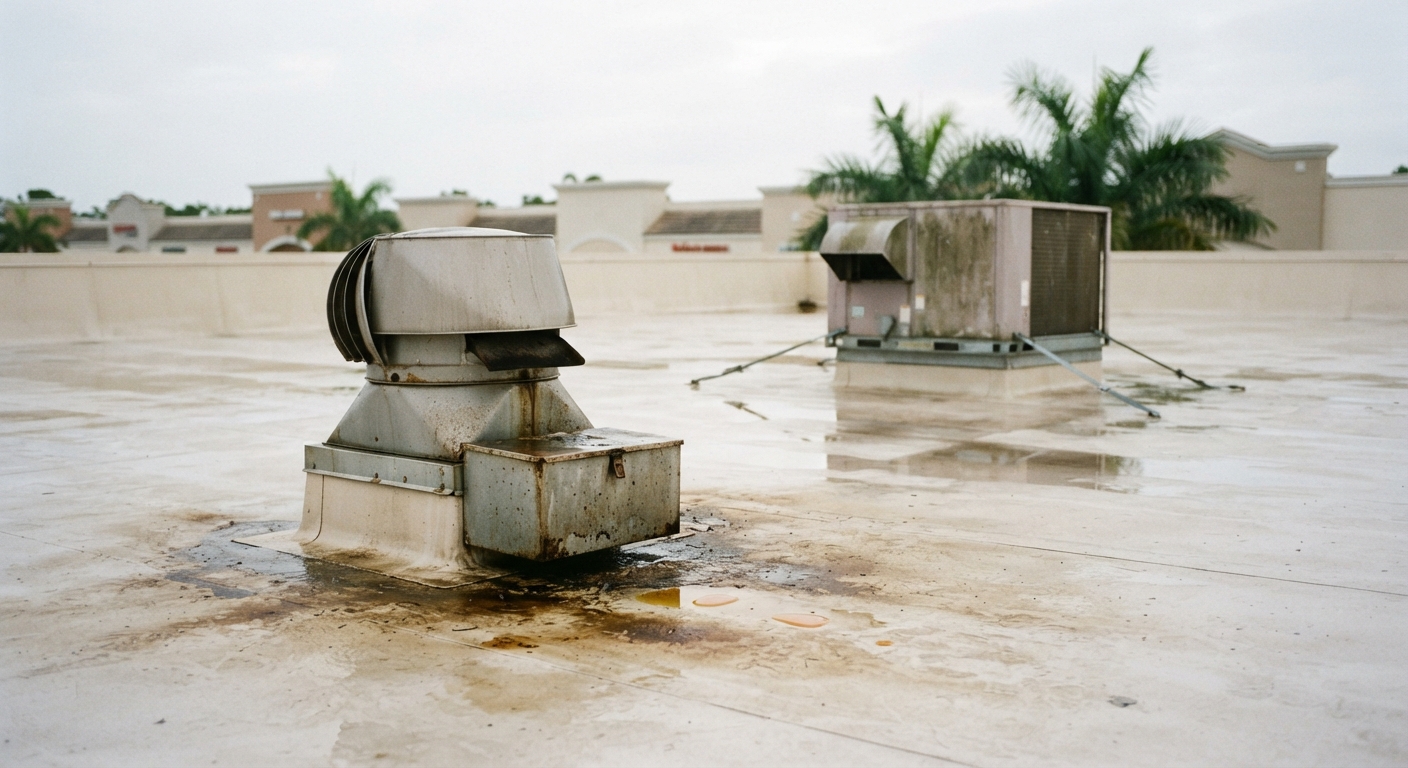
Coastal centers add salt deposition on coils and cabinets; coastal HVAC corrosion in South Florida covers coil protection. Condensate is the third common thread, because clogged pans and dry traps produce the ceiling stains that start disputes between tenants and landlords. The commercial condensate drain problems post explains how to trace them before the ceiling is opened.
Which model fits the center: tenant-maintained, landlord-maintained, or hybrid HVAC?
The responsibility model for property management HVAC services is set by the leases, and most South Florida centers run more than one model at the same time. Inline tenants often carry maintenance and repair obligations for the units serving their premises, anchors may run their own programs, and the landlord typically keeps the common areas and whatever the lease reserves. The comparison below shows where each model tends to fall short in practice.
| Model | How it usually works | Where it falls short |
|---|---|---|
| Tenant-maintained | Each tenant hires its own contractor for the units serving its premises; the lease may require a maintenance contract | Quality and records vary by tenant; roof access is hard to control; problems surface at move-out |
| Landlord-maintained, cost recovered | The landlord’s contractor services every unit; cost is recovered through common area maintenance (CAM) charges or additional rent where the lease allows | Tenants dispute charges when records are thin; the landlord carries the response obligation for every unit |
| Hybrid program | The landlord runs one standard and one contractor; tenants pay for their own units or must use the landlord’s vendor | Needs clear lease language and per-unit records; some tenants resist a required vendor |
| Anchor self-performs | A large tenant runs its own national maintenance program | Little visibility for the property manager; the anchor’s roof traffic and curb work still affect the shared roof |
No model is right for every center, and the lease controls; the table describes practice. Before changing how HVAC is handled, have the center’s attorney review each lease. A landlord-run program can also cost more per unit than the least expensive contractor a tenant would hire. The case for it rests on consistent records and fewer disputes, and the property manager should weigh that honestly against current costs. For centers that want one contractor across the fleet, Advanced Air Systems offers a commercial preventive maintenance program for rooftop equipment.
What drives the cost and timing of shopping center HVAC work?
The budget and schedule for shopping center HVAC work move with a short list of conditions the property manager can document before asking for bids. Advanced Air Systems does not publish pricing, and nothing in this section is a price; the drivers explain why similar plazas receive different numbers.
| Driver | Why it moves the budget or schedule | Reference |
|---|---|---|
| Unit count, tonnage, and age mix | Units from many vintages need more parts variety and staggered replacement planning | Center equipment inventory, organized per ANSI/ASHRAE/ACCA Standard 180 |
| Roof access and lift method | Units far from the roof edge or over occupied space may need a crane pick and after-hours staging | Site survey by the contractor |
| Coastal exposure | Salt deposition shortens coil and cabinet life and raises cleaning frequency | Site condition; manufacturer coil coating documentation |
| Restaurant tenants | Grease and exhaust raise coil cleaning needs and add makeup-air balancing | NFPA 96; test and balance report |
| Refrigerant type and charge (pounds) | Charge size and refrigerant decide which EPA leak-repair duties apply to a unit | EPA leak repair fact sheet, January 2026 |
| Work hours | Before-open or after-close work protects tenant sales and adds labor cost | Tenant operating hours in each lease |
| Utility programs | FPL’s Business HVAC program may rebate qualifying high-efficiency units; terms change | FPL program page, accessed November 2026 |
Replacement timing is the larger budget question. A unit-by-unit record of age, repair history, and coil condition lets ownership spread replacements across budget years, and the guide to commercial rooftop unit replacement in South Florida walks through that inventory. Lease expirations belong on the same calendar, because a vacancy is often the least disruptive moment to replace the unit serving that suite.
What changes when the center stays open during HVAC work?
A shopping center stays open during HVAC work, so the schedule is built around tenant hours, deliveries, and parking. Rooftop unit change-outs are sequenced one tenant at a time, with crane picks set before stores open and the lift zone in the parking lot closed to customers. Each tenant receives written notice of the shutdown window and the expected return to cooling, and restaurants, salons, and medical tenants are scheduled first because their windows are narrowest.
Roof access is a property management control point. Every contractor visit should be logged, whoever hired the contractor, and roof-penetrating work such as curb adapters or new line sets should be coordinated with the roofing contractor so the roof warranty is not put at risk. Advanced Air Systems handles rooftop change-outs with the group’s in-house crane division and coordinates curb and flashing work with its sister company, Advanced Roofing, which roofs malls and retail centers. On an occupied plaza, that removes a handoff between separate contractors on the most leak-prone part of the job.
Vacant suites need a plan of their own. A dark suite with its unit switched off gains moisture from adjacent spaces and outdoor air, and the first sign is often mold found during a leasing tour. Running the unit at a humidity-limiting setting, or adding dedicated equipment, keeps the space closer to EPA’s 60% guidance; see commercial dehumidification for South Florida buildings. A suite that needs remediation before it can be shown costs more than the electricity to keep it dry.
Daily closeout matters on a retail roof. Panels go back on, curbs are never left open overnight, and condensate lines are reconnected and tested before the tenant reopens. Before-and-after photographs of each unit give the property manager a record for tenant questions and for billing the right party.
Which refrigerant, code, and utility dates affect plaza HVAC decisions?
Federal refrigerant rules changed during 2026. EPA finalized a rule on May 21, 2026, effective July 27, 2026, that removed the January 1, 2026 installation deadline for residential and light commercial air conditioning and heat pump systems using refrigerants above 700 global warming potential, such as R-410A, provided the equipment was manufactured or imported before January 1, 2025. As of November 2026, a working R-410A rooftop unit does not have to be replaced because of the refrigerant transition, and servicing existing equipment continues. New equipment increasingly uses A2L refrigerants in commercial HVAC such as R-454B and R-32, which carry their own handling and installation requirements.
EPA’s leak repair requirements under the Emissions Reduction and Reclamation rule took effect January 1, 2026 for appliances holding 15 pounds or more of HFC refrigerant, and the same fact sheet exempts residential and light commercial air conditioning, so the contractor should document charge and classification unit by unit. Anyone opening the refrigerant circuit must hold EPA Section 608 technician certification, and property managers can require proof of it from tenant-hired vendors.
The Florida Building Code 9th Edition takes effect December 31, 2026, and Miami-Dade County’s permitting center has stated that applications submitted through its online portal after 4 p.m. on December 30, 2026 must comply with the new edition, including the rules for attaching rooftop equipment; see commercial HVAC permits in Miami-Dade and Broward. FPL’s Business HVAC program offers rebates for qualifying high-efficiency units, but terms change, so confirm eligibility with FPL before equipment is ordered. Tax treatment of any upgrade is a question for the owner’s tax advisor.
Shopping center HVAC South Florida checklist: who owns each decision?
A shopping center HVAC program in South Florida needs five things: a single equipment inventory, one maintenance standard for every unit, a lease-based owner for each unit, controlled roof access, and a multi-year replacement budget. The checklist below assigns each task to the person who owns it.
- Property manager: build one inventory of every rooftop unit, listing suite served, tonnage, refrigerant, install year, and responsible party under the lease.
- Property manager: adopt one maintenance standard based on Standard 180 and the federal Operations and Maintenance Best Practices Guide, applied to landlord and tenant units alike.
- Center attorney: review each lease’s maintenance, replacement, contractor approval, and roof access clauses before the program changes who does the work.
- Leasing team: require an HVAC condition report at move-in and move-out.
- Tenants: provide service records and their contractor’s name on request.
- HVAC contractor: log every roof visit, record refrigerant and charge for each unit, and photograph work, with those duties written into the commercial HVAC service contract.
- Roofing contractor: inspect curbs and flashings on the same walk as the HVAC inspection.
- Mechanical engineer: confirm the load calculation before a unit is replaced like-for-like or a restaurant replaces a retail use.
- Asset manager: approve a multi-year replacement budget built from the inventory, with lease expirations marked.
Frequently Asked Questions
Who is responsible for HVAC in a shopping center lease?
The lease decides. Many retail leases make inline tenants responsible for maintaining and repairing the units that serve their premises, while the landlord keeps the common areas and sometimes replacement; anchors often negotiate their own terms. The property manager should map each rooftop unit to its responsible party and have the center’s attorney confirm the reading.
How often should rooftop units on a retail plaza be serviced in South Florida?
Service frequency should come from the task requirements in ANSI/ASHRAE/ACCA Standard 180 and the manufacturer’s maintenance instructions, adjusted for runtime and exposure. South Florida rooftop units cool for most of the year, coastal units collect salt, and units near restaurant exhaust collect grease, so filter, coil, and condensate tasks need more attention than in a cooler climate. The contractor should state each task’s frequency in writing.
Should a landlord require tenants to carry an HVAC maintenance contract?
Many landlords do where the lease allows it, because the contract creates records the property manager can check. The requirement works only if it names minimum tasks, requires a licensed contractor whose technicians hold EPA Section 608 certification, and gives the landlord copies of service reports. Whether a lease can enforce it is a question for the center’s attorney.
How should HVAC be run in a vacant retail suite in Florida?
A vacant suite should be kept dry as well as cool. EPA guidance recommends indoor relative humidity below 60%, and a unit switched off during a South Florida summer lets humidity climb from adjacent suites and outdoor air. Run the unit at a humidity-limiting setting or add dehumidification, confirm the condensate system drains, and record humidity readings during routine property inspections.
Do R-410A rooftop units on a shopping center have to be replaced because of the refrigerant rules?
No. As of November 2026, EPA rules do not require replacing a working R-410A unit, and servicing existing equipment continues. EPA’s May 21, 2026 rule also removed the installation deadline for light commercial systems manufactured or imported before January 1, 2025. Replacement should be decided on the unit’s condition, repair history, and efficiency, with the rules re-checked before equipment is ordered.
What should a property manager check on HVAC before a new tenant opens?
Before turnover, have the unit serving the suite inspected for age, refrigerant type, coil and cabinet condition, condensate drainage, economizer operation, and curb condition, and record the results in the center’s inventory. If the new use changes the load, such as a restaurant or salon replacing a retail store, have a mechanical engineer review capacity and ventilation before the build-out is permitted.
One fleet, one record, many leases
A shopping center’s rooftop units fail one at a time, and they are best managed together. Multi-tenant retail is an energy-intensive building type, rooftop units are often under-maintained, and Florida humidity punishes the gaps between tenants, vacancies, and vendors. A single inventory, one maintenance standard, controlled roof access, and a replacement calendar tied to lease dates give the property manager a program that holds up regardless of who pays for each unit. The lease still decides the payments, and the program decides whether anyone sees the condition of the roof before a tenant calls. Start with the inventory, because every later decision depends on it.
Written by The Technical Team at Advanced Air Systems. Advanced Air Systems, a 100% employee-owned commercial HVAC contractor and a division of Advanced Roofing Inc., has served Florida buildings since 1994.
To set up a center-wide rooftop inspection or a maintenance program for your retail plaza, request a free HVAC quote or call (954) 332-1418. Our Fort Lauderdale commercial HVAC and Miami commercial HVAC teams serve properties across South Florida.